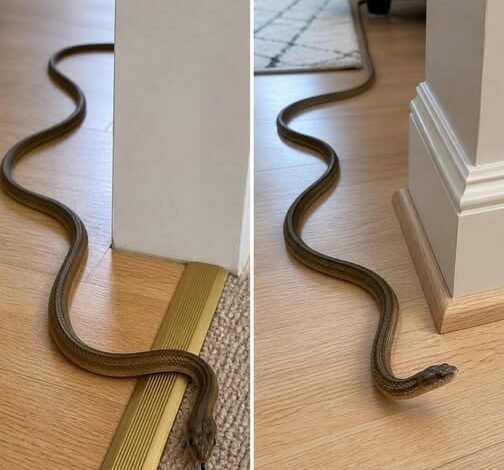
Few things can turn an ordinary day into a moment of panic faster than spotting a snake inside your home.
One second you’re walking down a hallway, carrying laundry, heading toward the basement, or grabbing something from storage. The next, your brain freezes as it registers a shape that absolutely should not be there.
A snake.
Suddenly, every instinct screams danger.
Questions race through your mind.
How did it get inside?
Is it venomous?
Are there more?
Why my house?
The scene can feel like something pulled from a horror movie.
But for the snake, the situation is far less dramatic.
It isn’t plotting an invasion.
It isn’t hunting people.
And it almost certainly isn’t interested in confrontation.
In most cases, it’s simply trying to survive.
Snakes enter homes for the same reasons many wild animals do: food, water, shelter, and protection from harsh conditions.
A house offers all four.
Small openings beneath doors, gaps around pipes, cracks in foundations, damaged vents, crawl spaces, and utility openings can all become unexpected entry points. Snakes don’t need much room. Many species can squeeze through spaces far smaller than most homeowners would imagine.
Once inside, they often find exactly what they’re looking for.
Cool shelter during extreme heat.
Warmth during cold weather.
Dark, quiet hiding spots.
And, perhaps most importantly, food.
A snake’s presence is sometimes a warning sign about another problem hiding nearby.
Rodents.
Mice.
Rats.
Even large insect populations.
To a snake, these aren’t pests.
They’re dinner.
A cluttered basement filled with boxes.
A storage room rarely visited.
A laundry area with dark corners.
A garage packed with unused items.
These locations create ideal hiding places not only for snakes but also for the animals they hunt.
What looks like a terrifying encounter to a homeowner can actually be the final link in an ecological chain that started long before the snake arrived.
Perhaps mice found their way into the house.
The snake followed the mice.
Perhaps insects multiplied unnoticed.
Rodents followed the insects.
Then the snake followed the rodents.
Nature has a way of finding opportunities.
Even inside our homes.
Of course, understanding the reason doesn’t necessarily make the encounter less frightening.
Knowledge may explain the situation, but it’s hard to stay calm when a live snake is stretched across your floor.
That’s why safety must come first.
If you encounter a snake indoors, the best response is often the simplest.
Stop.
Step back.
Create distance.
Avoid sudden movements.
Do not attempt to grab, corner, strike, or handle the animal.
Even nonvenomous snakes may bite when frightened.
Children and pets should be moved away immediately.
If it can be done safely, close the door to the room or limit the snake’s access to other areas of the house.
Then call professionals.
Animal control officers, wildlife specialists, and trained removal experts have the equipment and experience necessary to handle the situation safely.
Trying to identify a snake yourself from a few seconds of observation can be risky.
Many species look surprisingly similar.
Professional removal protects both the homeowner and the animal.
Once the immediate situation is resolved, attention should turn toward prevention.
Because removing a snake is only half the solution.
Understanding why it entered is equally important.
Wildlife experts often recommend inspecting the home’s exterior carefully.
Small cracks in foundations should be sealed.
Damaged door sweeps should be repaired.
Openings around plumbing, wiring, and utility lines should be closed.
Vents should be screened properly.
Yards matter too.
Overgrown vegetation creates cover.
Tall grass provides protection.
Wood piles, debris piles, and dense shrubs can attract rodents and create ideal shelter for snakes.
Keeping vegetation trimmed and maintaining clear space around the home makes the property less attractive to unwanted visitors.
Equally important is addressing food sources.
Rodent control remains one of the most effective long-term prevention strategies.
Where mice and rats thrive, predators often follow.
Reducing access to food, securing trash, sealing entry points, and eliminating nesting areas can dramatically reduce the likelihood of future encounters.
In many ways, snake prevention is less about repelling snakes and more about making your property unappealing to everything they depend on.
The goal isn’t to eliminate wildlife.
It’s to remove the invitation.
Because snakes aren’t searching for people.
They’re searching for opportunity.
And when a home accidentally provides shelter, safety, water, and food, nature tends to take notice.
The good news is that most encounters can be prevented with simple maintenance and awareness.
You may never be able to stop snakes from existing.
You may never completely eliminate the possibility of one passing through your yard.
But you can make your home far less attractive as a destination.
And that distinction matters.
Because while a snake in your hallway may feel like the beginning of a nightmare, it is usually something much simpler:
A wild animal following its instincts.
The real challenge isn’t panic.
It’s understanding what brought it there—and making sure it has no reason to come back.