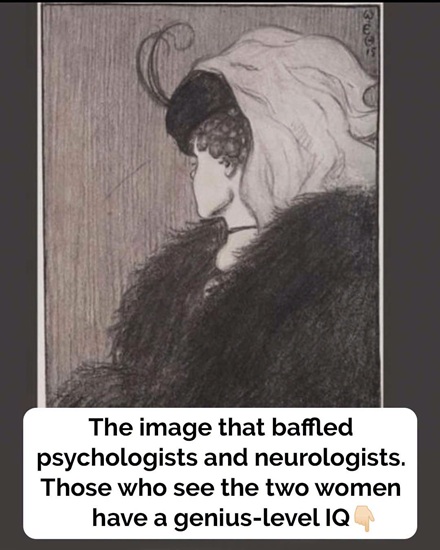
At first glance, it looks like a simple drawing.
A woman in profile.
Nothing unusual.
Then someone points out a second face hidden inside the image—and suddenly what seemed obvious becomes uncertain. Your eyes shift. Your brain struggles. The picture transforms. What was once impossible to see becomes impossible to ignore.
This strange experience is exactly why optical illusions have fascinated people for generations.
They remind us that seeing is not as straightforward as we like to believe.
The human brain constantly interprets visual information, making rapid decisions about shapes, depth, contrast, and patterns. Most of the time, those decisions happen so quickly that we never notice them. Optical illusions expose that hidden process. They reveal that perception is not a perfect recording of reality but an interpretation—one that can change in an instant.
That combination of mystery, surprise, and psychology has made optical illusions some of the most enduring visual puzzles ever created.
Few examples are more famous than the classic “Young Girl / Old Woman” illusion.
More than a century after its creation, it continues to confuse, entertain, and amaze people around the world.
At first, many viewers see a young woman turning her face away. Her profile appears elegant and youthful, her head tilted slightly as she looks into the distance.
But look again.
Suddenly another figure emerges.
An older woman.
Her nose becomes visible.
Her mouth appears.
Her expression seems entirely different.
Nothing in the image has changed.
Yet everything has changed.
The drawing is believed to have originated in the late nineteenth century, with early versions appearing around 1888. During that era, illustrated postcards, newspapers, and printed artwork were among the most popular forms of entertainment and communication. People shared visual puzzles much like people share internet challenges today.
The illusion spread because it invited participation.
People wanted to know what others saw.
And once they discovered the hidden image, they wanted to show someone else.
The most widely recognized version is often associated with British cartoonist W. E. Hill, whose famous illustration “My Wife and My Mother-in-Law” became one of the best-known examples of visual ambiguity ever created.
Hill’s genius was deceptively simple.
He used a single collection of lines to create two completely different faces.
The young woman’s chin becomes the old woman’s nose.
The young woman’s necklace transforms into the older woman’s mouth.
Features overlap in ways that allow the brain to choose one interpretation while temporarily ignoring the other.
That is what makes the illusion so powerful.
Both images are present at the same time.
Yet most people can only focus clearly on one version at a time.
Psychologists describe this type of image as a bistable illusion.
In simple terms, it contains two valid interpretations that compete for attention. The brain naturally tries to organize visual information into familiar patterns, and once it settles on one interpretation, it tends to stick with it.
This phenomenon is known as perceptual bias.
When the brain identifies a pattern, it becomes reluctant to abandon it.
That is why some viewers instantly see the young woman but struggle to find the older one.
Others experience the exact opposite.
Neither person is wrong.
Their brains are simply prioritizing different visual cues.
The moment when the second image finally appears often feels almost magical.
People stare at the drawing.
They search.
They squint.
Then suddenly—
There it is.
The hidden face emerges as if it had appeared from nowhere, even though it was there all along.
That moment of discovery is one reason the illusion remains so captivating.
It transforms perception into a puzzle.
And the reward is not solving the image, but realizing how easily the mind can be fooled.
Optical illusions like this are more than entertainment.
They have become valuable tools in psychology and neuroscience.
Researchers use them to study how the brain processes information, recognizes patterns, and constructs reality from incomplete visual signals.
These studies have revealed an important truth:
The world we experience is not a direct copy of reality.
It is a mental interpretation.
Our brains constantly fill in gaps, make assumptions, and prioritize certain details while ignoring others. Most of the time, this process helps us navigate life efficiently.
But illusions expose the shortcuts.
They reveal the hidden machinery behind perception.
That insight has fascinated scientists for decades.
In the modern era, the “Young Girl / Old Woman” illusion has found an entirely new audience online.
Social media platforms have introduced the image to millions of people who may never have encountered it otherwise. Users challenge friends, compare interpretations, and debate which image they saw first.
Its popularity endures because of its simplicity.
There are no bright colors.
No complex animations.
No digital effects.
Just a black-and-white drawing created more than a century ago.
And yet it continues to captivate people in ways that many modern images cannot.
Perhaps that is because the illusion taps into something universal.
Everyone sees the world through their own perspective.
Everyone interprets reality through the lens of experience, expectation, and attention.
The drawing becomes a visual metaphor for that truth.
Two people can look at the exact same image and genuinely see something different.
Neither is wrong.
Both are correct.
The difference lies in perception.
That lesson extends far beyond art and psychology.
It reminds us that certainty can be fragile.
That first impressions are not always complete.
And that sometimes another reality exists just beyond what we initially notice.
More than one hundred years after its creation, the “Young Girl / Old Woman” illusion continues to prove that the most fascinating mysteries are not always hidden in the world around us.
Sometimes they are hidden inside our own minds.
A single image.
Two completely different realities.
And one timeless reminder:
What we see depends as much on how we look as on what is actually there.