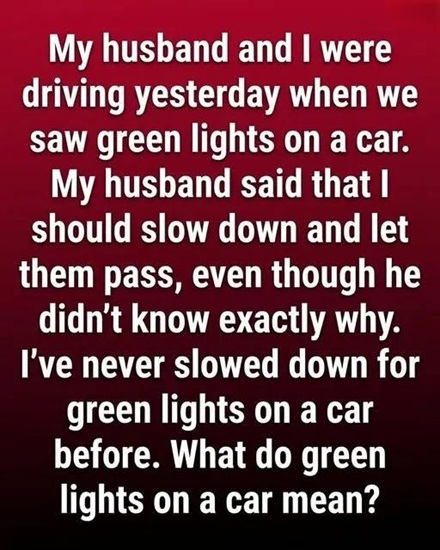
Most drivers know exactly what to do when they see flashing red and blue lights in their rearview mirror.
Your heart rate jumps.
You check your speed.
You look for a safe place to move over.
The meaning is instantly recognizable.
But what if the light behind you isn’t red?
What if it’s green?
For many drivers, that unexpected flash of green creates a moment of confusion. Questions immediately race through the mind.
Is it an emergency vehicle?
Am I supposed to pull over?
Is something wrong?
Or am I breaking a traffic rule without realizing it?
The uncertainty is understandable.
After all, green flashing lights are far less common than traditional emergency signals, and many motorists may drive for years without encountering one. Yet in certain regions, these lights serve specific purposes that are important to understand.
Knowing what they mean can help drivers stay calm, make better decisions, and avoid unnecessary panic on the road.
Night driving already presents unique challenges.
Visibility is reduced.
Distances can be harder to judge.
Reflections from headlights and streetlights can distort perception.
In these conditions, any unusual light can immediately draw attention.
Our brains are wired to respond quickly to visual signals, especially those associated with authority, danger, or emergencies. When something unexpected appears in traffic, the instinctive reaction is often to assume urgency.
That reaction can be useful.
But it can also create confusion when the signal is unfamiliar.
Unlike red and blue emergency lights, green flashing lights do not have a single universal meaning.
Their purpose varies depending on the country, state, province, or local jurisdiction.
In some areas, green lights are used by volunteer firefighters responding to emergencies.
In others, they may identify volunteer medical responders, support vehicles, emergency coordinators, or specialized transportation services.
Certain regions permit green lights as visibility markers rather than emergency signals.
Because traffic laws differ from place to place, drivers may encounter entirely different uses for the same light color depending on where they are traveling.
This lack of standardization is one reason many motorists are uncertain when they first see a green flashing light.
The important thing to remember is that green lights generally do not carry the same legal authority as traditional emergency lights.
Police vehicles, ambulances, and fire apparatus operating with officially authorized lights and sirens are typically granted special roadway privileges under traffic laws.
Green-light vehicles, where permitted, often do not receive those same rights.
That means surrounding drivers are usually not required to react in the same way they would for a police car or ambulance.
Understanding this distinction can prevent unnecessary overreactions.
Unfortunately, uncertainty sometimes causes drivers to make sudden decisions.
A motorist spots an unfamiliar flashing light.
They slam on the brakes.
They abruptly change lanes.
They hesitate unpredictably in traffic.
These reactions can create more danger than the light itself.
Defensive driving experts consistently emphasize one principle above all others:
Remain predictable.
Predictable drivers create safer roads.
When motorists maintain a steady speed, stay aware of their surroundings, and make smooth, deliberate decisions, traffic flows more safely for everyone involved.
This principle becomes especially important when encountering unfamiliar vehicle lighting.
Rather than reacting emotionally, drivers should focus on observation.
What is the vehicle doing?
Is it approaching rapidly?
Is it simply traveling normally?
Does it appear to be assisting another vehicle?
Is it displaying other signals?
Careful observation often provides valuable context.
In many cases, green flashing lights are intended primarily as visibility aids.
Certain authorized vehicles operate in environments where being easily noticed can improve safety.
The light helps other road users recognize the vehicle without necessarily signaling an emergency.
This is particularly useful during nighttime driving, severe weather, or low-visibility conditions.
From that perspective, the green light functions more as communication than command.
It says:
“Notice me.”
Not:
“Move immediately.”
That distinction matters.
Many misunderstandings occur simply because drivers have never been taught what certain signals mean.
Most people learn about stop signs, traffic lights, school zones, and emergency vehicles early in their driving education.
Far fewer receive detailed explanations about regional variations in vehicle lighting.
As a result, unfamiliar signals can feel alarming when they are actually routine.
Traffic safety organizations frequently encourage drivers to stay informed about local regulations, particularly when traveling between states or countries.
Road systems evolve.
New technologies emerge.
Different jurisdictions adopt different practices.
A well-informed driver is generally a safer driver.
Situational awareness also plays a major role.
Experienced drivers regularly scan mirrors, monitor surrounding traffic, and maintain awareness of changing conditions around them.
This habit allows them to process unusual situations calmly rather than reacting impulsively.
When a vehicle displaying green flashing lights appears, awareness helps transform uncertainty into informed decision-making.
Instead of focusing solely on the light itself, attentive drivers evaluate the entire traffic environment.
What matters most is maintaining control.
Control of speed.
Control of direction.
Control of judgment.
These factors contribute far more to road safety than any individual signal ever could.
The broader lesson extends beyond green lights.
Modern traffic systems depend on cooperation.
Every driver shares responsibility for creating a predictable and safe environment.
Whether interacting with emergency responders, service vehicles, commercial trucks, or ordinary passenger cars, consistency remains one of the most valuable tools on the road.
Unexpected situations are inevitable.
Panic is optional.
Many nighttime driving concerns arise not because the situation is truly dangerous but because the brain struggles with uncertainty.
When people encounter something unfamiliar, they often assume the worst before understanding the facts.
Knowledge helps replace fear with confidence.
That is especially true when it comes to unusual vehicle lighting.
Green flashing lights may appear uncommon, but in most cases they are part of regulated systems designed for specific purposes.
They are not intended to frighten drivers.
They are not designed to create confusion.
They exist to improve visibility, communication, and roadway awareness under certain circumstances.
The next time you notice green flashing lights in the distance or reflected in your mirror, remember that the safest response is usually the simplest one.
Stay calm.
Stay aware.
Continue driving responsibly.
Observe the situation.
Follow local traffic laws.
And avoid making sudden movements based solely on uncertainty.
Ultimately, safe driving depends less on reacting to every unexpected stimulus and more on maintaining sound judgment under all conditions.
Green flashing lights serve as a useful reminder that roads are shared spaces filled with many different types of vehicles, each with its own role and purpose.
Understanding those differences helps create safer journeys for everyone.
Because the most effective drivers are not the ones who never encounter surprises.
They are the ones who know how to handle them calmly when they do.