Few things are more frustrating than staring at a sealed can of food when you have no can opener.
Whether you’re camping, dealing with a power outage, unpacking after a move, or facing an unexpected emergency, that small metal lid can suddenly feel like an impossible obstacle. The food you need is right there—close enough to touch, yet completely inaccessible.
Fortunately, a missing can opener doesn’t always mean you’re out of options.
With a little patience and the right technique, it’s often possible to open a can using common household items or even natural surfaces. These methods aren’t as convenient as using the proper tool, and they require extra care, but they can help when no better alternative is available.
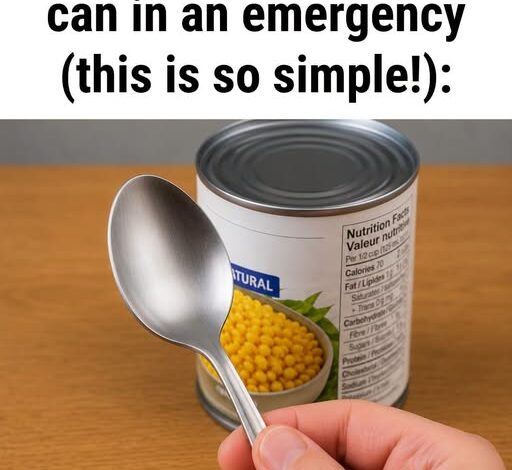
One of the simplest approaches involves nothing more than a sturdy metal spoon.
At first, the idea sounds unlikely.
After all, a spoon isn’t designed to cut through steel.
But with steady pressure and persistence, it can gradually wear away the thin metal around the inside edge of the lid.
Hold the can securely on a stable surface and grip the spoon firmly by its handle. Position the tip of the spoon against the groove near the rim, then rub back and forth while applying downward pressure. The repeated friction slowly thins the metal until a small opening begins to form.
Once you’ve punctured the lid, continue working around the edge, enlarging the opening little by little.
It isn’t fast.
It certainly isn’t effortless.
But with enough patience, the lid will eventually loosen enough to be lifted away.
Another method uses the sturdy heel—the thickest part nearest the handle—of a chef’s knife.
This technique requires considerably more caution because knives can slip if used carelessly.
Rather than attempting to slice through the lid, place the heel of the blade into the groove near the rim while keeping your fingers well away from the cutting edge. Apply controlled downward pressure and gently rock the knife until it pierces the metal. Repeat the process around the circumference, creating a series of punctures that eventually allow the lid to separate.
The key is control, not force.
Trying to stab aggressively at the can greatly increases the risk of injury.
If you ever find yourself outdoors without tools, even the ground itself can become surprisingly useful.
A flat piece of rough concrete or coarse stone can wear away the raised rim that seals the can.
Turn the can upside down and rub the sealed edge back and forth across the abrasive surface using steady, even pressure. As the metal gradually grinds away, the seal weakens. Once enough material has been removed, gentle pressure on the lid may cause it to release.
This approach can take several minutes, but it requires no specialized equipment.
Regardless of which method you use, safety should remain your highest priority.
Improvised openings often leave extremely sharp metal edges capable of causing deep cuts. Handle both the can and the loosened lid carefully, and whenever possible, use a cloth, towel, or pair of work gloves to help protect your hands.
Before eating, inspect the food and the inside of the can.
If the can was badly damaged before opening—especially if it was swollen, leaking, severely dented at the seams, or showed signs of rust—it may no longer be safe to consume its contents. Likewise, if metal fragments appear to have fallen into the food during opening, remove them carefully, and consider whether the remaining contents can be safely used.
Of course, the safest and easiest solution is simply to keep a reliable manual can opener available.
Many emergency preparedness experts recommend storing one in kitchen drawers, camping equipment, emergency kits, and even vehicle supplies. A compact manual opener weighs very little, costs relatively little, and can save considerable frustration when electricity is unavailable or kitchen tools go missing.
Still, life doesn’t always unfold according to plan.
Tools get misplaced.
Equipment breaks.
Unexpected situations arise.
Knowing a few practical alternatives can make the difference between feeling stranded and solving the problem calmly.
Perhaps the greatest lesson these methods offer isn’t really about opening cans at all.
It’s about adaptability.
Human beings have always overcome obstacles by observing, improvising, and making the most of whatever resources happen to be available. A spoon becomes a cutting tool through persistence. A rough stone becomes a substitute for specialized equipment through simple physics and patience.
Resourcefulness often looks far less dramatic than people imagine.
It’s rarely about having the perfect tool.
More often, it’s about understanding the principles behind a problem and finding another way to achieve the same result.
So if you ever find yourself holding a stubborn can with no opener in sight, don’t assume you’re out of luck.
Take your time.
Work carefully.
Respect the sharp edges.
And remember that even the simplest objects can become surprisingly useful when approached with patience, creativity, and a little practical know-how.
Sometimes the most valuable survival skill isn’t strength or expensive equipment.
It’s the ability to look at an ordinary situation, think differently, and discover that the solution has been in your hands all along.