The first time Susan Boyle walked onto that stage, almost nobody knew what was coming.
Years later, when she returned, everybody did.
That made the second walk harder.
The audience already knew the voice.
They knew the unlikely story that had traveled around the world, the audition that transformed an unknown Scottish woman into an international sensation almost overnight.
They knew what she had sounded like at her best.
But this time, Susan wasn’t walking onto the stage as an anonymous contestant with nothing to lose.
She was returning as someone who had nearly lost the ability to stand there at all.
The difference could be seen before she sang a note.
Her steps were careful.
Her posture carried a slight caution that hadn’t been there before.
She smiled, but behind that familiar expression was a history the audience now understood.
Hospital rooms.
Doctors.
Rehabilitation.
Fear.
The long, repetitive work of teaching a recovering body to trust itself again.
Then the music began.
For a few seconds, the room seemed to travel backward in time.
Not completely.
That would have been impossible.
Susan wasn’t trying to recreate the woman who had first walked onto Britain’s Got Talent all those years earlier.
That woman belonged to another chapter.
Instead, she stood before the audience as she was now.
Older.
Changed.
More vulnerable.
And still willing to sing.
That mattered more than perfection.
The first notes emerged carefully.
There was familiarity in them, but something else too.
Weight.
A voice can carry biography.
It can reveal exhaustion even when the words don’t.
It can contain years.
Susan’s performance seemed to do exactly that.
The pauses felt different.
The phrasing seemed more deliberate.
Even the moments when her voice wasn’t completely effortless added something to the performance.
She wasn’t pretending nothing had happened.
She was singing after it had.
That distinction transformed the moment.
Susan Boyle’s original rise to fame had been built around surprise.
When she appeared on Britain’s Got Talent in 2009, the audience made assumptions before she opened her mouth.
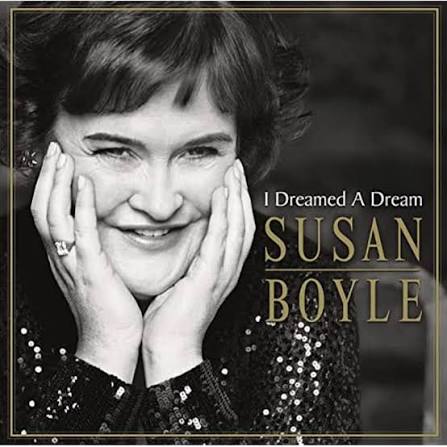
Then she began singing “I Dreamed a Dream.”
Everything changed.
The contrast between expectation and reality became irresistible television.
People who had laughed stopped laughing.
Judges stared.
The audience rose.
Within days, the audition had spread far beyond Britain.
Millions watched it online.
Susan became one of the defining viral sensations of the early social-media era.
Her story seemed almost perfectly constructed.
An ordinary woman walks onto a talent-show stage.
People underestimate her.
She opens her mouth.
A remarkable voice comes out.
The world realizes it was wrong.
It was the kind of moment television producers spend careers hoping to capture.
But viral moments create their own prisons.
Once the world meets you during an extraordinary instant, it expects you to remain frozen there.
Susan could never again simply be a woman who loved singing.
She became Susan Boyle.
The voice.
The audition.
The transformation.
The phenomenon.
Every performance afterward existed in comparison with that first one.
Was she as good?
Did she still have it?
Could she recreate the magic?
That’s an exhausting standard for anyone.
Then life imposed a much more serious challenge.
Susan later revealed that she had suffered a stroke.
Suddenly, the question wasn’t whether she could recreate a famous performance.
It was whether she could recover enough to perform again.
A stroke can change life without warning.
One ordinary moment becomes a dividing line.
Before.
After.
The body you’ve trusted for decades can suddenly feel unfamiliar.
Movement may require concentration.
Balance may change.
Tasks once performed automatically can demand effort.
For a singer, the fear can extend even further.
What about the voice?
What about breath control?
What about memory?
What about standing beneath stage lights while thousands of people watch?
Recovery wasn’t something Susan could accomplish with one dramatic act of determination.
It required rehabilitation.
Physiotherapy.
Practice.
Patience.
And perhaps hardest of all, accepting that progress might happen much more slowly than she wanted.
There is nothing glamorous about rehabilitation.
The public usually sees two photographs.
The hospital.
Then the comeback.
Between those images can be months of work.
Trying.
Resting.
Repeating.
Taking a few steps.
Doing the same exercise again.
Celebrating improvements that would once have seemed ridiculously small.
Getting frustrated.
Starting over the next morning.
For someone accustomed to applause, recovery demands a different measurement of success.
Nobody cheers because you stood slightly longer today.
There is no standing ovation because a movement became a little easier.
But those victories matter.
They accumulate.
One becomes another.
Eventually, things that once seemed impossible begin looking possible again.
For Susan, one of those possibilities was singing publicly.
That meant more than producing the notes.
A performance requires a body.
Standing.
Breathing.
Timing.
Concentration.
Confidence.
Walking onto the stage itself can become part of the challenge.
And then there is fear.
What if something happens?
What if the voice doesn’t respond?
What if the audience notices weakness?
What if the return proves that the person you used to be is gone?
Those questions can become reasons never to try.
Susan tried anyway.
That is why her return carried such emotional force.
The stage hadn’t changed much.
The lights still shone.
The judges still watched.
The audience still waited.
But Susan had changed.
And perhaps that was exactly why she needed to return.
Certain places become landmarks in our lives.
A school.
A hospital.
A childhood home.
A street corner.
A theater.
We return years later and discover that the physical location is almost beside the point.
We’re really visiting an earlier version of ourselves.
For Susan Boyle, that stage represented an enormous beginning.
It was where strangers first heard her.
Where ridicule transformed into astonishment.
Where anonymity ended.
Where the life she had known disappeared almost overnight.
Returning after a serious health crisis gave the place another meaning.
This time, she wasn’t asking the audience to discover her.
She was rediscovering herself.
The difference could be felt in the room.
Nobody needed convincing.
Nobody was laughing at the woman standing before them.
Nobody wondered whether she belonged there.
The question had changed.
Could she do it again after everything she’d endured?
Then she sang.
Not as the untouched voice preserved in an old viral video.
As the woman standing there now.
That is what audiences sometimes misunderstand about comebacks.
We expect restoration.
We want the athlete to run exactly as fast.
The actor to look exactly the same.
The singer to hit every note exactly as before.
We call that recovery.
But recovery isn’t always restoration.
Sometimes recovery means building a new way forward with what remains.
A scar doesn’t mean the wound never healed.
A cautious step doesn’t mean someone failed to recover.
A changed voice isn’t necessarily a diminished one.
Sometimes the change is precisely where the meaning lives.
Susan didn’t need to erase what happened to prove she had survived it.
She didn’t need to perform as though the hospital had never existed.
The hospital was part of the performance now.
So were the rehabilitation sessions.
So were the frightening nights.
So were the mornings when progress seemed invisible.
Every careful step onto that stage carried them.
And when the audience began responding, the emotion felt different from 2009.
Back then, applause was partly an apology.
People had underestimated her.
Then her voice forced them to reconsider.
This time, there was nothing to correct.
The audience knew exactly who Susan Boyle was.
The applause came from recognition.
Recognition of effort.
Recognition of survival.
Recognition of the courage required to return to a place where everyone remembered you at your strongest.
The judges rose.
Then more people stood.
Soon the room was on its feet.
Susan smiled.
There are moments when a standing ovation celebrates technical brilliance.
And there are moments when it celebrates the fact that somebody made it back.
This felt like the latter.
The woman receiving that applause wasn’t the same woman who had stunned the world years earlier.
She couldn’t be.
None of us remain unchanged.
Time alone would have guaranteed that.
Success changes people.
Loss changes people.
Illness changes people.
Recovery changes people.
The mistake is believing that changed means ruined.
Susan’s return offered another possibility.
Changed can mean deeper.
Her original audition had been about a dream.
Her comeback was about something more elemental.
Presence.
She was there.
After everything, she was standing beneath those lights.
There is tremendous dignity in simply showing up after life has given you reasons to hide.
People recovering from illness understand that.
So do people living through grief.
Depression.
Divorce.
Failure.
A career collapse.
Any event that creates a before and an after.
The world loves dramatic comeback stories because they make recovery look clean.
Someone falls.
Someone fights.
Someone returns stronger than ever.
Real life is messier.
Sometimes you return tired.
Sometimes you’re still frightened.
Sometimes you’re not stronger than before.
Sometimes strength isn’t even the point.
Sometimes the victory is that you returned at all.
Susan didn’t have to become better than the singer from 2009.
She didn’t need to defeat her younger self.
She didn’t need another viral moment.
That first audition already belonged to history.
Trying to reproduce it exactly would have been pointless.
What she needed was something quieter.
To hear her own voice in that room again.
To feel the stage beneath her feet.
To look toward the judges instead of a hospital ceiling.
To finish a song.
Perhaps that’s why the performance resonated so strongly with people who had never experienced a stroke.
Everyone eventually loses some version of themselves.
Youth disappears.
Careers change.
Bodies change.
People leave.
Confidence gets damaged.
Plans collapse.
At some point, almost everyone has to decide whether they can continue without becoming exactly who they used to be.
That can be terrifying.
We spend so much energy trying to “get back to normal.”
But what if normal no longer exists?
Then perhaps the better question is:
What can I build from here?
Susan’s answer came through music.
She stood where the world had first discovered her and sang from the life she had now.
No erasing.
No pretending.
No apology.
That is different from redemption.
Redemption implies she had failed.
She hadn’t.
A medical crisis isn’t a moral failure.
Needing rehabilitation isn’t weakness.
A changed performance isn’t defeat.
Susan didn’t owe the world proof that she was still worthy of the fame she’d earned.
She had nothing to redeem.
What she sought seemed closer to reunion.
With an audience.
With a stage.
With music.
Perhaps with herself.
And that makes the standing ovation easier to understand.
People weren’t simply applauding a celebrity for returning to television.
They were watching someone confront a place filled with enormous expectations and refuse to be intimidated by the comparison.
She let herself be seen as she was.
That takes courage.
Celebrity culture encourages people to conceal decline.
Hide the scar.
Fix the photograph.
Control the angle.
Never let the audience see weakness.
Susan’s return worked because weakness wasn’t hidden.
The careful movements were visible.
The emotion was visible.
The history was visible.
She did not need to announce every difficult detail.
Her presence communicated enough.
She had been through something.
And she was here.
Perhaps that is one of the most valuable things public figures can occasionally give audiences.
Not inspiration in the shallow sense.
Not “If I can do it, anyone can.”
Life doesn’t work that way.
People face different illnesses, resources, circumstances, and outcomes.
No celebrity recovery story should become a measuring stick used against someone whose recovery looks different.
What Susan’s moment offered was permission.
Permission to return imperfectly.
Permission to let people see that something changed you.
Permission to stop waiting until every scar disappears before participating in life again.
We often postpone living because we want to arrive polished.
When I’m stronger.
When I’m less afraid.
When I look like myself again.
When I’m certain I won’t fail.
Then I’ll return.
But certainty may never come.
Sometimes you walk onto the stage while still carrying the fear.
You take your place.
The music begins.
Your first breath trembles slightly.
And you sing anyway.
After the performance ended, the applause eventually stopped.
It always does.
The judges sat down.
The cameras moved on.
Another television moment became another clip online.
But for Susan, the significance was larger than those few minutes.
She had returned to the place where one life began after surviving an experience that threatened to close another chapter.
The circle wasn’t perfect.
It didn’t need to be.
Neither was she.
Neither is anyone.
The younger Susan Boyle had once stood before a skeptical audience and demanded, through sheer talent, that people reconsider what they thought they saw.
Years later, she returned with a different lesson.
A person doesn’t become less worthy because life leaves marks.
A voice can carry damage and still carry beauty.
A body can move cautiously and still move forward.
A comeback doesn’t require pretending you never fell.
And courage isn’t always loud.
Sometimes courage is a familiar woman taking careful steps toward a familiar microphone.
Breathing in.
Looking out at a room that remembers who she used to be.
And deciding that who she is now deserves to be heard too.
Then the music starts.
She opens her mouth.
And she sings.