THE SHOCKING PROMOTION THAT CHANGES EVERYTHING TIM WALZ IS THRUST INTO THE NATIONAL SPOTLIGHT AS HARRISS RUNNING MATE

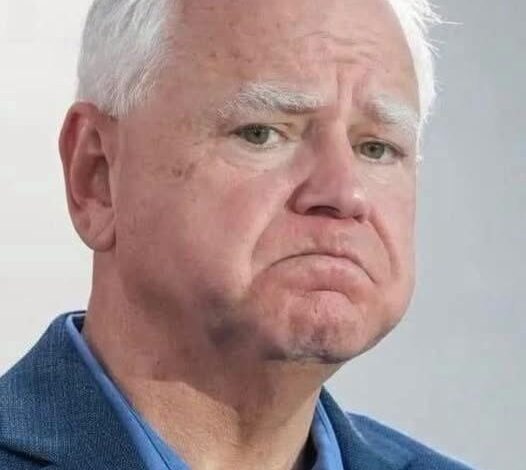
The announcement changed Tim Walz’s political life in an instant.
One moment, he was primarily known as Minnesota’s governor—a former teacher, football coach, congressman, and Midwestern Democrat whose biggest battles had unfolded inside the boundaries of his state.
The next, Kamala Harris had chosen him as her running mate.
Suddenly, every speech Walz had ever delivered mattered nationally.
Every law he had signed became campaign material.
Every controversy, accomplishment, photograph, interview, and forgotten comment was about to be pulled from the archives and examined by millions of people who may barely have known his name days earlier.
For Minnesota, it was a surreal transformation.
Its governor had not simply entered another election.
He had stepped onto one of the largest political stages in the world.
And the rules changed immediately.
State politics allows a governor to develop a complicated record over years.
Voters may know the context behind difficult decisions.
They remember crises.
They understand local debates.
National campaigns rarely offer that luxury.
Complexity gets compressed.
A policy becomes a slogan.
A legislative fight becomes a thirty-second advertisement.
A remark from years ago can suddenly become the centerpiece of a week-long controversy.
Walz’s record would now be treated less like a history and more like evidence.
Supporters would point toward policies they believed showed effective Democratic governance.
Opponents would study those same policies looking for proof that the Harris-Walz ticket represented something voters should fear.
Almost overnight, Minnesota itself became part of the presidential argument.
What had happened there?
What worked?
What failed?
And what, if anything, did Walz want to reproduce nationally?
Those questions guaranteed scrutiny.
Walz had signed major legislation involving education, labor, healthcare, reproductive rights, gun policy, climate initiatives, and social programs.
To Democrats, much of that record could be presented as evidence that government can materially improve people’s lives.
To Republicans, the same record offered an opportunity to portray him as substantially more progressive than the plainspoken Midwestern image surrounding him might initially suggest.
That contradiction was likely to become central to the campaign.
Walz looked and sounded different from the traditional caricature of a national Democratic politician.
He spoke with the familiarity of someone who had spent years in classrooms and small-town communities.
He had served in the military.
He had represented a congressional district containing rural voters.
He could talk about agriculture, schools, hunting, veterans, and working-class concerns without sounding as though those subjects had been handed to him by campaign consultants.
For Democrats, that was part of his appeal.
They didn’t merely need someone who could defend Harris.
They needed someone who might communicate with voters who had increasingly felt disconnected from the party.
Walz’s political identity offered the possibility of doing both.
He could defend progressive policy while presenting himself as culturally familiar to parts of the Midwest.
Whether that combination would actually persuade undecided voters was another question.
Presidential campaigns have a way of destroying carefully constructed political identities.
Once the opposition defines you, you spend enormous amounts of time arguing that their version is false.
Walz’s critics were already preparing their version.
They would focus on Minnesota’s handling of public disorder.
Government spending.
COVID-era decisions.
Taxation.
Immigration.
Environmental rules.
Questions involving his military record and past statements.
Every vulnerability would become larger because the stakes were larger.
Nothing would remain local.
If a Minnesota voter once complained about a policy at a city council meeting, that complaint could now become footage in a national campaign advertisement.
If Walz had phrased something poorly in an old interview, millions of viewers could see it before breakfast.
That is what vice-presidential selection does.
It turns a politician’s past into opposition research.
And Walz would have almost no adjustment period.
National campaigns move brutally fast.
A governor can sometimes spend days developing a response to a state controversy.
A vice-presidential candidate may have minutes.
One awkward sentence can dominate cable television.
One joke can become a meme.
One factual mistake can generate days of attacks.
Every rally contains risk.
Every interview becomes an audition.
Every debate answer can either strengthen the ticket or create a new problem for the top of it.
Walz was no longer speaking simply as governor of Minnesota.
He was speaking as the person Harris believed should be one heartbeat away from the presidency.
That changes the weight of every word.
It also changes the emotional stakes.
Walz’s biography was likely to become one of the campaign’s most heavily used assets.
Before national office, he had worked as a teacher.
He coached football.
He served for years in the Army National Guard.
Then came Congress.
Then the governor’s mansion.
Supporters saw an appealing trajectory in that story.
He had not emerged from an elite political pipeline.
He had spent much of his life around students, service members, teachers, families, and communities far removed from Washington’s traditional centers of power.
Democrats hoped that background could give the ticket something difficult to manufacture:
Authenticity.
Walz could present himself as someone who understood ordinary frustration because he had lived much of his life outside the political class.
That image would be tested relentlessly.
Opponents would argue that biography and policy are different things.
A candidate can sound moderate while supporting policies critics consider strongly progressive.
Republicans were therefore likely to make the “Minnesota model” itself part of the case against him.
They would ask voters to imagine Walz’s state-level agenda expanded nationwide.
Democrats would ask almost the opposite question.
Why shouldn’t successful policies spread?
That disagreement would turn Minnesota into a proxy battlefield for national ideology.
School meals could become an argument about government’s role in family life.
Labor protections could become an argument about business regulation.
Abortion policy could become an argument about individual rights and state authority.
Climate measures could become an argument about economic cost versus environmental responsibility.
Public-safety decisions could become arguments over policing, protest, and leadership during crisis.
Walz would have to defend all of it while helping Harris prosecute a broader case against their Republican opponents.
That is the peculiar role of a running mate.
You’re expected to possess presidential credibility while simultaneously functioning as the campaign’s most aggressive surrogate.
You must appear ready to govern without overshadowing the person at the top of the ticket.
You must attack without appearing reckless.
You must defend without sounding defensive.
You must introduce yourself while talking mostly about someone else.
And you must do it under constant pressure.
For Walz, the transition would be especially dramatic because Minnesota had offered something Washington never would:
A familiar environment.
He knew the institutions.
He knew the press.
He knew the political terrain.
Now he would wake up in a different state every morning.
Airports.
Motorcades.
Hotel rooms.
Teleprompters.
Union halls.
College campuses.
Television studios.
Donor events.
Rallies where people had arrived not because of him but because of what he represented on the ticket.
His political instincts would be tested at a speed impossible to simulate.
The consequences reached his legacy too.
Before the announcement, Walz’s historical reputation could have been judged primarily through Minnesota.
Afterward, that would never again be possible.
Winning would make him vice president and place him near the center of American government.
Losing would attach his name permanently to one of the most consequential presidential campaigns of the era.
Either outcome would redefine him.
That is the gamble every running mate accepts.
A governor can sometimes choose when to seek national relevance.
A vice-presidential nomination eliminates the transition period.
Relevance arrives immediately.
So does judgment.
For Minnesotans, watching that transformation could produce conflicting emotions.
There was pride in seeing a local political figure selected for a national ticket.
There was also the strange experience of watching the rest of America suddenly discover someone the state had been arguing about for years.
National commentators would describe Walz in sweeping terms.
Moderate.
Progressive.
Pragmatist.
Radical.
Every label would reveal as much about the person using it as about Walz himself.
The campaign would eventually have to move beyond labels.
Voters would hear him.
Watch him under pressure.
See how he responded when challenged.
They would decide whether the genial teacher-coach image held up when the questions became hostile and the consequences enormous.
That is where political mythology meets reality.
A résumé can get someone selected.
Only performance determines what happens afterward.
Walz had reached the point where every political accomplishment behind him became preparation for a much larger test.
The classroom.
The military.
Congress.
The governorship.
All of it had brought him to this moment.
Now none of it guaranteed anything.
The country would decide what those experiences meant.
Was he the grounded Midwestern partner Harris needed?
Was he evidence of a Democratic agenda opponents believed had moved too far left?
Could he appeal to voters beyond the Democratic coalition?
Could he survive the scrutiny waiting for him?
Could he help Harris win?
Those questions would not be answered by the announcement.
They would be answered on campaign stages, in interviews, during debates, and ultimately by voters.
For Tim Walz, the quietest part of his political career was over.
Minnesota’s governor had become a national candidate.
Everything from his past was about to be reopened.
Everything he said next would matter more.
And from the moment Kamala Harris placed him on the ticket, he stepped into the one arena where political lives can be transformed—or consumed—in a matter of months.
The campaign had found its newest central character.
Now America would decide what to make of him.