Trump’s $400 million Air Force One plane from Qatar is being removed from service weeks after first flight – here’s why

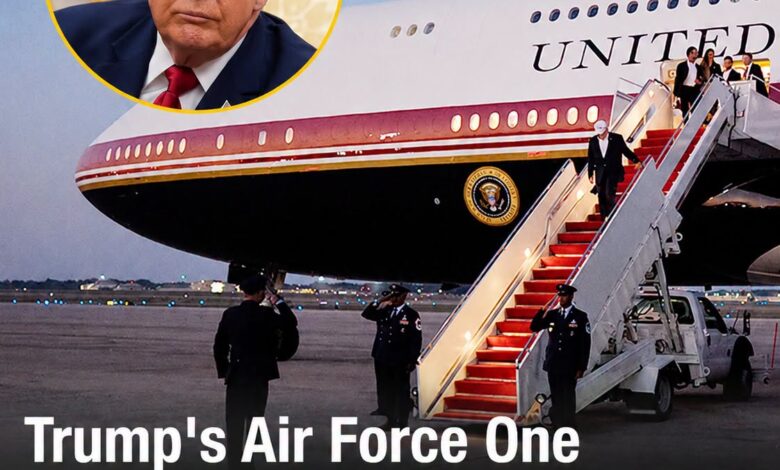
The aircraft was supposed to embody power before it ever left the runway. A lavish Boeing 747, reportedly valued at around $400 million and donated by the Qatari royal family, was presented as the future of presidential travel—a gleaming symbol of American prestige that Donald Trump eagerly embraced. He praised it as “maybe the greatest commercial plane ever built,” transforming what might have been a routine aviation story into a carefully staged political spectacle. Plans called for the jet to make its high-profile debut during a July 1 trip to North Dakota, reinforcing an image of strength, success, and momentum.
For a brief moment, the optics were exactly as intended.
The enormous aircraft dominated headlines, photographs, and television broadcasts. Standing beside its polished exterior, Trump projected confidence, treating the jet as more than a means of transportation. It became another character in the larger narrative he has long cultivated—one built around grandeur, visibility, and unmistakable symbolism.
But political symbols rarely remain uncomplicated for long.
As excitement surrounding the aircraft grew, questions began to surface about whether the plane was truly ready to serve as Air Force One. Reports suggested that essential military upgrades—including sophisticated defensive and communications systems expected on a presidential aircraft—had not yet been fully completed. While details surrounding such equipment remain highly sensitive, the discussion quickly shifted from luxury to national security.
Suddenly, attention was no longer focused on the aircraft’s impressive size or lavish interior.
Instead, critics and analysts began asking whether appearance had raced ahead of preparation.
The controversy extended beyond technical concerns. The aircraft’s reported origin as a gift from a foreign government reignited debate over constitutional ethics and the appropriate boundaries surrounding gifts to American officials. Legal scholars, political commentators, and lawmakers questioned whether accepting such an extraordinary asset from an overseas monarchy raised broader issues of transparency, influence, and public trust.
Supporters viewed the arrangement as a practical opportunity.
Critics saw it as a constitutional dilemma.
The White House rejected suggestions that the aircraft’s withdrawal reflected deeper problems. Officials described the move as a routine part of the certification process, explaining that the jet needed additional work before it could satisfy the demanding requirements expected of a presidential aircraft. According to their explanation, the plane had reached the limits of its current capabilities and would undergo further modifications to meet what they described as the highest operational standards.
From that perspective, the delay represented caution rather than crisis.
Yet perception often moves faster than official explanations.
As the highly publicized aircraft quietly disappeared for another round of upgrades, President Trump resumed traveling aboard an older presidential jet. The contrast proved difficult to ignore. The plane introduced as a powerful symbol of a new era had, at least temporarily, given way to the familiar aircraft it was expected to replace.
That reversal carried its own symbolism.
The episode became less about aviation and more about the complicated intersection of image, security, and politics. Presidential aircraft are designed not merely to transport the commander in chief but to function as airborne command centers capable of operating under extraordinary circumstances. Every system, every communication network, and every defensive capability is expected to undergo exhaustive testing before carrying a president.
Those standards exist for a reason.
The office demands reliability that goes far beyond luxury or appearance.
Whether the additional modifications ultimately prove routine or more extensive than initially anticipated, the story has highlighted the tension that often accompanies high-profile political decisions. A project introduced with dramatic fanfare found itself overshadowed by practical questions that could not be answered with photographs or campaign-style messaging.
In many ways, the aircraft has become a metaphor for the broader challenges facing modern political leadership.
Prestige attracts attention.
Security requires patience.
Public spectacle generates headlines.
Institutional trust depends on transparency.
Those competing forces rarely coexist comfortably, particularly when every development unfolds under constant public scrutiny.
Supporters continue to see the aircraft as a bold investment in presidential travel and an example of Trump’s preference for visible displays of strength. Critics argue that the controversy illustrates the risks of allowing symbolism to outpace careful governance. Both perspectives reflect the larger political environment in which every decision is examined not only for what it accomplishes but also for what it appears to represent.
For now, the jet remains out of public view, undergoing additional work before its future role can be fully realized.
Whether it eventually enters service as planned or becomes remembered primarily for the debate surrounding its arrival, its story has already evolved far beyond that of an airplane. It now stands at the intersection of national security, constitutional questions, diplomatic relationships, and political theater—a reminder that in Washington, even an aircraft can become a symbol of competing visions of power.
The gleaming Boeing that once promised an unmistakable image of presidential dominance has instead become something more complicated: a powerful illustration of how quickly triumph can give way to scrutiny, and how, in politics, the distance between spectacle and vulnerability is often much shorter than it first appears.