Republican leaders have moved quickly to define Trump’s Iran campaign as more than a military strategy.
They want it understood as a moral necessity.
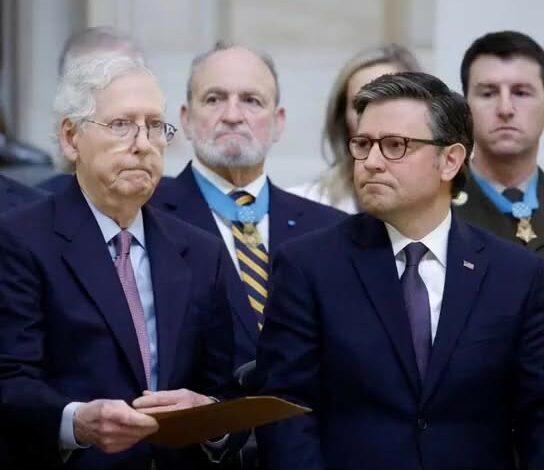
In their framing, the strikes and pressure campaign are not acts of aggression, but acts of reluctant justice. Mitch McConnell describes Tehran as a violent adversary finally weakened after years of bloodshed and provocation. Mike Johnson reaches even further back, invoking the language of Christian just war tradition to argue that force, when used for a limited and righteous purpose, can become an instrument of mercy.
To Johnson, the argument is not simply about missiles, ports, or military targets.
It is about preventing greater suffering.
He suggests that action against Iran could spare “millions of innocent people” from terror, casting the campaign as a painful but necessary duty. In this telling, war is not embraced. It is endured. Violence is not celebrated. It is justified as the lesser evil when faced with a regime they describe as dangerous and unrestrained.
But Pope Leo XIV has introduced a far more severe moral challenge.
His warning that Christ “does not listen to the prayers of those who wage war” cuts directly against the religious framework Johnson and others have used to defend the campaign. Where Republican leaders see just war, the pope sees a spiritual contradiction. Where they argue that force may protect the innocent, he warns that faith cannot be used to sanctify violence.
That clash has turned the debate into something deeper than foreign policy.
It is now a struggle over the meaning of faith in public life.
Trump’s angry response only widened the divide. His counterattacks against critics, combined with the Navy’s blockade of Iranian ports, have hardened the sense that the conflict is moving beyond deterrence and into a dangerous moral confrontation.
The question is no longer only whether the campaign will succeed strategically.
It is whether it can be justified spiritually.
For Trump’s allies, strength is a moral obligation when facing evil.
For the pope and other critics, the deeper obligation is to resist the temptation to dress war in sacred language.
Between those positions lies a question that has haunted nations for centuries:
Can faith bless the missiles?
Or must it stand in their way?
What began as a geopolitical crisis has become a spiritual referendum—one that forces religious leaders, politicians, and citizens alike to decide whether prayer should accompany power, restrain it, or refuse to serve it at all.