The show was supposed to feel magical.
Families had packed the Ocean World stadium expecting the kind of performance they had seen in commercials and brochures: bright music, glittering water, synchronized movements, soaring leaps, and the breathtaking sight of a trainer standing beside one of the ocean’s most powerful animals.
Children leaned forward in their seats.
Parents lifted phones to record.
The crowd waited for wonder.
But beneath the applause, beneath the carefully timed choreography, beneath the polished illusion of harmony between human and whale, something was already wrong.
No one in the stands understood it yet.
Not when the music began.
Not when the water shimmered beneath the lights.
Not even when Cairo, the massive killer whale at the center of the show, hesitated for a fraction too long.
But the trainers noticed.
Maris Ellington would have noticed most of all.
She knew Cairo better than almost anyone.
For years, Maris had worked with him patiently, carefully, and with a level of devotion that colleagues often described as extraordinary. She was not the kind of trainer who treated animals like props. She watched their moods. She studied their movements. She respected their intelligence.
To her, Cairo was not a spectacle.
He was a living being with memory, emotion, strength, and limits.
That was why their partnership had become one of Ocean World’s most admired. Audiences saw confidence and beauty. Her colleagues saw something deeper: trust built slowly through years of discipline, patience, and care.
But trust, even when real, does not erase danger.
On that day, during what should have been a familiar routine, something shifted.
At first, it was subtle.
A delay.
A change in movement.
A break in rhythm.
To the audience, it may have looked like part of the show. To those who understood Cairo, it was enough to create concern.
Then the moment turned.
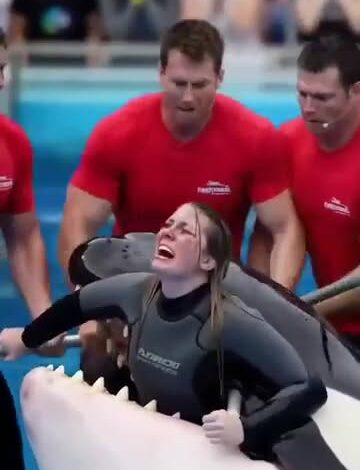
Within seconds, the performance collapsed into chaos.
The music no longer mattered. The applause vanished. Trainers rushed forward as emergency signals cut through the air. The stadium, moments earlier filled with excitement, fell into stunned silence.
Some spectators did not immediately understand what they had witnessed.
Others understood too quickly.
Maris had been fatally injured.
What had begun as an afternoon of entertainment became one of the darkest days in the park’s history.
In the hours that followed, grief spread far beyond Ocean World. Maris was not only remembered as a trainer, but as a respected voice in the marine community. She had spent her career advocating for safer practices, better understanding of animal behavior, and more compassionate treatment of the creatures in her care.
Those who knew her described her as calm, thoughtful, and deeply committed.
She believed connection with marine animals required humility.
She believed power should never be mistaken for control.
And she understood, perhaps better than most, that even the strongest bond between trainer and animal exists within boundaries humans do not fully command.
That truth now sits at the center of the investigation.
Was this an unavoidable tragedy?
Or had warning signs been missed?
Marine experts, investigators, and animal welfare advocates are now examining the details carefully. They are looking at Cairo’s behavior before the show, the conditions inside the facility, the pressure of repeated performances, and whether protocols were strong enough to protect both trainers and animals.
For many watching from outside the industry, the incident shattered a familiar fantasy.
Marine shows are often presented as joyful, educational, and controlled. The audience sees smiles, tricks, music, and applause. What they do not see is the complexity beneath the surface: the stress captivity can place on intelligent animals, the physical risks trainers accept, and the constant tension between entertainment and welfare.
Killer whales are not ordinary performers.
They are massive, emotional, highly intelligent predators whose natural lives are shaped by distance, family bonds, hunting, communication, and the open sea. In captivity, those instincts do not disappear. They remain inside animals asked to live and perform in environments far smaller and more controlled than the world they were built for.
Maris understood that complexity.
And that is part of what makes her death so painful.
She was not careless.
She was not inexperienced.
She was not someone who failed to appreciate the animal in front of her.
She loved the work, but she also respected its risks.
In the days after the incident, Ocean World released statements expressing sorrow and promising a full review of its training procedures, safety systems, and animal care policies. Outside organizations demanded transparency. Advocates called for reform. Former visitors began questioning whether the beauty of these performances had distracted them from harder ethical questions.
The tragedy became more than a story about one accident.
It became a turning point.
A moment forcing the public to ask what should come next for marine entertainment.
Some argue that better training standards, improved emergency protocols, and redesigned facilities could reduce future risks. Others believe the entire model must change, shifting away from performance-based shows and toward education, rescue, rehabilitation, and conservation.
What most agree on is this: continuing as before would dishonor what happened.
Maris Ellington’s death cannot be treated as an isolated headline that fades with time.
Her life mattered too much.
Her work mattered too much.
And the questions raised by her passing are too important to ignore.
Her colleagues say she cared deeply about both people and animals. She wanted safer conditions for trainers. She wanted greater respect for marine mammals. She believed that understanding should guide every interaction with wildlife.
Now, those beliefs have become part of her legacy.
The loss of Maris is heartbreaking because it reminds us that love for animals does not make them tame, and expertise does not eliminate risk. It reminds us that captivity carries consequences that are not always visible from the stands. And it forces us to confront the uncomfortable truth that entertainment should never outweigh responsibility.
The stadium lights may dim.
The music may stop.
The audience may go home.
But what happened that day at Ocean World will continue to echo.
In every safety review.
In every debate about captivity.
In every conversation about what humans owe the wild creatures they claim to love.
Maris Ellington gave her life to the animals in her care.
The only worthy response now is to ensure that her death leads to something more than grief.
It must lead to change.
A change rooted in safety.
In humility.
In compassion.
And in the understanding that the natural world is not ours to command, but ours to respect.