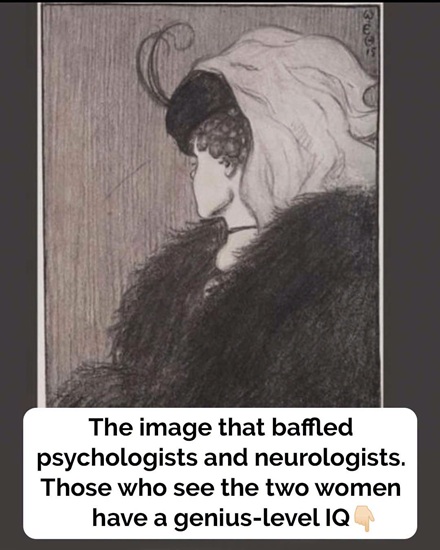
What if the face you’re looking at isn’t the only one there?
At first glance, the image appears simple—just a drawing of a woman. But look a little longer, and something remarkable happens. The picture begins to change. Features that seemed obvious suddenly take on a different meaning. A new face emerges where none existed before.
This is the magic of optical illusions.
For generations, optical illusions have fascinated people because they reveal something surprising about the human mind: seeing is not as straightforward as we think. Our eyes may capture visual information, but it is the brain that decides what that information means. Sometimes, that interpretation changes, allowing us to see entirely different images within the same drawing.
Few examples demonstrate this phenomenon better than the famous “Young Girl / Old Woman” illusion—one of the most enduring and widely discussed visual puzzles ever created.
More than a century after it first appeared, this remarkable image continues to challenge viewers around the world, proving that perception is often far more flexible than reality itself.
A Drawing That Has Survived Generations
Long before social media challenges and viral internet trends existed, people were already fascinated by visual puzzles.
The “Young Girl / Old Woman” illusion traces its roots back to the late nineteenth century, with early versions believed to have appeared around 1888. During that era, printed illustrations, newspapers, magazines, and postcards served as major forms of entertainment and communication.
Without television, smartphones, or the internet, people often found amusement in clever artwork that challenged their imagination and observation skills.
Visual puzzles quickly became popular because they encouraged discussion.
Friends would compare what they saw.
Families would debate hidden details.
Readers would stare at an image, trying to uncover what others had already discovered.
The “Young Girl / Old Woman” illusion became one of the most successful examples of this phenomenon.
Even today, more than a hundred years later, it continues to spark the same conversations.
The Artist Behind the Famous Illusion
The version most people recognize today is commonly associated with British cartoonist W.E. Hill.
Hill became known for creating illustrations that played with perception, often embedding multiple meanings within a single image. His work demonstrated an extraordinary understanding of how the human brain interprets visual information.
One of his most famous creations was a drawing titled My Wife and My Mother-in-Law, published in 1915.
The illustration quickly gained attention because viewers often disagreed about what they saw first.
Some immediately noticed a young woman looking away into the distance.
Others instantly recognized an elderly woman with a prominent nose and a downward gaze.
The remarkable aspect of the drawing is that both interpretations are completely correct.
The same lines create two entirely different faces.
And once you discover both images, it becomes difficult to believe they were hidden in plain sight all along.
What Do You See First?
For many people, the first image they notice is a young woman.
She appears elegant and youthful, her head turned away from the viewer. Her jawline is visible, and she seems to be wearing a feathered hat or decorative accessory.
But for others, the elderly woman appears immediately.
Her face seems turned slightly sideways, revealing a larger nose, a wrinkled mouth, and a more mature profile.
The fascinating part is that neither image is actually hidden.
Both exist simultaneously.
Your brain simply chooses one interpretation before recognizing the other.
This creates the illusion’s signature surprise effect.
Once the second image appears, many viewers wonder how they missed it in the first place.
How the Illusion Tricks the Brain
The “Young Girl / Old Woman” drawing belongs to a category known as bistable images.
A bistable image contains two valid visual interpretations, but the brain can only strongly focus on one at a time.
Rather than seeing both versions equally, the mind alternates between them.
This happens because the brain constantly searches for familiar patterns.
Every second, your visual system processes enormous amounts of information. To make sense of the world efficiently, the brain relies on shortcuts and assumptions.
When viewing the illusion, the brain attempts to organize the lines into a recognizable face.
Depending on which features receive attention first, the mind settles on either the younger woman or the older woman.
For example:
- The young woman’s chin can become the older woman’s nose.
- The young woman’s ear becomes the older woman’s eye.
- A necklace transforms into the older woman’s mouth.
- Hair and facial contours shift meaning depending on interpretation.
Nothing in the image changes.
Only your perception does.
Why Some People Struggle to See the Second Face
If you’ve ever stared at the illusion and only seen one image, you’re not alone.
This is a perfectly normal response.
The brain tends to favor the first interpretation it discovers. Once it has established a visual pattern, it often ignores information that conflicts with that pattern.
Psychologists refer to this tendency as perceptual bias.
In simple terms, the mind prefers consistency.
After recognizing one face, your brain unconsciously filters out clues that suggest another possibility.
That’s why many people need someone else to point out the hidden image before they can see it.
Once the second interpretation is revealed, however, the brain becomes capable of switching back and forth between both versions.
This sudden realization often creates a powerful “aha!” moment that makes optical illusions so enjoyable.
What Optical Illusions Teach Us About Reality
Beyond entertainment, optical illusions offer valuable insight into how human perception works.
Most people assume they see the world exactly as it exists.
In reality, perception is a construction.
The brain gathers information from the eyes and then interprets it based on experience, expectations, memory, and context.
In other words, we do not simply see reality.
We interpret it.
Optical illusions expose this process in a way that is easy to observe.
They remind us that what feels obvious isn’t always objective.
Two people can look at the exact same image and see entirely different things.
Neither person is wrong.
Their brains are simply prioritizing different interpretations.
This concept extends far beyond visual puzzles and influences how humans understand situations, relationships, and even everyday events.
Why Psychologists and Scientists Study Illusions
Researchers have long used optical illusions to better understand the human mind.
By studying how people interpret ambiguous images, scientists gain valuable insights into perception, attention, memory, and cognitive processing.
Illusions help answer important questions:
- How does the brain recognize faces?
- Why do people focus on certain details while ignoring others?
- How do expectations influence perception?
- What shortcuts does the brain use when processing information?
Because optical illusions reveal these hidden mental processes, they have become important tools in psychology, neuroscience, and vision research.
What begins as a simple drawing often provides clues about some of the brain’s most complex functions.
The Internet’s Endless Fascination With the Illusion
More than a century after its creation, the “Young Girl / Old Woman” illusion remains as popular as ever.
The internet has introduced the image to entirely new generations.
Social media users regularly share it as a challenge.
Educational websites use it to teach perception.
Content creators feature it in videos designed to test observation skills.
Every time the image resurfaces online, the same pattern repeats itself.
Thousands of people debate what they saw first.
Others struggle to find the second face.
And many experience the same moment of surprise that viewers experienced over a hundred years ago.
Very few images have maintained that level of cultural relevance for so long.
Why Optical Illusions Never Get Old
The enduring appeal of optical illusions comes from a simple truth:
People are endlessly curious about their own minds.
Optical illusions transform ordinary images into mysteries waiting to be solved. They challenge assumptions, reward observation, and reveal unexpected weaknesses in our perception.
Most importantly, they remind us that reality is often more complicated than it appears.
A single image can contain multiple truths.
A single set of lines can create two entirely different faces.
And a single glance can hide details that become obvious moments later.
That realization is both entertaining and profound.
More Than Just a Picture
The “Young Girl / Old Woman” illusion is far more than a clever drawing.
It is a powerful demonstration of how the human brain constructs meaning from visual information.
For more than a century, this simple black-and-white illustration has captivated millions of people because it forces us to question what we think we see.
Every viewer experiences the image differently.
Some see youth first.
Others see age.
Some discover both immediately.
Others need time.
Yet all of them are looking at the exact same picture.
Perhaps that’s the illusion’s greatest lesson.
Reality is not always defined by what is in front of us.
Sometimes, it is defined by the perspective through which we choose to see it.
And that is what makes this century-old optical illusion just as fascinating today as it was when people first encountered it more than a hundred years ago.