Biker Discovers Secret Bundle in Gas Station Bathroom and Makes Life Changing Decision at 3 AM

At 3 a.m. on a quiet Sunday, the neon lights of the convenience store buzzed against the darkness outside. Those late-night hours usually belonged to exhausted travelers, lonely souls, and people carrying burdens too heavy to sleep through. I was busy stocking shelves, half-lost in the routine sound of cans sliding into place, when the deep rumble of a motorcycle rolled through the parking lot.
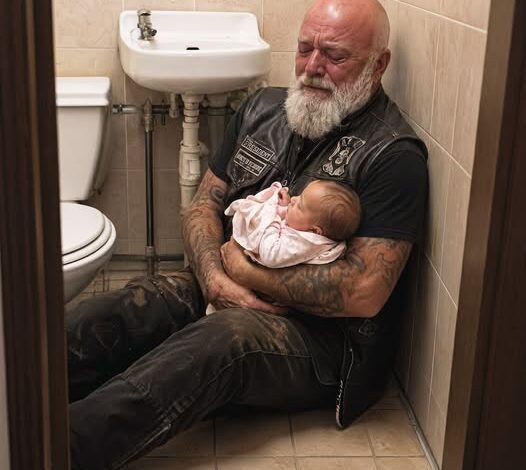
A biker stopped beside pump seven. Through the window, I noticed an older man climbing off the bike. He looked intimidating at first glance—broad shoulders, weathered face, a silver beard stretching down his chest, and a leather vest covered in faded patches from years on the road. But what truly caught my attention wasn’t the man himself. It was the baby carrier strapped awkwardly to the back of the motorcycle.
The infant inside was crying hysterically.
The man carefully unhooked the carrier with giant trembling hands, trying his best to rock the baby while pumping gas. Even from inside the store, I could see the exhaustion in his eyes. His face looked worn down by sleepless nights and something even heavier than fatigue.
A few minutes later, he entered the store carrying the screaming baby. In a rough, cracked voice, he asked where the restroom was. I pointed him toward the back hallway and returned to work, though something about him stayed in my mind.
Then I heard it.
Beyond the baby’s cries came another sound—deep, painful sobbing from behind the bathroom door. It wasn’t ordinary frustration. It sounded like someone completely falling apart. I walked to the door and knocked gently, asking if everything was okay.
For a long moment there was silence.
Finally, a weak voice answered that he didn’t know what he was doing anymore.
I’ve raised three children myself, so I recognized that kind of desperation instantly. I told him I was coming in. Inside, the scene broke my heart. The huge biker was sitting on the floor with his face buried in his hands, while the baby lay beside him with a diaper fastened completely wrong. The poor little girl was soaked, uncomfortable, and exhausted from crying.
I knelt beside her and fixed the diaper properly. Once she was cleaned up and dry, the screaming slowly faded into soft little whimpers. She couldn’t have been older than three months, with dark hair sticking up in every direction. She immediately started searching for food, rooting against my hand.
When I asked when she had last eaten, the man looked completely lost. He guessed maybe five or six hours earlier. He admitted he had formula with him but had been too overwhelmed to stop and think clearly.
That’s when he finally introduced himself as David—and told me the truth.
His daughter, Jessica, had died from an overdose only two nights before. The baby, Emma, was all he had left of her.
As I made a bottle in the employee break room, David opened up completely. He explained that he’d spent most of his life working as a truck driver, always moving from one highway to another. After losing his wife years ago, he had raised Jessica alone, though he admitted he often failed to be present enough. Jessica had battled addiction for years, drifting between recovery and relapse. Recently, she had seemed determined to rebuild her life for Emma’s sake.
But then David found her unconscious in the bathroom.
After her death, Child Protective Services got involved. Because of his age and lack of parenting experience, they started discussing foster care. Terrified of losing his granddaughter to the system, David panicked. Instead of staying to fight, he packed up the motorcycle and rode away with Emma, hoping distance would somehow solve everything.
Looking at him trembling while feeding that tiny baby, I realized he didn’t need judgment. He needed help.
So I called my daughter, who happens to be a family lawyer, even though it was after three in the morning. She listened carefully to David’s story and immediately explained his legal options. She promised to help him for free and reassured him that running away would only hurt his chances. If he wanted to keep Emma, he needed to return and fight properly.
For the first time all night, I saw a small spark of hope appear in his face.
David stayed in the break room until my shift ended that morning. During those hours, I showed him simple things most new parents learn slowly over time—how to hold a baby securely, how to burp her after feeding, how to prepare formula correctly, and how to calm her when she fussed.
By sunrise, he no longer looked like a man escaping from his life. He looked like someone preparing to face it.
Three months later, he called me with good news. The court had granted him full custody of Emma. The judge saw his commitment, the parenting classes he had started attending, and the support system my daughter helped him build. David even sold the motorcycle and bought a safe family car with a proper car seat.
A few weeks after that, he visited my home with Emma. The difference in both of them was incredible. David seemed lighter, calmer, almost younger. Emma had grown into a healthy, smiling little baby who immediately reached out toward me the second she saw me.
That day, David told me he planned to make sure Emma always knew the full truth about her mother—not only her struggles, but also her love and her effort to become better before she died.
I still think about that night often. Most people would have looked at an old biker carrying a baby on a motorcycle at three in the morning and assumed the worst. Some might have called the police immediately without asking questions. But sometimes, what changes a person’s life isn’t punishment or suspicion. Sometimes it’s simply compassion from a stranger willing to stop and help.
David once joked that I had become Emma’s honorary grandmother. Honestly, I think he was right. And every time I hear the distant roar of a motorcycle now, I no longer picture danger. I picture a grieving grandfather trying desperately to save the last piece of his daughter that he had left.
After that first visit, David and Emma slowly became part of my life in ways none of us expected.
At first it was small things.
A phone call every few weeks asking questions about babies:
“Is it normal she cries every time I put her down?”
“How do you know if she’s teething?”
“She won’t sleep unless I drive around the block—am I ruining her?”
I would laugh softly and reassure him that nearly every exhausted parent asks the exact same questions eventually.
David approached fatherhood—or grandfatherhood—with the intensity of a man terrified of failing someone twice.
That fear sat underneath everything he did.
You could hear it in the way he double-checked instructions.
The way he apologized whenever Emma fussed too long.
The way he constantly worried he was “doing it wrong.”
Grief complicated all of it.
Because every milestone Emma reached also reminded him painfully of Jessica.
The first time Emma laughed, he cried afterward.
The first time she said “Mama,” he locked himself in the bathroom for twenty minutes because hearing the word felt like reopening a wound that never fully closed.
People often assume addiction erases love inside families.
It doesn’t.
Sometimes it simply buries love beneath pain, exhaustion, fear, and years of disappointment until nobody remembers how to reach each other clearly anymore.
One rainy afternoon about a year after we met, David invited me to Emma’s first birthday party.
The celebration took place in a small community park outside town. Nothing extravagant—just folding tables, grocery store cake, balloons tied to picnic benches, and a handful of people from David’s parenting support group.
But watching him carry Emma across the grass that day felt almost surreal compared to the broken man sobbing on the convenience store bathroom floor the night we met.
He looked steadier now.
Still rough around the edges.
Still carrying grief visibly in certain moments.
But grounded.
Emma wore a ridiculous pink jacket with tiny bear ears sewn onto the hood. Every few minutes she waddled uncertainly toward pigeons before collapsing onto the grass laughing hysterically at absolutely nothing.
David watched her like someone witnessing a miracle.
At one point during the party, I noticed him standing alone near the parking lot staring toward the highway quietly.
“You okay?” I asked.
He nodded slowly without looking at me.
“Just thinking.”
“About Jessica?”
He swallowed hard before answering.
“She should’ve been here.”
There are no comforting responses for sentences like that.
Parents who lose children to addiction often carry a specific kind of grief tangled tightly with guilt. They replay arguments, missed signs, angry words spoken during relapse cycles. They wonder constantly whether loving harder could have changed the outcome.
David carried all of that.
“I used to get so angry at her,” he admitted softly. “Toward the end, sometimes I answered the phone already prepared for disappointment.”
I stayed quiet.
“And now I’d give anything just to hear her ask me for help again.”
The honesty in his voice nearly broke me.
Because grief does not erase complicated love. If anything, it sharpens it painfully.
Emma suddenly spotted us from across the grass then and began wobbling toward David at full speed, arms stretched upward excitedly.
“Papa!”
David immediately bent down and scooped her into his arms while she grabbed handfuls of his beard laughing.
And for a brief second, some of the sadness left his face completely.
Later that afternoon, while helping clean up paper plates and decorations, one of the younger mothers from David’s parenting class approached me quietly.
“You’re the woman from the gas station?”
I blinked slightly.
“That obvious?”
She smiled warmly.
“He talks about you constantly.”
I laughed.
“Oh no.”
“No,” she said gently. “It’s sweet.”
She folded tablecloths carefully before continuing.
“You saved him, you know.”
I immediately shook my head.
“No. David saved himself.”
But even as I said it, I understood what she meant.
Sometimes people do not need someone to rescue them completely.
They just need one person willing to interrupt the moment they’ve convinced themselves they are beyond saving.
That tiny interruption can become everything.
As Emma grew older, she became impossible not to love.
Curious.
Fearless.
Loud in the funniest ways.
By age three she had already learned how to wrap David completely around her finger emotionally. The giant biker who once terrified strangers now sat through tea parties wearing plastic tiaras while tiny stuffed animals attended imaginary birthday celebrations around the living room.
One afternoon I visited their house and found David letting Emma paint his fingernails bright purple while she lectured him very seriously about “princess manners.”
He looked exhausted but deeply happy.
“You spoil her,” I teased.
“I’m old,” he replied immediately. “I don’t have time for moderation.”
Emma gasped dramatically.
“Papa says bad words in traffic!”
David looked horrified.
“That was one time.”
“THREE times.”
I laughed so hard I nearly dropped my coffee.
Watching them together healed something inside me too.
Because after decades working overnight shifts at the convenience store, I had grown used to seeing people mostly during their breaking points:
addiction,
loneliness,
financial desperation,
runaways,
affairs,
panic attacks at two in the morning.
Human suffering passes through gas stations quietly all night long.
You learn how fragile people really are.
But David and Emma reminded me that broken lives do not always stay broken forever.
Sometimes they rebuild themselves slowly through ordinary love.
Through bedtime stories.
Doctor appointments.
Tiny shoes by the front door.
Pancake breakfasts on Saturdays.
Healing rarely looks dramatic while it’s happening.
Usually it just looks like surviving one ordinary day after another until eventually those days become a life again.
When Emma turned five, David invited me to her kindergarten graduation ceremony.
Afterward, she ran directly toward me waving a handmade paper certificate excitedly.
“Grandma June! Look!”
The word hit me unexpectedly.
Grandma.
Not honorary.
Not joking anymore.
Real in her mind.
I looked toward David immediately.
He smiled softly.
“I figured it stopped being honorary a long time ago.”
I cried in the school parking lot after that.
Not because I needed the title.
Because life had quietly given me family in a place I never expected to find it: inside a fluorescent-lit convenience store during a graveyard shift most people spent trying to forget.
Years later, when people ask why I stayed working nights for so long instead of retiring early, I always think about that bathroom door.
About hearing a grown man crying while a baby screamed beside him.
About choosing compassion before judgment.
About how differently everything might have unfolded if I had simply ignored it.
Most people believe life-changing moments announce themselves loudly.
But they rarely do.
Sometimes they arrive disguised as interruptions:
a crying child,
a stranger asking for help,
a knock on a bathroom door at three in the morning.
And sometimes the smallest decision—to stop, to listen, to care—creates consequences far larger than anyone realizes at the time.
Emma is ten now.
Smart as a whip.
Still stubborn.
Still obsessed with motorcycles because David never completely lost that part of himself.
Last Christmas, she handed me a framed photograph she made at school.
It showed all three of us sitting together at a diner booth laughing over pancakes.
Across the top she had written carefully in uneven handwriting:
Families are the people who stay.
I hung it in my kitchen the same day.
Because after everything life has taught me, I think that may be the truest thing of all.