Justice Denied? A Mother’s Final, Desperate Plea for Mercy in the Face of a Brutal Murder Verdict

The courtroom had been filled with tension for weeks, but nothing compared to the silence that settled over the room when the jury finally returned.
Every person inside seemed to understand that the next few moments would change lives forever.
Family members sat frozen in anticipation. Attorneys stared toward the jury box. Reporters gripped their notebooks. Even the routine sounds that normally accompany a crowded courtroom seemed to disappear.
Then came the verdict.
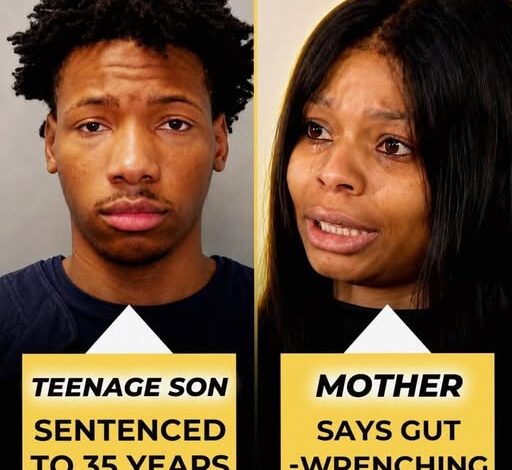
Nineteen-year-old Karmelo Anthony was found guilty of murder.
The words landed with enormous force.
For Austin Metcalf’s family, the decision represented accountability for a tragedy that had shattered their lives more than a year earlier. For Karmelo’s family, it marked the beginning of a painful new reality—one in which a young man they loved would spend decades behind bars.
Among the most emotional moments came from Karmelo’s mother, Kayla Hayes.
As the verdict sank in, she reportedly struggled to contain her grief. Tears streamed down her face as she confronted the outcome she had spent months hoping to avoid. Witnesses described her anguish as raw and unmistakable, the heartbreak of a mother watching her son’s future disappear before her eyes.
The courtroom had become the final chapter of a story that began on what should have been an ordinary spring morning.
On April 2, 2025, students from multiple schools gathered at Kuykendall Stadium in Frisco, Texas, for a track and field competition. It was supposed to be a day filled with races, cheering crowds, personal records, and school pride.
Instead, it became the setting for a tragedy that would leave an entire community in shock.
Austin Metcalf, a 17-year-old junior known by friends and family as a dedicated student-athlete, arrived expecting to compete and spend time with teammates. Like everyone else present, he had no reason to believe that within minutes his life would be over.
According to testimony presented during the trial, the confrontation began inside a tent designated for athletes.
Witnesses described what initially appeared to be a relatively minor dispute.
Karmelo Anthony, who attended a different school, was reportedly sitting inside an area assigned to another team. Several students testified that Austin approached him and asked him to move.
At first, the exchange may have seemed insignificant.
The kind of disagreement that occurs regularly at crowded sporting events.
But prosecutors argued that the encounter quickly escalated beyond a simple misunderstanding.
Multiple witnesses described a growing tension between the two teenagers. According to testimony, Anthony refused requests to leave and responded with increasingly confrontational behavior.
Several witnesses recalled hearing him issue a warning.
“Touch me and see what happens.”
Those words would become one of the most discussed moments of the entire trial.
Prosecutors argued that the statement demonstrated a willingness to escalate the conflict. The defense, meanwhile, portrayed the situation differently, emphasizing the rapidly unfolding nature of the confrontation and the emotions involved.
As the exchange intensified, Austin eventually pushed Anthony.
It lasted only a moment.
A brief physical contact.
Yet what followed would alter countless lives.
According to witness testimony, Anthony responded by producing a knife and stabbing Austin in the chest.
The scene immediately descended into chaos.
Students screamed.
Coaches rushed forward.
Athletic trainers abandoned their posts and sprinted toward the injured teenager.
What moments earlier had been a bustling high school sporting event suddenly became a desperate fight to save a life.
Witnesses recalled seeing adults perform CPR while others called emergency services. Panic spread throughout the stadium as students struggled to understand what had happened.
Despite the efforts of first responders and medical personnel, Austin’s injuries proved fatal.
He was later pronounced dead.
The devastating news rippled throughout the community.
For Austin’s family, the loss was unimaginable.
Perhaps no one felt it more acutely than his twin brother, Hunter.
Throughout the trial, Hunter’s presence served as a constant reminder of the human cost behind the legal arguments. He was not merely losing a sibling.
He had lost someone who shared every stage of his life.
A best friend.
A teammate.
A constant companion.
Someone who had been there from the very beginning.
Testimony revealed that Hunter witnessed the incident and remained with his brother during the frantic attempts to save him. The memory would become one of the most heartbreaking elements of the case.
As the trial unfolded, both sides worked to convince jurors of vastly different interpretations of what happened that day.
The defense argued that Anthony acted out of fear.
Attorney Mike Howard urged jurors to consider the situation through the eyes of a frightened teenager confronted during a rapidly escalating dispute. He maintained that Anthony believed he was in danger and reacted in what he perceived to be self-defense.
The prosecution rejected that narrative.
Prosecutors argued that Anthony’s actions went far beyond reasonable self-protection. They contended that he arrived at the event carrying a knife, deliberately escalated the conflict, and ultimately used deadly force in response to a situation that did not justify it.
Throughout the proceedings, jurors were asked to evaluate witness testimony, physical evidence, and competing interpretations of the confrontation.
The central question remained the same.
Was this self-defense?
Or was it murder?
After reviewing the evidence, jurors reached their conclusion.
They rejected the self-defense claim.
They also rejected arguments suggesting the killing occurred under “sudden passion,” a legal finding that could have reduced Anthony’s punishment.
The guilty verdict set the stage for an emotional sentencing phase.
What followed may have been the most difficult portion of the trial.
Family members from both sides addressed the court.
Their words revealed the enormous pain left in the tragedy’s wake.
Kayla Hayes took the stand and spoke about the son she knew.
Not the defendant described by prosecutors.
Not the teenager whose actions dominated headlines.
But the child she raised.
The young man she loved.
She pleaded with the jury to show mercy, describing a son who regretted what had happened and whose life still held the possibility of redemption.
Her testimony reflected the anguish of a parent forced to watch her child face the consequences of a decision that could never be undone.
Across the courtroom sat the Metcalf family.
Their grief looked different but was no less profound.
Hunter Metcalf delivered a victim impact statement that left many observers visibly emotional.
Addressing Anthony directly, he spoke about the future that had been stolen from his family.
The birthdays Austin would never celebrate.
The milestones he would never reach.
The conversations they would never have.
The memories they would never create together.
He described not only the loss of a brother but the loss of a shared future.
A future that vanished in seconds.
By the time the jury retired to deliberate sentencing, the emotional weight inside the courtroom had become nearly unbearable.
Hours later, the decision arrived.
At approximately 7:30 p.m., jurors announced their sentence.
Thirty-five years in state prison.
Under Texas law, Anthony will be required to serve a substantial portion of that sentence before becoming eligible for parole consideration.
The announcement triggered visible reactions throughout the courtroom.
Some family members wept.
Others sat silently.
Many simply stared ahead, exhausted by the long legal battle that had finally reached its conclusion.
As deputies prepared to escort Anthony from the courtroom, one final moment unfolded.
According to reports, he turned toward his parents and quietly mouthed the words, “I’m sorry.”
The apology was brief.
Almost whispered.
Yet it underscored the tragedy that had consumed two families.
For the Metcalfs, no sentence could bring Austin back.
For the Anthony family, no amount of regret could change what had happened.
The judge’s final remarks and the sound of the gavel brought the legal proceedings to a close.
But the story itself did not end there.
Long after the courtroom emptied, both families would continue living with the consequences of that afternoon at Kuykendall Stadium.
One family would return home without a son whose future had been stolen.
The other would return home knowing their son would spend decades incarcerated.
Neither side left feeling victorious.
Because in cases like this, victory is impossible.
The tragedy serves as a sobering reminder of how quickly lives can change when anger, pride, and impulsive decisions collide. A disagreement that lasted less than a minute ultimately destroyed futures that had taken years to build.
For the Frisco community, the case remains a painful chapter that will not soon be forgotten.
For those who knew Austin Metcalf, his memory continues through the stories, friendships, and relationships he left behind.
And for those reflecting on Karmelo Anthony’s fate, the case stands as a powerful warning about the irreversible consequences that can follow a single moment of violence.
The legal system delivered its judgment.
The jury rendered its verdict.
The sentence was imposed.
Yet the deepest consequences of that day cannot be measured in years, court filings, or prison terms.
They live in empty bedrooms.
In family photographs.
In missed birthdays.
In quiet moments when loved ones remember what once was and what might have been.
More than a year after a track meet became the center of a national tragedy, one reality remains unchanged:
Two families entered that stadium expecting an ordinary day.
Neither left with the future they imagined.