The Strange Green Ring Inside Your Hard Boiled Egg Is Freaking People Out—But The Real Reason It Appears May Surprise You

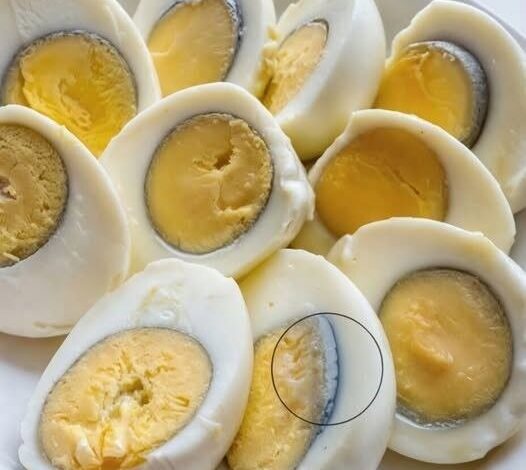
You carefully crack the shell of a hard-boiled egg, expecting the familiar sight of a firm white exterior wrapped around a bright golden yolk.
Everything seems normal at first.
Then you cut it open.
Suddenly, something doesn’t look right.
Encircling the yolk is a strange greenish-gray ring, a discoloration that immediately raises alarm bells. The vibrant yellow center you expected has been replaced by what looks like a warning sign from nature itself.
You pause.
Is the egg spoiled?
Did it somehow go bad during cooking?
Could it make you sick?
For many people, the discovery is enough to ruin breakfast.
Some immediately throw the egg into the trash. Others begin searching the internet for answers. A few convince themselves they’ve accidentally created something unsafe to eat.
The unusual color certainly doesn’t inspire confidence.
After all, when food turns green or gray, that’s usually not a good sign.
But in this case, appearances are deceiving.
The mysterious ring surrounding the yolk is not mold.
It isn’t evidence of spoilage.
And despite its somewhat unsettling appearance, it poses no health risk whatsoever.
In fact, this strange discoloration is one of the most common kitchen mysteries people encounter—and one of the most misunderstood.
The real explanation has nothing to do with freshness or contamination.
Instead, it comes down to a surprisingly simple chemical reaction that occurs when eggs spend too much time exposed to heat.
Understanding why it happens not only removes the worry but can also help you consistently make picture-perfect hard-boiled eggs every time.
At first glance, boiling eggs seems almost impossible to get wrong.
Compared to complicated recipes involving multiple ingredients and precise measurements, hard-boiled eggs appear refreshingly simple.
Place eggs in water.
Turn on the stove.
Wait.
Peel.
Eat.
What could be easier?
Yet anyone who has spent time in the kitchen knows that achieving the perfect hard-boiled egg is surprisingly delicate.
A difference of only a few minutes can dramatically alter the outcome.
Too little cooking leaves the center soft and underdone.
Too much cooking transforms the yolk into a dry, crumbly texture and often creates that infamous green ring.
The frustrating part is that many people don’t even realize they’ve overcooked the eggs.
The difference between a flawless yolk and a discolored one can be surprisingly small.
The science behind the discoloration begins inside the egg itself.
Although eggs appear simple from the outside, they contain a complex mixture of naturally occurring compounds.
The yolk contains iron.
The white contains sulfur.
Normally, these substances remain separate and unnoticed.
However, when eggs are exposed to excessive heat for too long, something interesting happens.
The sulfur in the egg white begins reacting with the iron found in the yolk.
As these compounds interact, they form a new substance known as iron sulfide.
It is this iron sulfide that creates the greenish-gray ring visible around the outer edge of the yolk.
The longer the egg remains exposed to high temperatures, the more likely the reaction becomes.
This means the discoloration isn’t actually a sign that anything is wrong.
It’s simply chemistry at work.
A harmless reaction.
Nothing more.
Many people are surprised to learn that egg freshness has virtually nothing to do with the appearance of the ring.
Fresh eggs can develop it.
Older eggs can develop it.
Organic eggs can develop it.
Store-bought eggs can develop it.
The determining factor isn’t age.
It’s heat.
More specifically, too much heat for too long.
The same process responsible for the green ring also explains another familiar characteristic of overcooked eggs.
That strong sulfur smell.
Almost everyone has encountered it at some point.
You peel an egg and immediately notice an odor reminiscent of sulfur or even rotten eggs.
While unpleasant, this smell is also harmless.
It simply indicates that the proteins and sulfur compounds inside the egg have been exposed to prolonged heat.
In essence, the green ring and the sulfur smell are two symptoms of the same cooking mistake.
Fortunately, both problems are incredibly easy to avoid once you understand what causes them.
The secret begins before the stove is even turned on.
Many professional chefs and experienced home cooks recommend starting with cold water rather than dropping eggs directly into boiling water.
This approach allows the eggs to warm gradually.
The temperature rises more evenly, reducing stress on the shells and minimizing the chances of cracking during cooking.
It may seem like a minor detail, but it can significantly improve consistency.
Once the eggs are placed in a pot and covered with cold water, patience becomes important.
Many people make the mistake of cranking the burner to maximum heat in an effort to speed things up.
While understandable, this often creates unnecessary problems.
Violent boiling causes eggs to bounce around inside the pot.
They collide with one another.
They strike the sides.
Cracks become more likely.
A gentler approach typically produces much better results.
Bring the water to a controlled boil rather than a rolling frenzy.
Then comes the step that many people overlook.
Once the water reaches a boil, you don’t necessarily need to keep boiling the eggs aggressively.
In fact, many cooking experts recommend turning off the heat altogether.
Simply cover the pot and allow the eggs to remain in the hot water.
The residual heat continues cooking them more gently and evenly than constant boiling.
This method dramatically reduces the risk of overcooking.
Timing then becomes the key factor.
For those who prefer slightly creamy centers, approximately nine minutes often works well.
For fully cooked yolks that are firm but still vibrant and smooth, around twelve minutes is usually ideal.
Beyond that point, the chances of developing the green ring increase significantly.
Every extra minute matters.
Many people unknowingly leave eggs in hot water while attending to other tasks.
A quick distraction can become fifteen extra minutes.
By then, the damage is already done.
Yet even perfect timing is only part of the solution.
The next step may be even more important than the cooking itself.
Cooling.
The moment the eggs finish cooking, they should be transferred into ice water or extremely cold water.
This process immediately stops the cooking reaction.
Without rapid cooling, eggs continue cooking internally long after they have been removed from the stove.
The residual heat trapped inside the shell keeps working.
In many cases, this hidden extra cooking time is what ultimately produces the green ring.
An ice bath acts like an emergency brake.
It halts the cooking process before the iron-sulfur reaction can continue developing.
The benefits don’t stop there.
Cooling also makes peeling dramatically easier.
Anyone who has spent ten frustrating minutes picking tiny shell fragments from a hard-boiled egg understands the struggle.
Sometimes half the egg white seems determined to come off with the shell.
Rapid cooling helps separate the egg from its inner membrane, making peeling smoother and more efficient.
A simple bowl of ice water can save both time and frustration.
Experienced home cooks often have additional tricks as well.
One popular tip involves using eggs that aren’t perfectly fresh.
Although freshness is generally desirable in most situations, eggs that are a few days old often peel more easily than eggs laid very recently.
This occurs because the internal chemistry changes slightly as the egg ages.
The membrane loosens, reducing its tendency to cling stubbornly to the white.
Other cooks swear by adding a small amount of vinegar or salt to the cooking water.
These ingredients won’t prevent the green ring directly, but they can help reduce mess if a shell cracks during cooking.
Storage also plays an important role in maintaining quality.
Hard-boiled eggs are popular because they can be prepared ahead of time and enjoyed throughout the week.
When left unpeeled, they generally remain fresh in the refrigerator for about seven days.
The shell acts as a natural protective barrier.
Once peeled, however, eggs should be eaten sooner to preserve both flavor and texture.
What makes the green ring so fascinating is how dramatically it affects perception.
Humans are naturally cautious about unusual colors in food.
A golden yolk feels familiar.
A green-gray yolk feels suspicious.
Even though the egg remains perfectly safe, our instincts tell us something must be wrong.
That reaction is understandable.
Throughout history, unusual colors often served as warning signs of spoilage or contamination.
Our brains learned to pay attention.
In this particular case, however, the warning is false.
The discoloration isn’t signaling danger.
It’s simply revealing a bit of chemistry.
No bacteria.
No toxins.
No hidden threat.
Just iron and sulfur combining under prolonged heat.
Once you understand the science, the mystery disappears.
What initially looks alarming becomes completely ordinary.
And perhaps that’s the most satisfying part.
A problem that seems complicated turns out to have a remarkably simple explanation.
The next time you slice open a hard-boiled egg and notice that green ring, you’ll know exactly what happened.
And if you’d rather avoid it altogether, the solution is equally simple.
Start with cold water.
Avoid excessive cooking times.
Cool the eggs immediately when they’re done.
That’s it.
No complicated techniques.
No expensive equipment.
Just a few small adjustments that make a big difference.
Because sometimes the line between a disappointing hard-boiled egg and a perfectly golden one isn’t measured in ingredients or skill.
It’s measured in a handful of minutes—and a bowl full of ice water.