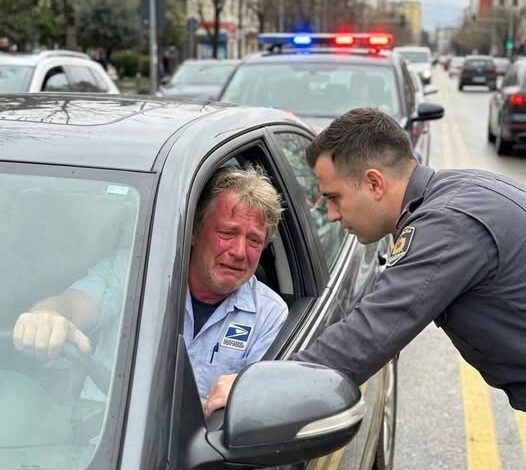
The speeding driver looked terrified.
Not angry.
Not reckless.
Terrified.
When I approached the vehicle that afternoon, I expected the usual explanations. Over the years, I’d heard them all. People claimed they were late for work, rushing to an appointment, or simply not paying attention. Most drivers had a reason for speeding, but few had one that truly justified it.
This felt different.
The man’s hands trembled as he gripped the steering wheel.
His eyes were red.
His breathing was shallow.
Before I could even begin asking questions, he blurted out the reason he was driving so fast.
“My daughter is in the hospital,” he said. “She’s having complications. They’re not sure what’s happening. I just need to get there.”
For a moment, neither of us spoke.
Traffic rushed past us on both sides of the highway.
The afternoon sun reflected off hundreds of vehicles packed tightly together in bumper-to-bumper congestion.
I looked at the man.
Then I looked at the road ahead.
Even if I issued no citation and let him continue, there was a good chance he would remain trapped in traffic for quite some time.
And judging by the fear on his face, every minute felt unbearable.
I returned to my patrol vehicle and contacted dispatch.
After explaining the situation and receiving authorization, I made a decision.
Instead of simply sending him on his way, I instructed him to stay close behind my patrol car.
“We’ll get you there,” I said.
The relief that crossed his face was immediate.
Within minutes, I activated my emergency equipment and coordinated with dispatch as we carefully worked through the heavy traffic.
Drivers moved aside as the lights flashed.
Vehicles shifted lanes.
The crowded highway slowly opened.
Behind me, the father followed closely, never taking his eyes off my patrol vehicle.
The mission was simple.
Help a worried father reach his daughter.
Nothing more.
Nothing less.
As we traveled, I found myself wondering about the young woman waiting at the hospital.
What condition was she in?
How serious were the complications?
Would her father arrive in time?
Questions filled my mind, but there was no way to know the answers.
All I could do was keep moving forward.
Eventually, the hospital came into view.
I led him to the entrance and pulled to the curb.
Before I could say anything, he jumped out of the vehicle.
“Thank you,” he said quickly.
Then he was gone.
Running through the hospital doors.
I watched him disappear inside before returning to my patrol car.
My shift wasn’t over.
There were calls waiting.
Reports to finish.
Traffic to monitor.
Yet I couldn’t stop thinking about what was happening inside that building.
I sat there for a few moments, preparing to leave.
Then someone knocked on my window.
A nurse stood outside.
I lowered the glass.
What she told me next made everything suddenly feel much more real.
She explained that the man’s daughter—Emily—had been experiencing serious complications.
The medical team was doing everything possible to stabilize her condition.
The situation had been frightening.
Uncertain.
Stressful for everyone involved.
But when her father arrived, something changed.
Not medically.
Emotionally.
The nurse smiled softly as she described it.
“Sometimes people need more than doctors,” she said.
They need family.
They need reassurance.
They need someone they trust standing beside them when they’re scared.
According to the nurse, Emily had been asking for her father repeatedly.
And because he arrived when he did, he was able to be there during one of the most difficult moments of her life.
The nurse thanked me.
Not for saving anyone.
Not for performing some heroic act.
Simply for helping a father reach his daughter.
Before leaving, she asked if I would like to briefly meet the family.
Normally, I would have politely declined.
But something told me I should go.
A few minutes later, I found myself standing quietly in a recovery room.
The atmosphere was completely different from the panic of the highway.
Everything felt calm.
Peaceful.
Almost sacred.
Emily rested in bed, looking exhausted but relieved.
Beside her stood her father.
And in his arms was a newborn baby.
For a moment, nobody spoke.
The room seemed filled with a kind of gratitude that words couldn’t fully capture.
Emily smiled when she saw me.
“Thank you for helping him get here,” she said softly.
The father nodded in agreement.
But his attention kept drifting back to the tiny child sleeping peacefully in his arms.
Like many new grandparents, he appeared completely overwhelmed.
Relief.
Joy.
Gratitude.
Wonder.
All mixed together.
Hours earlier, he had been speeding down a crowded highway consumed by fear.
Now he stood holding a new life.
The contrast was remarkable.
The complications hadn’t magically disappeared.
The family still faced challenges.
But a healthy baby had arrived.
A father had made it to his daughter.
And a family was together when they needed each other most.
Eventually, I excused myself and returned to my patrol vehicle.
As I drove away, I found myself reflecting on the experience.
People often imagine public service as dramatic rescues and life-or-death emergencies.
Sometimes it is.
Sometimes there are moments that make headlines.
Moments filled with danger, courage, and urgency.
But most service looks different.
Most of it happens quietly.
One decision at a time.
One interaction at a time.
One person at a time.
Enforcing laws matters.
Following procedures matters.
Protecting public safety matters.
Those responsibilities exist for good reason.
But occasionally, situations require something else.
Judgment.
Compassion.
The ability to see the human story behind the circumstances.
That day, I didn’t deliver a baby.
I didn’t perform surgery.
I didn’t solve every problem that family faced.
The doctors and nurses carried the heaviest burden.
The parents carried the deepest emotions.
The family carried the greatest responsibility.
My role was much smaller.
I simply helped a father reach his daughter.
Yet somehow, that small act mattered.
Because timing matters.
Presence matters.
Being there matters.
Sometimes the greatest gift we can offer another person isn’t a solution.
It’s an opportunity.
An opportunity to show up.
An opportunity to hold someone’s hand.
An opportunity to stand beside the people who need us most.
Long after the details of that shift faded, one image remained clear in my mind.
A grandfather holding his grandchild for the first time.
A daughter looking relieved because her father had arrived.
A family sharing a moment they would remember forever.
That is what service is really about.
Not recognition.
Not headlines.
Not praise.
It’s about helping people reach the moments that matter most.
Because sometimes you don’t change someone’s life by doing something extraordinary.
Sometimes you change it simply by helping them arrive exactly where they’re needed.
And on that afternoon, that was more than enough reason to wear the uniform.