My Boss Publicly Embarrassed Me for Helping a Hungry Girl—Then Her Father Walked In Looking for Me

Vera Sullivan never imagined that a five-dollar breakfast could cost her job.
She certainly never imagined it would change her life.
The trouble started on an ordinary Tuesday morning at Waverly Diner.
The breakfast rush was in full swing. Plates clattered, coffee poured endlessly, and waitresses hurried between crowded tables carrying stacks of pancakes and steaming mugs.
Vera had worked there for nearly twelve years.
She knew most customers by name.
She knew who wanted extra cream in their coffee, who always ordered rye toast, and who preferred the corner booths near the windows.
She also knew the little girl in the yellow jacket.
The child appeared several mornings each week.
Always alone.
Always quiet.
Always carrying a handful of carefully counted coins.
She never ordered much.
Usually an egg sandwich and a small glass of juice.
Nothing more.
Vera had noticed long ago that the girl often came up short.
A dollar here.
Fifty cents there.
Sometimes enough to matter.
Sometimes enough to leave the child staring anxiously at the menu before settling for something cheaper.
On those mornings, Vera quietly covered the difference.
She never made a show of it.
Never mentioned it.
Never expected anything in return.
To her, it was simply the right thing to do.
But on this particular morning, her manager noticed.
And he wasn’t pleased.
“Vera!”
The sharp voice cut through the diner.
Conversations stopped.
Forks paused halfway to mouths.
Every head seemed to turn.
Vera froze.
Her manager stood near the register, holding a receipt.
His face was red.
His voice was loud enough for everyone to hear.
“Are you giving away food again?”
The room fell silent.
In the corner booth, the little girl shrank into her seat.
Embarrassment flooded her face.
Vera immediately understood what had happened.
The manager waved the receipt.
“This diner is a business, not a charity.”
Several customers looked uncomfortable.
Others stared openly.
The little girl lowered her eyes.
Vera felt her heart sink.
Not because she was being scolded.
Because the child was hearing every word.
“She was hungry,” Vera said quietly.
The manager scoffed.
“Then someone else can feed her.”
A few uncomfortable seconds passed.
Then he issued a formal warning in front of everyone.
One more incident.
One more free meal.
And she could lose her job.
The humiliation lingered long after the breakfast crowd left.
Yet Vera couldn’t stop thinking about the little girl.
About the way she had stared at the table.
About the shame in her eyes.
That night, Vera made a decision.
If necessary, she would pay for every meal herself.
No child should feel unwelcome because they were hungry.
The next morning she arrived early.
And waited.
She watched the door.
Every time it opened, she glanced up.
Expecting to see the familiar yellow jacket.
But the girl never came.
Hours passed.
The breakfast crowd thinned.
Lunch approached.
Still nothing.
By afternoon, concern had replaced disappointment.
What if something had happened?
What if she had been too embarrassed to return?
The thought weighed heavily on Vera.
Then, shortly after noon, something unusual happened.
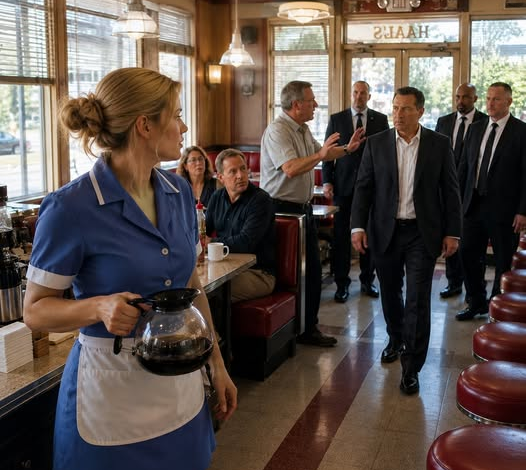
A sleek black SUV pulled into the parking lot.
Then another.
Several sharply dressed men stepped out.
Conversations immediately slowed.
Customers turned toward the windows.
A distinguished man emerged from the lead vehicle.
His presence seemed to command attention without effort.
He entered the diner and surveyed the room.
Silence spread quickly.
Then he spoke.
“I’m looking for Vera Sullivan.”
Every eye landed on her.
Confused, Vera slowly stood.
“I’m Vera.”
The man studied her carefully.
Then a faint smile crossed his face.
“I hoped it would be you.”
Nobody understood what was happening.
Least of all Vera.
The stranger stepped closer.
“My name is Nathan Fraser.”
The name instantly sparked recognition.
Nathan Fraser was one of the city’s most successful business leaders.
His companies employed thousands.
His philanthropic work was widely known.
Yet what he said next stunned everyone.
“My daughter has been coming here for several weeks.”
The room grew even quieter.
Vera’s pulse quickened.
“The girl in the yellow jacket?”
Nathan nodded.
“Emily.”
He reached into his jacket and removed a folded piece of paper.
Carefully, he unfolded it.
“This is the first letter my daughter has written voluntarily in years.”
His voice softened.
The entire diner listened.
Nathan explained that after the death of his wife, Emily had withdrawn almost completely from the world.
Therapists tried to help.
Doctors tried to help.
Family members tried to help.
Nothing seemed to reach her.
She rarely spoke.
Rarely smiled.
Rarely connected with anyone.
Then she started visiting Waverly Diner.
And something changed.
Nathan handed Vera the note.
Written in uneven handwriting were a few simple sentences.
Thank you for always being kind to me.
Thank you for talking to me.
Thank you for making me feel welcome.
I like coming here because you make me feel important.
Tears instantly filled Vera’s eyes.
Around the diner, several customers quietly wiped their own.
Nathan smiled gently.
“You may think you were serving breakfast.”
He paused.
“But you were giving my daughter something nobody else could.”
“Hope.”
For a moment, nobody spoke.
Then the manager suddenly stepped forward.
A nervous smile spread across his face.
“Well, we’ve always encouraged our staff to take special care of customers—”
Nathan cut him off immediately.
“No.”
The single word landed like a hammer.
The manager fell silent.
Nathan’s expression remained calm.
“I’ve already spoken to multiple employees.”
The room stiffened.
“I know exactly how Vera was treated.”
The manager’s face lost color.
And before he could respond, the diner door opened.
Everyone turned.
There she was.
The yellow jacket.
Emily.
She hesitated only briefly before walking inside.
Then, for the first time, she crossed the diner directly toward Vera.
No hesitation.
No fear.
No uncertainty.
She stopped beside her.
Looked up.
And smiled.
A real smile.
The kind her father hadn’t seen in years.
“Do you still have egg sandwiches?” she asked softly.
Vera laughed through tears.
“Always.”
Emily nodded.
“Good.”
Then she did something nobody expected.
She hugged her.
The entire diner watched in silence.
Some moments are too genuine for applause.
This was one of them.
A month later, Nathan approached Vera with an opportunity.
With his support and investment, she opened a small café of her own.
A place built on the values she had always believed in.
No child would ever be turned away.
No one would be shamed for needing help.
No customer would be made to feel invisible.
The café quickly became one of the community’s favorite gathering places.
But the business wasn’t the greatest success story.
Emily was.
Over time, she found her voice.
Her confidence.
Her sense of belonging.
She began talking more.
Laughing more.
Living more.
And through it all, she never stopped visiting Vera.
Years later, customers still asked how the café began.
Vera always smiled before answering.
Because the truth sounded almost too simple.
It started with a hungry little girl.
A breakfast sandwich.
And a decision to choose kindness when it would have been easier not to.
What began as a public humiliation became a new beginning.
For Vera.
For Emily.
And for countless others who eventually walked through the doors of a café built on one simple belief:
Sometimes the smallest acts of kindness create the biggest changes.
And sometimes, all it takes to change a life is making someone feel seen.