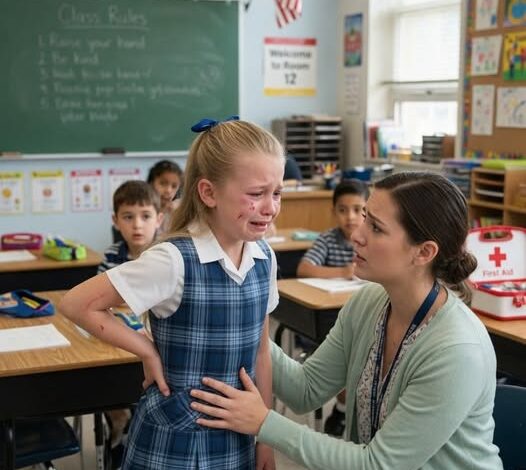
At exactly 8:53 on a cold gray October morning, second-grade teacher Valerie Kincaid noticed something that nearly every other adult in that building could have overlooked.
A seven-year-old girl named Lila Mercer was not crying.
She was not screaming.
She was not asking for help.
She was not behaving in any way that would immediately alarm most people.
Instead, she was doing something far more dangerous.
She was trying very hard to appear normal.
To an outsider, Lila simply looked quiet and tired. Children arrived at school exhausted all the time. Some came sleepy. Some came withdrawn. Some carried moods they couldn’t explain.
But Valerie had spent twelve years teaching second grade, and experience had taught her something important:
Children often speak long before they use words.
Sometimes pain appears in posture.
Sometimes fear appears in silence.
Sometimes suffering hides inside the careful movements of a child trying not to inconvenience anyone.
That morning, Lila stood from her desk slowly, placing one trembling hand against the edge as though she needed permission from her own body to move.
Her smile came too quickly.
Her steps were too careful.
Her face looked too pale beneath the fluorescent classroom lights.
The room had been noisy only moments before.
Pencils rolled across desks.
Backpacks dropped against chairs.
Children argued over crayons and breakfast snacks.
Then something changed.
Valerie walked toward Lila instinctively.
“Are you feeling okay this morning?” she asked gently.
Lila looked up immediately and answered with a sentence that would later spread across social media, divide parents, and ignite national arguments about schools, families, and child protection.
“I’m fine, Ms. Kincaid,” she whispered softly. “I just need to sit up straight.”
At first glance, the sentence sounded harmless.
But there are moments when something inside another human being recognizes danger before logic catches up.
Valerie didn’t fully understand why her chest tightened after hearing those words.
She only knew one thing:
That little girl was trying too hard to sound okay.
Only minutes later, Lila’s math papers slipped from her hands and scattered across the classroom floor.
Before anyone fully understood what was happening, her knees buckled beneath her.
Valerie caught her before her body struck the tile.
The classroom fell completely silent.
Not ordinary silence.
The terrible kind.
The kind that arrives when children suddenly realize something frightening is happening and look to adults for clues about whether they should panic.
Twenty second graders watched their teacher kneeling on the floor beside a little girl whose body had finally stopped pretending it could continue.
The school nurse was called immediately.
The principal was notified.
Within minutes, the hallway outside Room 204 filled with whispers before any official report had even been written.
Inside the nurse’s office, fluorescent lights cast a cold glow over everything.
Lila lay on the paper-covered cot staring silently at the ceiling.
Her pulse was irregular.
Her blood pressure was low.
Her tiny fingers twisted tightly around the blanket in her lap.
At first, the nurse assumed dehydration.
That explanation was easier.
Safer.
Adults prefer simple explanations because simple explanations allow everyone to breathe again.
But then Lila quietly said something that changed the entire atmosphere inside the room.
“My dad said it wouldn’t hurt,” she whispered. “But it does.”
The nurse stopped writing instantly.
Years later, Valerie would still remember the exact sound of the fluorescent lights buzzing overhead after those words left Lila’s mouth.
Nobody screamed.
Nobody panicked.
Nobody started making accusations.
That’s the part many people online later failed to understand.
Real fear rarely arrives dramatically.
It enters quietly.
Through a child gripping a blanket too tightly.
Through hesitation before answering simple questions.
Through an adult realizing their instincts are screaming louder than the evidence in front of them.
When the nurse gently asked where Lila was hurting, the little girl looked toward the closed office door first.
Then she stayed silent.
That glance alone was enough.
By lunchtime, mandatory reports had been filed.
By dismissal, rumors had already spread through the parent pickup line.
And by dinner that evening, social media exploded after someone posted that “a teacher saved a child because she noticed what everyone else ignored.”
Within hours, thousands of strangers were arguing online about a child they had never met.
Some praised Valerie as a hero.
Others accused the school of interfering in private family matters.
Some insisted teachers were becoming too involved in children’s personal lives.
And beneath all of those arguments sat one uncomfortable question:
How many signs should adults ignore before action becomes necessary?
The school district released a carefully worded statement the next morning confirming only that staff had followed child safety procedures after concerns involving a student’s wellbeing.
No names were mentioned publicly.
No details were released.
That restraint did absolutely nothing to stop the internet.
Comment sections filled instantly.
Parents argued.
Teachers shared stories.
Former nurses explained mandatory reporting laws.
Political commentators transformed the situation into a cultural debate within hours.
One mother wrote that teachers spend enough time around children to notice changes many parents might miss.
Another parent responded angrily that schools were becoming too intrusive and treating ordinary parenting like criminal behavior.
A retired pediatric nurse commented beneath both arguments:
“Mandatory reporting is not punishment. It is a request for trained professionals to investigate concerns before a child’s suffering becomes irreversible.”
That comment alone was shared tens of thousands of times.
But almost immediately, the story stopped being about Lila.
That was the tragedy.
People turned her pain into a battlefield for their opinions.
Some defended parental rights.
Others defended schools.
Others demanded harsher investigations.
Others demanded schools “mind their business.”
Meanwhile, the actual child disappeared beneath the noise.
Valerie never joined the public conversation.
She didn’t post statements.
Didn’t grant interviews.
Didn’t defend herself online.
The following Monday she simply returned to Room 204 and taught spelling lessons to nineteen students who kept glancing toward one empty desk.
Lila’s desk.
Her pale blue cardigan still hung quietly inside her cubby.
Nobody moved it.
Teachers didn’t know whether removing it would feel more painful than leaving it there.
Children began asking questions carefully.
“Is Lila sick?”
“Is she coming back?”
“Did she go to the hospital?”
Valerie answered only what she safely could.
“She’s being cared for.”
“She’s safe right now.”
“We’re going to keep being kind.”
Those answers were true.
But they weren’t enough to remove the heaviness inside the classroom.
By Wednesday, several parents complained their children felt frightened after hearing rumors.
By Thursday, other parents thanked the school for paying attention to warning signs.
By Friday, the school board’s voicemail was overflowing.
Because the truth is, stories like this force adults to confront something deeply uncomfortable:
Most warning signs do not arrive dramatically.
They arrive quietly.
Through posture.
Through exhaustion.
Through children trying too hard to seem okay.
That’s why Lila’s story unsettled so many people.
It didn’t begin with bruises publicly displayed.
It didn’t begin with screaming.
It began with a child carefully lowering herself into a chair.
And a teacher deciding not to dismiss what her instincts recognized.
For years, teachers have said society asks them to become far more than educators.
They are counselors.
Nurses.
Emotional first responders.
Social workers.
Protectors.
Many parents praise educators for those roles until intervention touches someone’s private home.
Then praise quickly turns into suspicion.
The controversy surrounding Valerie Kincaid exposed a truth many people prefer avoiding:
Society claims it wants children protected.
But many adults become deeply uncomfortable when protection requires questioning another adult’s behavior.
That discomfort fuels silence.
And silence survives in ordinary places.
Neighbors avoid conflict.
Relatives avoid scandal.
Teachers fear being wrong.
Institutions fear lawsuits.
Children learn these patterns early.
They learn which subjects make adults tense.
They learn which truths create cold rooms.
They learn how to smile so grown-ups stop asking questions.
That’s what made Lila’s sentence so devastating.
“My dad said it wouldn’t hurt.”
It sounded less like spontaneous honesty and more like something rehearsed for survival.
Investigators later handled facts privately, as they should have.
The public never deserved access to every detail.
But the visible outline alone was enough to disturb anyone paying attention.
A child arrived at school hurting.
A teacher noticed.
Adults followed procedure.
And society immediately began debating whether noticing itself had been inappropriate.
That reaction says something deeply troubling about modern culture.
Why are people often more disturbed by intervention than by the possibility a child needed intervention?
Why do adults demand impossible certainty before offering protection to children who may not even understand how to explain their own fear?
Critics online insisted false accusations can destroy families.
They were correct.
False accusations absolutely matter.
Due process matters too.
But mandatory reporting laws exist because children are not responsible for building legal cases before adults help them.
Teachers are not investigators.
School nurses are not judges.
Their responsibility is not proving guilt.
Their responsibility is recognizing concern early enough that waiting does not become irreversible.
That difference matters enormously.
It is the difference between caution and neglect.
It is also the difference between protecting reputations and protecting children.
The most widely shared post about the incident came from another local parent who wrote:
“Valerie saw the sentence Lila’s body was writing before Lila could say it aloud.”
The wording sounded dramatic.
But people shared it because they understood the terrifying truth hidden inside it.
Everyone fears missing something important until it’s too late.
Still, backlash continued.
Some accused schools of becoming surveillance systems.
Others insisted family matters should remain private no matter what.
Teachers across the country began sharing their own experiences online.
Stories flooded social media about children arriving hungry, bruised, terrified, exhausted, withdrawn, or desperate not to go home.
Some stories ended safely.
Others didn’t.
One teacher wrote something that resonated painfully with thousands of educators:
“The hardest part isn’t seeing warning signs. The hardest part is wondering whether the signs are enough to risk being hated for reporting them.”
That sentence revealed the emotional trap adults face.
If they report concerns and are wrong, they may be criticized.
If they stay silent and are right, a child may continue suffering.
Between those possibilities, morality should feel simple.
But courage rarely does.
Valerie’s coworkers later described her as calm, observant, and quietly compassionate.
She remembered birthdays.
Kept spare mittens for students during winter.
Could calm classrooms without raising her voice.
Nothing about her looked dramatic.
That’s what made her credible.
Because heroism in real life rarely looks cinematic.
Sometimes it looks like paperwork.
Patience.
Observation.
And refusing to dismiss discomfort simply because action feels inconvenient.
The nurse became equally important to the story.
She didn’t pressure Lila aggressively.
Didn’t demand dramatic disclosures.
Didn’t panic.
Instead, she created enough safety for one frightened sentence to become the beginning of help.
That’s something trained professionals understand deeply:
Children rarely reveal suffering through perfect explanations.
Truth leaks out slowly.
Through fragments.
Through hesitation.
Through body language.
Adults must learn how to hear fragments without demanding performances.
Because the painful reality is this:
Society often waits until children’s suffering becomes undeniable before finally believing them.
By then, warning signs have often existed for months.
Lila’s classmates didn’t know the entire story.
But they understood enough to feel its shadow.
Children became quieter around her desk.
One student asked if someone could save her artwork from the drying rack.
Another left a purple crayon inside her desk because purple had been her favorite color.
Valerie found the crayon after dismissal and sat down crying alone in the empty classroom.
Because that small gesture reminded her of something adults online kept forgetting:
Lila was not a political argument.
She was seven years old.
She liked library day.
Purple crayons.
Drawing houses with oversized chimneys and blue skies.
She was not a symbol for debates about government overreach.
She was simply a child whose body had asked for help before her voice fully could.
The district later announced expanded staff training for recognizing signs of distress in young students.
Some praised the decision.
Others mocked it publicly.
Both reactions probably contained pieces of truth.
Training alone cannot prevent every tragedy.
But attention without training can become panic, and panic rarely protects children effectively.
The strongest child protection begins not with suspicion, but with literacy.
Adults must become fluent in the quiet language of children who have learned honesty can feel dangerous.
That language includes:
Perfection.
Withdrawal.
Unexplained pain.
Fear at dismissal time.
Children insisting they are “fine” while struggling simply to stand.
The reason Lila’s story spread nationally was because it destroyed a comforting myth.
People want to believe harm announces itself loudly enough that only careless adults miss it.
But reality is far more frightening.
Pain can exist in clean homes.
In respected families.
In ordinary neighborhoods.
Danger does not always look chaotic.
Sometimes danger sends a child to school in a pale blue cardigan and teaches her how to smile through pain.
That image stayed with people because it felt so ordinary.
And ordinary suffering is exactly what society ignores most effectively.
By the time parenting blogs and national media pages began discussing the story, public opinion had divided sharply.
Some insisted teachers should always be trusted.
Others argued schools were gaining too much authority.
But a quieter group asked a more important question:
Why are those ideas treated like enemies?
A healthy society can value parental rights while still protecting children.
A healthy society can respect privacy without turning privacy into silence.
A healthy society can admit adults make mistakes while refusing to make children pay for adult hesitation.
That balance is difficult.
But necessary.
No reasonable person wants schools treating every family suspiciously.
But no ethical society should require children to provide courtroom-level proof before adults respond to possible danger.
Between those extremes lies the difficult work of care.
Imperfect.
Messy.
Uncomfortable.
Still infinitely better than silence.
Valerie’s report didn’t magically solve everything.
One intervention never does.
Healing happens slowly.
Quietly.
Away from headlines and internet debates.
Inside counseling offices.
Safe routines.
Medical appointments.
Gentle adults who don’t demand gratitude from hurting children.
That privacy matters deeply.
Because while the internet often consumes tragedy as entertainment, children are not public property simply because their pain teaches adults something important.
The ethical question was never whether the story deserved discussion.
It absolutely did.
The ethical question was whether discussion kept the child’s wellbeing at the center instead of turning her suffering into content.
Valerie understood that instinctively.
When reporters approached her outside school, she declined interviews.
When parents praised her publicly, she redirected attention toward student safety procedures and school staff.
And when someone called her a hero, she reportedly answered:
“I simply did what I was supposed to do.”
That answer disappointed people wanting drama.
But it revealed the deeper truth.
Protecting children should never require heroism.
It should be ordinary.
Expected.
Automatic.
And yet ordinary protection still feels radical inside cultures trained to avoid uncomfortable truths.
People look away from warning signs constantly.
From exhausted children.
From frightened teenagers.
From neighbors shouting through thin apartment walls.
Adults often look away until looking away becomes impossible.
Then society asks afterward:
“How did nobody notice?”
Lila’s story hurts because someone did notice.
Not because they had proof.
Because they had concern.
Valerie chose concern over comfort.
That decision became the moral center of the entire story.
Not outrage.
Not gossip.
Not social media arguments.
A teacher simply choosing responsibility over convenience.
And perhaps that’s the part people should remember most.
Because somewhere else, in another classroom, another child may already be sitting carefully in silence.
Smiling politely.
Repeating rehearsed explanations.
Trying desperately not to become “a problem.”
The question isn’t whether adults should panic.
They shouldn’t.
The question is whether someone will notice.
Whether someone will respond.
Whether someone will protect the child before protecting everyone else’s comfort.
Because sometimes the sentence that changes a life does not begin with screaming.
Sometimes it arrives quietly.
Softly.
Almost invisibly.
Sometimes it begins with:
“My dad said it wouldn’t hurt.”
And sometimes everything depends on whether one adult understands that “I’m fine” was never really the truth at all.