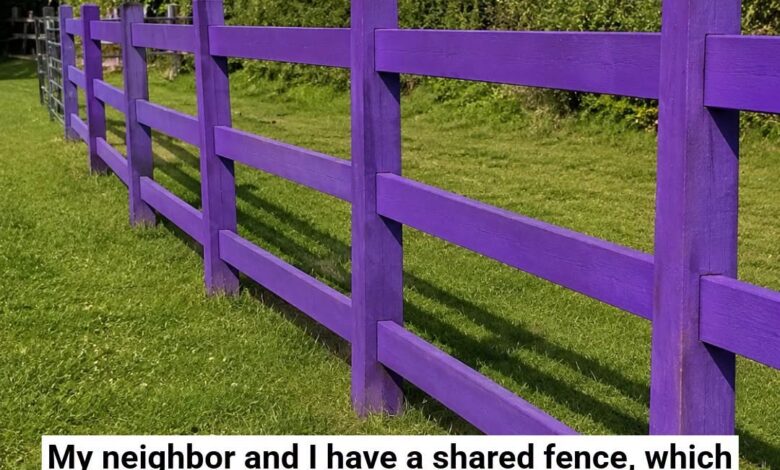
At first glance, it looks almost random.
A single stripe of bright purple paint appears on a tree trunk or stretches down the post of an old fence. There’s no written message, no warning, and no explanation—just a bold splash of color standing out against bark or weathered wood.
Many people assume it’s leftover paint from a construction project, a property marker, or even a decorative touch.
In many parts of the United States, however, that simple purple mark carries a very specific meaning.
It can be the legal equivalent of a “No Trespassing” sign.
Rather than hanging signs that can fade, blow away, rust, or be removed, many property owners use purple paint to communicate a clear message: this is private property, and entry is not permitted without permission.
The system may seem unusual, but it was created for practical reasons.
Traditional signs require regular replacement. Wind can tear them down. Sunlight can bleach the lettering until it’s unreadable. Curious visitors—or determined trespassers—may even remove them entirely.
Paint, on the other hand, is much harder to ignore.
Applied directly to trees, fence posts, or other permanent structures, it remains visible through changing seasons, heavy rain, strong winds, and years of weather.
With only a few brushstrokes, landowners can mark large stretches of property without worrying about replacing damaged signs every few months.
The markings themselves generally follow state guidelines where these laws exist.
Although the exact requirements vary, the paint is often applied as a vertical stripe placed at approximately eye level and repeated at regular intervals along the property boundary. This consistent pattern allows someone approaching the land to recognize that they are crossing into a privately owned area.
From a distance, the forest or field may appear open and inviting.
The purple paint quietly says otherwise.
One reason these markings surprise so many people is that they don’t look official.
There are no bold capital letters.
No warning symbols.
No legal language.
Just a stripe of color.
Yet in states that recognize purple paint laws, those simple marks can carry the same legal weight as posted signs.
Ignoring them may lead to trespassing violations, fines, civil penalties, or even criminal charges, depending on local laws and the circumstances involved.
It’s important to remember, however, that purple paint laws are not nationwide.
Only certain U.S. states have adopted legislation recognizing purple paint as an official no-trespassing notice, and the details differ from one jurisdiction to another. Some states specify the exact dimensions of each stripe, the spacing between markings, and the surfaces on which they may be applied. Others have different requirements—or no purple paint law at all.
That means crossing a state line can completely change the meaning of the same painted tree.
In one location, it serves as a legally recognized property boundary.
In another, it may simply be leftover paint with no legal significance.
This difference is exactly what makes the markings so intriguing.
They appear informal, almost accidental.
But depending on where you are, they may represent a clear legal warning backed by state law.
For hikers, hunters, photographers, and anyone who enjoys exploring rural areas, understanding these markings can prevent uncomfortable—and potentially costly—situations.
A trail that seems public may actually lead toward private land.
An open field without fences may still have clearly marked boundaries.
A line of trees with purple stripes is often the owner’s quiet way of saying, “Please do not enter.”
Even when you’re unsure whether a particular state recognizes purple paint laws, the safest response is simple.
Treat the marking with respect.
If you see a clearly painted boundary and you’re uncertain about access, avoid crossing it unless you have permission from the property owner.
Doing so protects both you and the landowner from misunderstandings that could easily be avoided.
These markings are not meant to intimidate responsible visitors.
They exist to communicate ownership clearly, reduce accidental trespassing, and help prevent conflicts before they begin.
Sometimes the most effective warnings are also the quietest.
A single stripe of purple paint doesn’t shout.
It doesn’t need flashing lights or large signs to make its point.
It simply marks a boundary and asks that it be respected.
The next time you’re walking through the countryside and notice an unexpected streak of purple on a fence or tree, pause before taking another step.
It may look like nothing more than an odd splash of color.
But in the right place, it speaks with the full authority of the law—and listening to that silent message is often the wisest choice.