At first glance, a yellow ladybug almost looks like a mistake.
Most people expect the familiar bright red shell dotted with black spots, so when a tiny golden or lemon-colored ladybug lands nearby, it immediately catches the eye. It feels unusual enough that many people pause, wondering whether it carries a special message or symbolizes something beyond an ordinary insect.
That reaction is perfectly natural.
The unexpected has a way of making us pay closer attention, and the yellow ladybug has become one of those small encounters that many people remember long after it flies away.
Across different cultures and traditions, ladybugs have long been associated with good fortune, protection, and hope. Yellow varieties add another layer of interpretation. They are often seen as symbols of happiness, fresh beginnings, emotional healing, optimism, and the courage to embrace change. Some believe they appear during moments of personal transition, quietly encouraging people to release old worries and look toward new opportunities with confidence.
Whether those meanings come from folklore, personal belief, or simple coincidence, they resonate because they speak to something deeply human.
People naturally search for meaning in unexpected moments.
When a splash of bright yellow appears where you expected red, your brain immediately notices the difference. Psychologists describe this as our tendency to pay special attention to events that stand out from the ordinary. An unusual experience often feels more significant simply because it breaks our routine, making it easier to remember and more likely to inspire reflection.
In that sense, the yellow ladybug becomes more than just an insect.
It becomes a pause.
A reminder to slow down, look more carefully at the world around you, and appreciate the surprising details that often go unnoticed.
Yet the scientific explanation is every bit as fascinating as the symbolism.
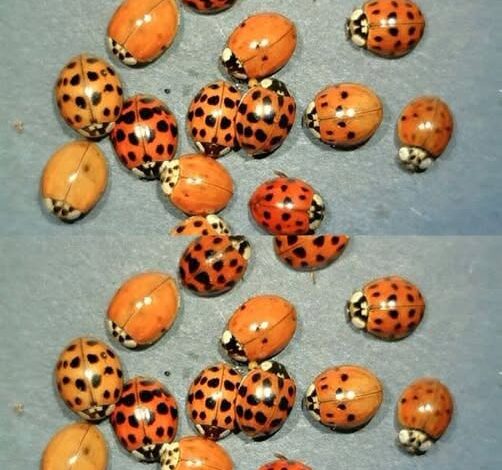
Yellow ladybugs are not rare mutations or magical creatures. They are entirely natural members of the Coccinellidae family, a diverse group that includes thousands of ladybug species found across the world. Their color is determined by genetics and species-specific characteristics rather than anything unusual or mysterious.
Some species are naturally yellow throughout their lives, while others display shades ranging from pale cream and golden yellow to rich orange. Their markings also vary widely. Some have black spots, others have faint patterns, and a few appear almost completely spotless.
This remarkable diversity reflects millions of years of evolution rather than chance.
Their bright colors serve an important biological purpose known as aposematic coloration, or warning coloration.
Instead of helping the insects hide, these vivid colors warn potential predators that the ladybug may taste unpleasant or release defensive chemicals if attacked. Birds, lizards, and other predators quickly learn to associate those bright colors with an unpleasant meal, making them less likely to attack in the future.
The yellow shell is therefore not simply attractive—it is part of an effective survival strategy.
Despite their striking appearance, yellow ladybugs are completely harmless to people.
They do not sting.
They do not spread diseases.
They are not interested in damaging your home or attacking humans.
Although a ladybug may occasionally give a tiny defensive nip if handled roughly, the sensation is usually mild and causes no lasting harm.
For gardeners, many yellow ladybug species are actually welcome visitors.
While the classic red ladybugs are famous for feeding on aphids, several yellow species specialize in something different. Some feed on powdery mildew, fungi, and other microscopic organisms that can damage flowers, vegetables, and ornamental plants.
By naturally controlling these problems, they help maintain healthier gardens without relying heavily on chemical treatments.
In other words, these tiny insects quietly perform valuable ecological work every day.
Their presence is often a sign of a balanced, healthy environment where natural relationships between plants, insects, and microorganisms continue to function as they should.
Seeing one in your yard can be a small reminder that nature is constantly working behind the scenes in ways we rarely notice.
Every flower bed, hedge, or patch of grass supports countless interactions that help keep ecosystems thriving.
The yellow ladybug is just one visible participant in that much larger story.
Because they are harmless and beneficial, the best response when you encounter one is simply to leave it alone.
Watch it for a moment.
Notice how carefully it explores a leaf, how its tiny legs move with surprising confidence, and how its wings disappear neatly beneath its colorful shell before it takes flight again.
Moments like these rarely last more than a few seconds, yet they often linger in memory because they interrupt the rush of everyday life.
Whether you see the yellow ladybug as a symbol of hope, renewal, and optimism or simply admire it as a remarkable example of evolutionary adaptation, both perspectives can exist comfortably together.
One speaks to human meaning.
The other speaks to biological reality.
Neither diminishes the other.
In fact, understanding the science often makes the experience even richer. Knowing that this tiny insect evolved its brilliant color over countless generations, plays an important role in protecting plants, and contributes to the health of local ecosystems only adds to the sense of wonder it inspires.
Sometimes the most extraordinary encounters come in the smallest forms.
A yellow ladybug may not arrive carrying a message from the universe, but it does offer something equally valuable: a brief opportunity to slow down, observe closely, and reconnect with the remarkable diversity that quietly surrounds us every day.
For a few moments, one tiny insect reminds us that nature is filled with surprises—beautiful, meaningful, and entirely real.