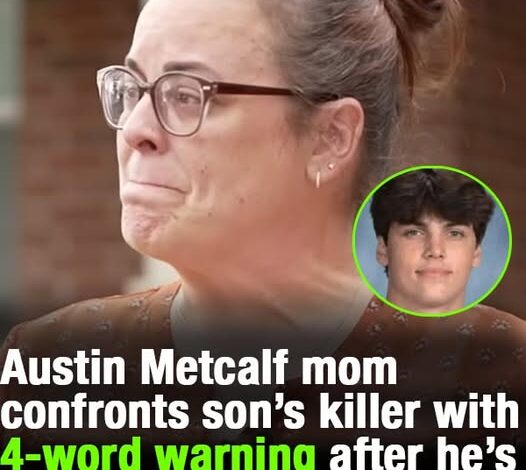
The courtroom was silent when Austin’s mother, Meghan, rose to speak. Not the ordinary silence of people waiting their turn, but the heavy kind—the kind that settles over a room when everyone understands that words are about to carry more weight than they were ever meant to bear.
She stood facing the young man convicted of taking her son’s life and, for a moment, seemed less like a witness at a sentencing hearing and more like a mother trying to explain the impossible.
Austin, she said, was never supposed to become a photograph framed on a mantel or a name etched into stone. He was supposed to be growing up. He was supposed to be filling the house with noise, leaving dishes in the sink, borrowing the car, and making plans for a future that now no longer existed.
Instead, she spoke of a bedroom frozen in time.
A bed that would never again be slept in.
Clothes hanging untouched in a closet.
A silence that had settled over her home and refused to leave.
She described how grief had altered the shape of everyday life. How ordinary moments—the kind most families never think twice about—had become painful reminders of everything that had been stolen. There would be no more birthdays, no graduation, no wedding day, no grandchildren. Every milestone she once imagined for her son now existed only in the painful space between memory and possibility.
“Austin was a hugger,” she told the court.
The words seemed simple, but they carried a lifetime behind them.
He was the teenager who pulled people together rather than pushing them apart. The friend who tried to make peace when tensions rose. The son who checked on people when they were hurting. The kind of young man who made others feel seen and valued.
As she spoke, her voice carried both heartbreak and determination. She refused to allow Austin to be reduced to a statistic or a case file. He was a person. He was her child.
Then she turned her attention to the defendant.
There was no screaming.
No dramatic outburst.
Just a devastating truth delivered with the clarity that only profound loss can create.
One day, she said, he would leave prison.
One day, he would walk outside, breathe free air, and have the opportunity to rebuild some version of a life.
She would not.
Her sentence had no release date.
No appeals process.
No possibility of parole.
The punishment she carried began the day her son died and would remain for the rest of her life.
No courtroom could change that.
No verdict could erase it.
No amount of time could undo what had happened.
When Austin’s father, Jeff, stood to speak, the room felt different.
His grief was no less profound, but it emerged in another form—steady, controlled, and deliberate.
He looked directly toward the defendant and spoke with a calmness that somehow made every word land harder.
Jeff accused him of lacking the courage to do something simple: look him in the eye.
He noted the contradiction that had haunted him throughout the proceedings. The young man had found the courage to commit an act of irreversible violence, yet now seemed unable to face the family whose lives he had shattered.
The observation hung in the room.
Not angry.
Not theatrical.
Just painfully honest.
Jeff then spoke about what the loss of Austin had done to him personally.
He admitted that his son’s death had destroyed the version of himself that existed before that day. The man he once was, the father who believed certain tragedies happened only to other families, no longer existed.
Grief had changed him.
It had changed the way he viewed the world.
The way he trusted people.
The way he measured time.
Everything now existed in two categories: before Austin died and after.
Yet despite carrying that pain, Jeff offered something few people in the courtroom expected to hear.
Forgiveness.
Not forgiveness for the act itself.
Not forgiveness that excused what had happened.
Not forgiveness that erased responsibility.
Instead, he spoke of a difficult and deeply personal decision to separate the crime from the person who committed it.
It was not an act of weakness.
It was not an act of surrender.
It was a choice to refuse to let hatred become another casualty of the tragedy.
The courtroom listened as he carefully rejected attempts by others to frame the case through the lens of race or division. He reminded everyone present that the loss of a child transcends politics, categories, and labels.
“We all bleed the same color,” he said.
The statement cut through months of argument and commentary with a simple truth.
A grieving father was standing before them.
A son was gone.
And no social or political narrative could change that reality.
As he reached the end of his remarks, Jeff delivered one final message directly to the young man who had taken Austin’s life.
The words were neither emotional nor dramatic.
They were matter-of-fact.
Almost instructional.
The kind of lesson a father might teach a son.
“Choices are free,” he said.
Then he paused.
“Consequences are not.”
The meaning was unmistakable.
Every decision carries a cost.
Some costs are small.
Some last a lifetime.
And some arrive in a courtroom where families gather to mourn a future that can never be recovered.
For Austin’s parents, those consequences had already begun years earlier, the moment they learned their son was gone.
For the defendant, Jeff said, they were only beginning now.
When the hearing ended, the courtroom slowly emptied.
But the words remained.
A mother’s grief.
A father’s hard-earned forgiveness.
A family forever changed by violence.
And a reminder that while justice may deliver a sentence, it cannot restore what was lost.
Austin’s life could not be returned.
His future could not be rebuilt.
Yet through the voices of those who loved him most, he was remembered not for the way he died, but for the way he lived—a peacemaker, a friend, a son, and a young man whose absence would be felt for the rest of their lives.