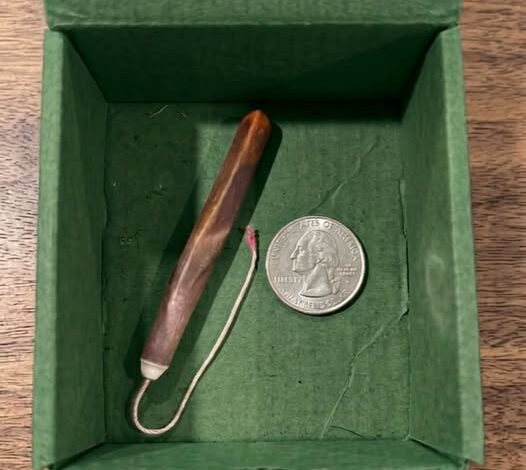
At first glance, it looked like something that didn’t belong among my grandmother’s sewing things.
It was slim, pointed, and unexpectedly sharp—far different from the familiar spools of thread, well-worn pincushions, and polished scissors I remembered from childhood. Holding it in my hand years later, I couldn’t place it, and that uncertainty allowed my imagination to wander.
I found myself drifting back to memories of afternoons spent in her sewing room.
She always sat beside the same window, where sunlight poured across her worktable and illuminated every careful stitch. The old sewing machine filled the room with its comforting rhythm, while scraps of fabric lay neatly folded in small stacks around her chair. She rarely hurried. Every movement was deliberate, every seam carefully measured, every button sewn on as though it truly mattered.
As a child, I never questioned what she was doing.
I simply watched.
To me, it seemed almost magical that pieces of cloth could become school uniforms, curtains, pillowcases, Halloween costumes, or favorite shirts that somehow lasted for years. She made difficult work look effortless, and I assumed every tool in her sewing basket had an obvious purpose.
Except this one.
I couldn’t remember ever seeing her use it.
That only deepened the mystery.
The longer I looked at the unfamiliar object, the more stories I invented to explain it. Perhaps it belonged to a hobby she’d never talked about. Maybe it was connected to some forgotten chapter of her life before I was born. For a fleeting moment, I even wondered whether it had been kept for protection or carried some sentimental meaning she had never shared.
It seemed too unusual to be ordinary.
Too carefully preserved to be insignificant.
Eventually, curiosity led me to search for an answer.
That’s when I discovered its true identity.
It was a vintage sewing stiletto.
Suddenly, everything made sense.
Despite its dramatic name and pointed appearance, the tool wasn’t designed as a weapon at all. It was created to help sew with greater precision. A sewing stiletto allows the user to guide delicate fabric safely beneath the sewing machine needle, press small seams into place, manipulate tiny corners, and keep fingers away from moving parts. Its sharp point can also assist in opening stubborn seams or positioning fabric with remarkable accuracy.
What had looked intimidating was, in reality, an instrument of patience.
A tool built not for force, but for finesse.
The discovery transformed the way I remembered my grandmother.
I realized there had been countless details I never noticed while she quietly worked beside that window. The finished clothes had always captured my attention, but I had overlooked the invisible craftsmanship that made them possible.
Every careful adjustment.
Every perfectly aligned seam.
Every small correction before a stitch became permanent.
That humble sewing stiletto had likely played a role in garments our family wore for years without giving a second thought to the skill behind them.
It reminded me how easily we overlook the quiet labor that holds families together.
Some people build their legacy through speeches or grand achievements.
Others do it one careful stitch at a time.
They mend torn sleeves instead of replacing them.
They shorten hems for growing children.
They patch worn knees in school pants.
They transform scraps of fabric into something useful, beautiful, and lasting.
Their work often goes unnoticed because it becomes woven into everyday life.
Only later do we realize how much love was hidden in those ordinary acts.
Holding that little tool now, I no longer see something mysterious.
I see evidence of remarkable craftsmanship.
I see long afternoons spent making sure every piece of clothing fit just right.
I see patience practiced so consistently that it became second nature.
Most of all, I see my grandmother—not through dramatic memories or extraordinary events, but through the quiet dedication she poured into caring for the people she loved.
It’s remarkable how a single object can change once its story is understood.
What first appeared strange became deeply familiar.
What seemed unsettling became comforting.
And what I once mistook for an odd relic revealed itself to be a symbol of careful hands, steady determination, and love expressed through work that rarely asked for recognition.
The sewing stiletto now rests among her belongings with a different meaning than it once held.
It is no longer a puzzle waiting to be solved.
It is a reminder that the most meaningful legacies are often built through small, patient acts repeated day after day—acts so ordinary in the moment that we barely notice them, yet so enduring that they continue to shape our lives long after the hands that performed them have come to rest.