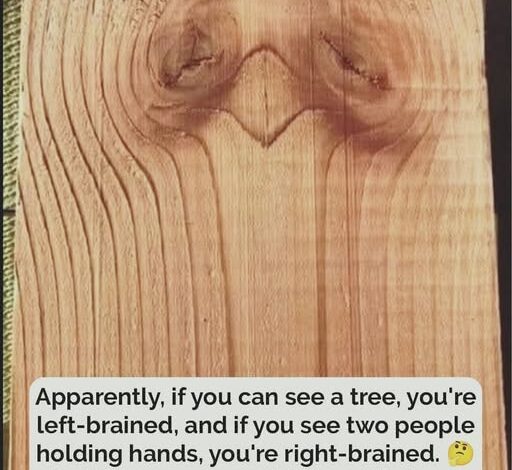
What if a single image could reveal something unexpected about the way your mind works?
At first glance, it may seem like a simple picture. But within seconds, people often begin arguing about what they saw first. Some immediately notice a tree. Others spot human figures. A few focus on smaller details that most viewers completely overlook. The fascinating part is that everyone is looking at exactly the same image.
So why do people see different things?
The answer lies in the remarkable way the human brain processes information.
Contrary to popular belief, your eyes don’t simply capture reality and send it to your brain like a camera recording video. Instead, the brain actively interprets everything it sees. It organizes visual information, filters out unnecessary details, fills in gaps, and searches for familiar patterns—all within fractions of a second.
This process is so fast and automatic that most people never realize it’s happening.
Yet it influences every image, object, and face they encounter.
For decades, psychologists and neuroscientists have studied how perception works and why different individuals can look at the same visual scene while experiencing it in completely different ways. Their findings reveal that perception is not just about eyesight. It is shaped by attention, memory, experience, emotions, and even cultural background.
In other words, what you notice first often says more about how your brain is processing information in that moment than about the image itself.
This is one reason optical illusions have become so popular.
Across social media, images are frequently shared alongside questions such as, “What did you see first?” or “The first thing you notice reveals your personality.”
Millions of people participate because the concept is intriguing. After all, who wouldn’t be curious about what their subconscious mind might reveal?
However, psychologists urge caution.
While these visual puzzles are entertaining, they are not scientifically validated personality tests. They are better understood as demonstrations of perception rather than reliable measures of character.
Still, the science behind them is genuinely fascinating.
Every second, your eyes send an enormous amount of information to your brain—far more than your conscious mind could ever process in real time. To handle this flood of data efficiently, the brain relies on shortcuts known as perceptual processing.
These mental shortcuts help us quickly identify objects, recognize faces, detect movement, and make sense of complex environments.
Without them, everyday life would be overwhelming.
Imagine walking into a crowded room and having to consciously analyze every shape, color, and object before recognizing where you are. The brain avoids this by prioritizing patterns it considers important or familiar.
This is why one person may instantly notice a human figure while another sees a tree, an animal, or a completely different shape.
Neither person is wrong.
Their brains are simply organizing the same information differently.
Scientists explain that perception is not purely objective. Instead, it represents a partnership between sensory input and mental interpretation.
What you see depends not only on what enters your eyes but also on how your brain chooses to organize that information.
This becomes especially apparent in ambiguous images.
When presented with a picture that can be interpreted in multiple ways, viewers often focus on different elements first. Some people naturally notice larger patterns and overall structures. Others gravitate toward details, textures, or individual objects.
These differences are sometimes linked to cognitive style—the ways people tend to process information.
For example, detail-oriented individuals may focus on specific shapes, outlines, or visual components before seeing the larger image. Others may immediately perceive the overall scene before noticing smaller elements.
Importantly, these tendencies are flexible rather than fixed.
Your mood, stress level, energy, and environment can all influence what catches your attention first.
One of the most widely shared examples is the classic “tree or people” illusion.
When viewers look at the image, some immediately recognize a tree. Others instantly see two people facing one another or holding hands.
Online interpretations often attach personality descriptions to these choices.
If you see the tree first, some claim you’re analytical and logical.
If you see the people first, you’re supposedly emotional, creative, or relationship-focused.
While these descriptions are entertaining, scientific evidence doesn’t support such direct conclusions.
The reality is far more interesting.
The brain is simply identifying whichever pattern appears most recognizable or visually dominant to that individual at that particular moment.
For some viewers, the structure of the tree stands out first.
For others, the human figures attract attention immediately.
This tendency is closely connected to a phenomenon known as pareidolia.
Pareidolia is the brain’s natural tendency to recognize familiar patterns—especially faces and human forms—in ambiguous or random visual information.
It’s the reason people see animals in clouds, faces in rock formations, or expressions in everyday objects.
The human brain is extraordinarily skilled at finding meaning.
In fact, it evolved specifically to do so.
Throughout human history, the ability to quickly recognize other people, identify potential threats, and detect important patterns played a crucial role in survival. As a result, our brains became highly efficient pattern-detection systems.
Sometimes that efficiency works so well that we perceive meaningful shapes even when none were intentionally placed there.
Optical illusions take advantage of this remarkable feature of human cognition.
Modern neuroscience suggests that perception is not simply reactive—it is predictive.
Rather than waiting passively for information, the brain constantly generates expectations about what it believes it will see. Incoming visual information is then compared against those predictions, allowing the brain to interpret scenes quickly and efficiently.
Most of the time, this system works brilliantly.
Occasionally, however, it produces surprising results.
That’s where illusions become so fascinating.
They reveal the hidden processes operating beneath conscious awareness and remind us that perception is not always as straightforward as it seems.
While viral optical illusion tests should never be treated as serious psychological evaluations, they do offer something valuable.
They encourage curiosity.
They remind us that people can experience the same reality differently.
And they provide a glimpse into the extraordinary complexity of the human mind.
Ultimately, what you see first in an image does not reveal secret truths about your personality.
It reveals something arguably more fascinating: the unique way your brain interprets the world around you.
Every person brings different experiences, memories, expectations, and attention patterns to every visual scene they encounter. That diversity of perception is part of what makes human cognition so remarkable.
So the next time an optical illusion appears on your screen and asks what you noticed first, enjoy the challenge.
Not because it defines who you are.
But because it offers a rare opportunity to witness your brain doing what it does best—searching for meaning in the world, one image at a time.