That “Weed” in Your Garden Might Be More Valuable Than You Think — Some Call It a Natural Superfood

For most people, the relationship with weeds begins with irritation.
They appear suddenly in carefully maintained gardens, pushing stubbornly through sidewalk cracks, climbing between rows of vegetables, or spreading across flower beds where they were never invited to grow. Gardeners pull them out by hand, spray them, cut them back, and watch them return anyway with almost defiant persistence.
A weed, after all, is usually defined less by biology than by inconvenience.
The word itself carries judgment.
Unwanted.
Out of place.
Intrusive.
Yet history has a habit of quietly complicating the categories humans create so confidently. Many plants now celebrated for nutrition, medicine, or beauty were once dismissed as nuisances simply because they grew too freely or survived too aggressively for cultivated landscapes.
Purslane belongs firmly inside that contradiction.
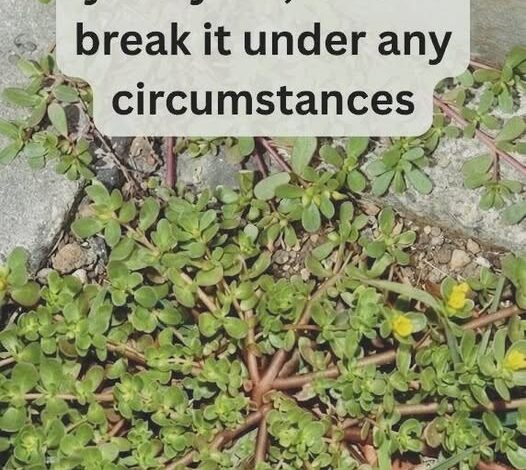
To some homeowners, it is nothing more than an irritating ground-covering weed spreading low and fast through warm soil after summer rain. To others, particularly across parts of the Mediterranean, Asia, the Middle East, and Latin America, it is an old and familiar food — something gathered intentionally, cooked carefully, and eaten long before modern wellness culture rediscovered it through health trends and internet nutrition lists.
Its scientific name, Portulaca oleracea, sounds elegant and distant compared to the humble way most people encounter it:
small succulent leaves,
reddish stems,
tiny yellow flowers opening quietly in sunlight.
At first glance, purslane rarely appears impressive.
It hugs the ground rather than reaching dramatically upward. It grows where many cultivated plants struggle:
dry soil,
disturbed spaces,
garden edges,
vacant lots,
cracks in pavement.
Its survival strategy is not grandeur.
It is persistence.
And perhaps that persistence explains why humans have spent centuries misunderstanding it.
Modern landscaping culture often values control above all else. Lawns must remain uniform. Garden beds should behave predictably. Plants are expected to grow where placed and nowhere else. Species that spread naturally without permission quickly acquire the label of weed regardless of their usefulness, nutritional value, or ecological role.
Purslane ignores those categories completely.
It grows wherever conditions allow, adapting quietly to harsh environments many ornamental plants could never tolerate. Drought rarely defeats it easily. Poor soil slows it but seldom stops it. Heat encourages it rather than damaging it.
From a botanical perspective, this resilience makes perfect sense.
Purslane is a succulent plant, meaning its thick leaves store moisture efficiently. That adaptation allows it to survive extended dry conditions by conserving water internally, much the way desert-adapted plants operate in harsher climates. While other greens wilt quickly beneath intense summer heat, purslane often remains startlingly vibrant close to the ground.
There is something almost ancient about plants like that.
They survive not because they dominate ecosystems aggressively, but because they adapt patiently to difficult conditions generation after generation. Human civilization repeatedly rediscovers them during periods when resilience matters more than aesthetics.
Historically, many communities understood purslane not as a weed but as a practical food source readily available without extensive cultivation. Before industrial agriculture standardized diets around a narrow range of crops, people relied far more heavily on local edible plants growing naturally around them.
Knowledge of those plants passed quietly through generations:
what could be eaten,
what seasons it appeared,
how to prepare it safely,
which flavors paired well with it.
Purslane became woven into those traditions not through marketing campaigns or nutritional branding, but through familiarity.
It was accessible.
That accessibility mattered deeply in societies where food availability depended less on supermarkets and more on observation of local landscapes. Families gathered edible greens from fields and garden edges because doing so expanded meals efficiently without requiring additional resources.
In parts of Greece, Turkey, Mexico, India, and the Middle East, purslane entered soups, salads, stews, yogurt dishes, and sautéed vegetable preparations naturally over time. Different cultures developed different uses, but most appreciated the same qualities:
its slight tang,
its crisp texture,
its ability to survive heat,
its abundance.
Food traditions often reveal practical intelligence accumulated slowly across centuries.
People continue eating certain plants because experience repeatedly proves them useful, nourishing, adaptable, or reliable under changing conditions. Purslane survived culturally because it earned space within ordinary diets long before nutritional databases existed to explain why.
Modern science later identified many of the compounds traditional diets had unknowingly incorporated all along.
Purslane contains vitamins,
minerals,
fiber,
antioxidants,
and plant-based omega-3 fatty acids known as alpha-linolenic acid, or ALA.
That last detail receives enormous attention in wellness culture because omega-3 fats are commonly associated with cardiovascular and neurological health. Since many plant foods contain only modest amounts naturally, purslane’s ALA content became one of its most discussed nutritional features.
Still, scientific nuance matters here.
Nutritional value exists on a spectrum, not inside miracle narratives.
Purslane can contribute beneficial nutrients to a balanced diet, but it is not a magical cure, detoxifier, or medically transformative superfood despite how aggressively internet wellness culture sometimes markets ordinary plants. Human health depends on overall dietary patterns, lifestyle, genetics, environment, and countless interacting factors — not on single ingredients elevated into nutritional mythology.
The term “superfood” itself remains largely promotional rather than scientific.
And perhaps that says something larger about modern culture too.
People increasingly search for dramatic nutritional solutions because modern life often feels chemically processed, disconnected from nature, and physically exhausting. Ancient or overlooked plants therefore acquire symbolic power beyond their actual composition. Eating something wild or traditional begins feeling emotionally restorative as much as nutritionally beneficial.
Purslane now exists partly inside that cultural movement.
Health blogs praise it.
Gardeners reconsider it.
Chefs experiment with it.
Nutrition discussions circulate its nutrient profile widely online.
Yet beneath all the modern attention, the plant itself remains unchanged:
small,
resilient,
quietly spreading through disturbed soil exactly as it always has.
There is something almost humbling about that.
Humans repeatedly rediscover value in things nature never stopped offering freely.
Scientifically, current research surrounding purslane remains interesting but still developing. Laboratory studies have examined antioxidant compounds present within the plant, including flavonoids and betalains. Researchers continue exploring how such compounds interact with oxidative stress processes at cellular levels.
But responsible science moves carefully.
Preliminary findings do not automatically translate into guaranteed medical outcomes for humans. Much nutritional research exists in early stages involving cell cultures, animal models, or limited observational data rather than large-scale clinical trials. Distinguishing between promising research and proven therapeutic effect remains essential.
That distinction protects both scientific integrity and public understanding.
Purslane can absolutely be appreciated nutritionally without exaggeration.
Its leaves and stems offer dietary variety.
Its texture adds freshness to meals.
Its nutrients contribute meaningfully alongside other vegetables.
Its historical use connects people to older food traditions emphasizing adaptability and local resources.
Those qualities alone are valuable.
Not every useful plant needs to become a miracle.
Culinarily, purslane possesses an understated versatility many leafy greens lack. The leaves remain slightly crisp even during cooking, while the stems develop a mild mucilaginous quality similar to okra when heated. Some soups intentionally use this texture as a natural thickening element.
Raw purslane works well in salads because of its refreshing slightly lemony taste. Combined with tomatoes, cucumbers, olive oil, yogurt, garlic, onions, or herbs, it integrates naturally into many traditional dishes without overwhelming other flavors.
The simplicity of those preparations feels important somehow.
Purslane does not require elaborate techniques or expensive ingredients to become edible. Historically, that practicality helped ensure its survival within ordinary diets rather than elite cuisine alone.
Its environmental role matters too, even if modestly.
Because purslane grows low to the ground and spreads horizontally, it can help reduce exposed soil surfaces in certain environments. Ground-covering plants contribute to soil stability, moisture retention, and small-scale biodiversity in ways often overlooked because they appear visually insignificant.
Tiny insects shelter beneath it.
Pollinators occasionally visit its flowers.
Microorganisms interact continuously with root systems underground.
Nature rarely operates through isolated functions.
Even plants dismissed casually as weeds participate in broader ecological systems quietly supporting soil health, insect populations, and local environmental balance.
At the same time, responsible management remains important. Certain purslane varieties spread aggressively under favorable conditions, particularly in warm climates. Left entirely uncontrolled, they may compete with cultivated crops or dominate garden spaces unexpectedly.
Nature’s resilience can become inconvenience depending on context.
Again, balance matters more than romanticizing everything wild automatically.
Foraging introduces additional complexity as well.
Modern interest in edible wild plants has grown rapidly alongside sustainability movements and natural eating trends. Yet safe foraging requires accurate identification and environmental awareness. Purslane should never be collected from contaminated areas near roadsides, industrial zones, pesticide-treated land, or polluted urban environments where heavy metals or toxins may accumulate.
Knowledge matters.
Traditional food systems often depended on generations of accumulated ecological understanding many modern people no longer inherit automatically. Reconnecting with edible plants therefore requires humility as much as curiosity.
Still, there is something deeply meaningful about recognizing that useful food can exist outside industrial packaging and cultivated supermarket systems.
Purslane quietly challenges assumptions about value itself.
What humans dismiss carelessly as weeds may still nourish ecosystems, preserve cultural memory, or contribute meaningfully to diets. The distinction between crop and nuisance often reflects human priorities more than biological worth.
And perhaps that idea extends far beyond gardening.
People categorize quickly.
Discard quickly.
Overlook quietly resilient things because they lack polish or prestige.
Yet resilience itself carries value.
Purslane survives because it adapts.
Because it wastes little.
Because it grows where conditions remain difficult.
Because hidden systems beneath the surface continue supporting visible life above ground.
That feels strangely symbolic in an age obsessed with spectacle.
The plant asks for almost nothing:
sunlight,
soil,
space.
In return, it offers nourishment,
persistence,
and continuity stretching backward through centuries of ordinary human survival.
Not glamorous.
Not miraculous.
Simply useful.
And maybe that usefulness is precisely what makes it fascinating.
Because long before wellness trends transformed humble plants into fashionable ingredients, people already understood something simpler:
life depends less on perfection than on adaptability.
Purslane embodies that truth quietly every time it pushes through dry soil after rain, spreading low across the earth without asking whether humans consider it valuable enough to belong there.
It grows anyway.
Steady.
Resilient.
Misunderstood by some.
Appreciated deeply by others.
A reminder that nature often hides usefulness inside forms people learn too quickly to ignore.