The lake had always felt a little strange.
Not dangerous exactly—just strange.
It sat at the edge of our village like a giant polished mirror, too still and too perfect to feel entirely natural. Everyone knew it was man-made. Decades ago, engineers had flooded a low-lying area to create a reservoir, and over time nature had softened the sharp edges of the project. Trees grew along the shoreline. Reeds appeared in the shallows. Ducks nested among the grasses.
To most people, it was simply part of the landscape.
To me, it always felt like something pretending to be natural.
Maybe that sounds odd, but there was something about the place that made my imagination work overtime. On quiet mornings, when fog drifted across the surface and the water reflected the sky so perfectly it looked bottomless, the lake seemed less like a body of water and more like a secret waiting to be discovered.
That particular afternoon only amplified the feeling.
The weather was unusually calm. No wind disturbed the surface. No boats crossed the water. Even the birds seemed quieter than normal.
I had walked down to the shoreline hoping for a bit of peace after a stressful week. Instead, I found myself staring at something that immediately sparked my curiosity.
The water was exceptionally clear.
Normally, the lake’s bottom disappeared into a murky green haze just a few feet from shore. But recent weather conditions had apparently settled the sediment, revealing details I had never noticed before.
And that’s when I saw them.
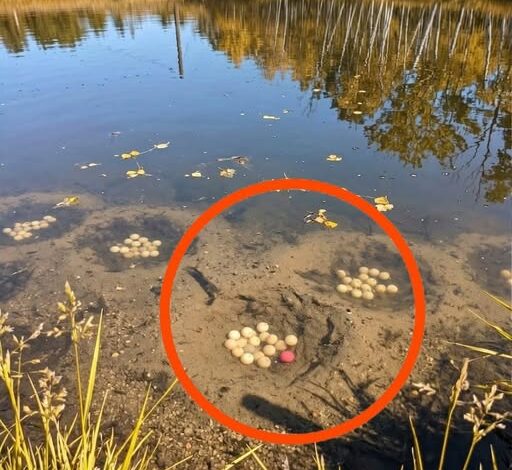
Scattered across the bottom were dozens of pale, rounded objects.
At first, I couldn’t tell what they were.
They appeared in clusters, resting among patches of sand and silt. Some sat alone. Others gathered in groups that looked almost deliberate.
The farther I stared, the stranger they seemed.
They weren’t rocks.
At least, they didn’t look like rocks.
Their shapes appeared too uniform.
Too similar.
Too intentional.
I moved closer.
The objects remained perfectly still.
For some reason, that made them even more unsettling.
My mind immediately began constructing theories.
Perhaps they were eggs.
Some rare species of amphibian laying enormous clusters beneath the surface.
Maybe they belonged to an invasive species.
We’d all heard stories about strange plants and animals appearing in lakes and rivers, disrupting ecosystems and multiplying rapidly before anyone realized what was happening.
Or maybe—my imagination being what it is—they were something entirely unknown.
The internet is full of stories about bizarre discoveries in remote lakes and ponds. Strange creatures. Unidentified organisms. Odd biological formations that leave experts scratching their heads.
The more I stared, the more possibilities emerged.
Each seemed more dramatic than the last.
I walked along the shore, trying to view them from different angles.
The clusters extended farther than I initially realized.
Dozens.
Maybe hundreds.
All resting silently beneath the surface.
The scene had an eerie quality that was difficult to explain.
Nothing was moving.
Nothing appeared threatening.
Yet the sight felt oddly deliberate, as if some hidden process was taking place beneath the water while the rest of the world remained unaware.
The stillness amplified everything.
The lake seemed to be holding its breath.
And before long, I was doing what people have done for centuries when confronted with something they don’t understand:
I started inventing stories.
Maybe these objects had always been there.
Maybe nobody had noticed.
Maybe they represented some fascinating natural phenomenon waiting to be documented.
I even imagined local news headlines.
“Mysterious Formation Discovered in Village Lake.”
Experts arriving.
Scientists collecting samples.
Reporters interviewing curious residents.
Ridiculous, perhaps.
But standing there alone, staring into clear water on an unusually quiet afternoon, it felt surprisingly plausible.
Eventually curiosity overcame caution.
I crouched near the shoreline.
Then I knelt.
Then I leaned so far forward I nearly lost my balance.
From that closer position, details began to emerge.
The objects weren’t perfectly smooth after all.
Several appeared slightly worn.
Scratched.
Discolored.
One seemed to have a faint marking on its surface.
I squinted.
Moved closer.
Adjusted my angle.
And then I saw it.
A tiny logo.
Barely visible beneath years of silt and algae.
For a moment, my brain refused to process what I was looking at.
Then the realization arrived all at once.
Golf balls.
They were golf balls.
Every single one of them.
Not mysterious eggs.
Not invasive organisms.
Not undiscovered aquatic life.
Just golf balls.
Dozens and dozens of ordinary golf balls resting on the bottom of the lake.
I sat back and laughed.
Actually laughed out loud.
The sound echoed across the empty shoreline.
The mystery evaporated instantly.
Suddenly everything made sense.
The golf course next door.
The position of the lake relative to several fairways.
Years of ambitious shots.
Years of terrible shots.
Years of slices, hooks, misjudged distances, and unfortunate swings.
One by one, golfers had unknowingly contributed to the collection beneath the water.
Over time, currents and sediment had gathered the balls into small depressions along the lakebed, creating the illusion of intentional clusters.
What I had interpreted as evidence of some hidden biological process was actually a monument to human imperfection.
A museum of missed shots.
A graveyard of golf balls.
And somehow, that explanation felt far more satisfying than any mystery I had imagined.
As I continued looking into the water, I noticed details I had overlooked before.
Some balls were nearly buried.
Others were coated in algae.
A few reflected sunlight like tiny pearls.
Nature had slowly reclaimed them, blending them into the environment until they became something entirely different from what they originally were.
That realization lingered with me long after I left the lake.
Not because of the golf balls themselves.
But because of what the experience revealed about the way we see the world.
Human beings are natural storytellers.
When information is incomplete, we fill the gaps.
When something appears unusual, we search for explanations.
And more often than not, our minds gravitate toward the extraordinary.
We imagine mysteries.
We imagine dangers.
We imagine miracles.
The truth is frequently much simpler.
A strange shape becomes a shadow.
A shadow becomes a creature.
A cluster of old golf balls becomes an unexplained phenomenon.
The lake hadn’t changed.
The objects hadn’t changed.
Only my understanding had changed.
And somehow, that felt comforting.
Because not every mystery hides a monster.
Not every unexplained sight conceals a secret.
Sometimes the world isn’t trying to surprise us at all.
Sometimes it’s simply reflecting our own imagination back at us.
As I walked away from the shoreline, I glanced back one last time.
The clusters remained exactly where they had been before.
Silent.
Motionless.
Unremarkable.
Yet somehow beautiful.
Not because they were mysterious.
But because they reminded me how easily the human mind transforms the ordinary into something extraordinary.
And perhaps that’s a mystery worth appreciating all by itself.