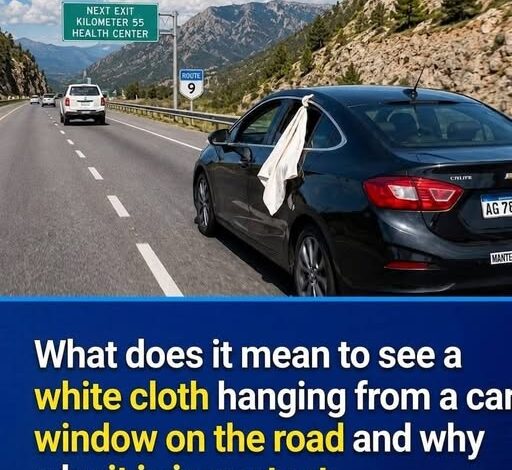
That simple white cloth tied to a car door, mirror, antenna, or window may look insignificant, but it often carries a message born from urgency, uncertainty, and human need. Long before mobile phones, roadside assistance apps, and GPS tracking became common, drivers relied on whatever they had available to communicate that something was wrong. A white handkerchief, towel, T-shirt, or piece of fabric became a silent signal that a vehicle was experiencing trouble and that its driver might need help.
Over time, the white cloth came to represent a variety of situations. It might indicate a mechanical breakdown, a flat tire, an overheated engine, an empty fuel tank, or a vehicle that has become stranded. In some cases, it may signal that the driver is dealing with a medical issue or waiting for assistance to arrive. During group travel, processions, or convoys, white cloths are sometimes used as informal markers so participants can identify one another more easily.
Despite these common uses, it is important to understand what the signal does not mean.
A white cloth is not an official traffic device. It does not carry legal authority, grant special privileges, or transform an ordinary vehicle into an emergency vehicle. A driver displaying a white cloth does not automatically have the right to exceed speed limits, ignore traffic signals, drive recklessly, or demand that other motorists clear a path. The fabric may communicate distress or difficulty, but it does not override traffic laws or public safety regulations.
This distinction matters because many people mistakenly assume the cloth represents an emergency status similar to an ambulance or police vehicle. In reality, it is simply an informal request for awareness and consideration from other road users.
When you notice a vehicle displaying a white cloth, the safest response is to remain calm and attentive. Slow down if necessary, maintain a safe following distance, and carefully assess the situation. Look for signs that the vehicle may be disabled, stopped unexpectedly, or experiencing a problem that requires assistance. Avoid making assumptions, but remain alert to the possibility that someone may genuinely need help.
If the circumstances appear serious—such as a vehicle stopped in a dangerous location, a driver showing signs of distress, or a situation that could pose a risk to public safety—it may be appropriate to contact emergency services or roadside assistance. Trained professionals are often better equipped to handle emergencies than well-meaning bystanders who rush into unfamiliar situations.
Helping others on the road can be valuable, but safety should always come first. If you choose to assist, do so only when conditions allow and without putting yourself or others at risk. In some situations, the most effective form of help is simply reporting the issue and allowing emergency responders to take over.
Ultimately, the white cloth remains a uniquely human signal. It exists outside official regulations, yet it continues to be recognized because it reflects something universal: the possibility that a person may be in trouble and trying to communicate that fact in the simplest way available.
Its meaning is not defined by law but by awareness, courtesy, and common sense.
The next time you see a white cloth attached to a vehicle, remember that it may represent frustration, uncertainty, fear, or a genuine request for help. Respond with caution, patience, and good judgment. Sometimes the safest and most effective assistance is not dramatic action, but careful observation, responsible decision-making, and ensuring that the people who need help receive it from those best qualified to provide it.