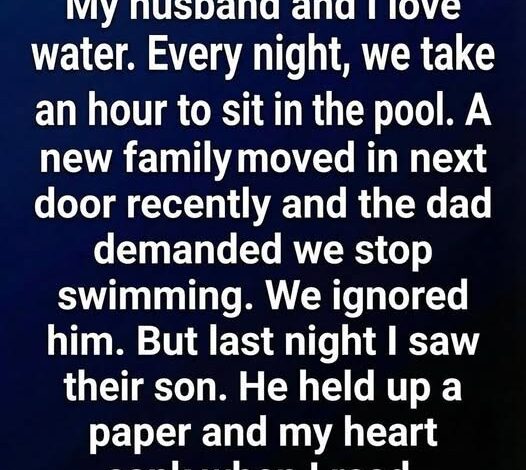
For years, my husband and I had the same evening ritual.
No matter how stressful the day had been, no matter how busy work or life became, we always found our way back to the backyard pool.
It wasn’t some luxurious escape.
It wasn’t about exercise.
And it certainly wasn’t about showing off.
The pool was simply where we reconnected.
After dinner, when the neighborhood grew quiet and the sky darkened overhead, we’d slip into the water and talk. Sometimes we discussed work. Sometimes family. Sometimes we sat in comfortable silence, listening to the gentle movement of water around us.
Those nightly swims became one of the strongest parts of our marriage.
They were our pause button.
Our reset.
Our peace.
That’s why we were surprised when our new neighbors moved in and almost immediately asked us to stop.
The family had arrived only a few weeks earlier.
We exchanged polite greetings while they settled into their new home, but we didn’t know much about them. They seemed private, keeping mostly to themselves.
Then one evening, the father knocked on our door.
He looked nervous.
Almost uncomfortable.
After a few moments of awkward conversation, he finally got to the point.
He wanted us to stop using our pool at night.
The request caught us completely off guard.
“Stop using it?” my husband asked.
The man nodded.
“Just in the evenings.”
There was a long pause.
Naturally, we asked why.
His answer wasn’t particularly detailed.
He simply said it was creating difficulties for his family.
That was it.
No further explanation.
No specific complaint.
No attempt to elaborate.
Just a request.
After he left, my husband and I stood in the kitchen staring at each other.
The whole interaction felt strange.
We weren’t throwing parties.
We weren’t blasting music.
We weren’t inviting groups of friends over.
We simply sat quietly in our own backyard.
The request felt unfair.
Maybe even a little unreasonable.
And because we didn’t understand it, we quietly decided to continue our routine.
We assumed the situation would eventually resolve itself.
Perhaps they would adjust.
Perhaps it had been a misunderstanding.
Either way, we didn’t think much more about it.
Until a few nights later.
That evening seemed completely ordinary.
The air was warm.
The water was calm.
We spent nearly an hour talking as we always did.
When we finally climbed out and began shutting everything down, I walked toward the pool controls to switch off the lights.
That’s when I noticed someone standing near the fence.
At first, the figure startled me.
Then I realized it was the neighbors’ son.
He couldn’t have been older than twelve.
He stood quietly in the shadows, watching.
Not in a threatening way.
Not angrily.
Almost nervously.
When our eyes met, he didn’t speak.
Instead, he pointed toward the bottom of the fence.
Then he stepped back.
Curious, I walked closer.
Tucked between two fence slats was a folded piece of paper.
I picked it up.
The handwriting inside was careful but uneven, as though someone had taken great care with every word.
As I began reading, my frustration slowly disappeared.
The note wasn’t from the father.
It was from the boy.
And it explained everything.
His younger sister had been sick for years.
The details weren’t fully described, but it was clear she had faced serious health challenges for much of her life.
During therapy treatments, she had often found comfort in the sound of moving water.
The gentle, predictable noise helped calm her during difficult moments.
For a long time, that association had been positive.
But recently, things had changed.
The note explained that her condition had worsened.
She was struggling physically and emotionally.
Sleep had become increasingly difficult.
And now, the sound of water late at night—particularly when she was trying desperately to rest—had become overwhelming rather than comforting.
The pool noise wasn’t loud.
It wasn’t disruptive in the traditional sense.
But for her, it had become impossible to ignore.
The boy ended his letter with a simple sentence.
“My dad didn’t know how to explain it. He was just trying to help her.”
I stood there staring at the page.
Suddenly, everything looked different.
The father’s awkwardness.
His lack of explanation.
His discomfort during our conversation.
It all made sense.
He hadn’t been trying to control us.
He wasn’t a difficult neighbor.
He wasn’t looking for an argument.
He was a worried father.
A father carrying burdens we couldn’t see.
A father trying to protect his child.
And because discussing her condition was painful, he had struggled to explain himself.
That night, my husband and I sat at the kitchen table long after the pool lights had gone dark.
Neither of us could stop thinking about the letter.
What struck me most wasn’t the request itself.
It was how quickly we had assumed the worst.
Because we lacked information, we filled in the blanks ourselves.
We created motives.
Assigned intentions.
Built an entire story around a situation we barely understood.
The truth turned out to be completely different.
The next afternoon, we walked next door.
The father answered the door looking immediately nervous.
I suspect he expected another disagreement.
Instead, I handed him the letter.
His face flushed.
For a moment, he looked embarrassed.
Then he sighed.
A long, exhausted sigh.
And for the first time, he explained everything.
We talked for nearly an hour.
About his daughter.
About her treatments.
About the challenges their family faced every day.
About how difficult it had been moving while managing her health concerns.
By the end of the conversation, the tension between us had completely disappeared.
What remained was understanding.
Together, we came up with a simple solution.
Nothing dramatic.
Nothing complicated.
We agreed to end our pool time earlier in the evening.
We adjusted some equipment settings to reduce unnecessary water movement and noise.
A few small changes.
That’s all it took.
For us, the sacrifice was minimal.
For their family, it made a meaningful difference.
The father’s relief was impossible to miss.
His shoulders visibly relaxed.
His voice softened.
And for the first time since they’d moved in, he smiled.
In the weeks that followed, something unexpected happened.
We became neighbors in the truest sense of the word.
The boy who left the letter began waving whenever he saw us.
His shy smile eventually became a cheerful greeting.
The father would stop and chat when he was outside.
Sometimes we’d ask about his daughter.
Sometimes we’d simply talk about everyday life.
The awkwardness was gone.
In its place was genuine connection.
Looking back, I often think about how differently things could have unfolded.
A simple request almost became resentment.
A misunderstanding nearly became conflict.
All because we didn’t know the story behind it.
That’s the thing about life.
Most people are carrying struggles we cannot see.
Pain that isn’t obvious.
Responsibilities that aren’t visible.
Battles being fought quietly behind closed doors.
And when we don’t know those stories, assumptions rush in to fill the silence.
Sometimes those assumptions are wrong.
Very wrong.
Our nightly pool routine never disappeared.
It simply changed.
And in many ways, it became even more meaningful.
Because every time we look at that still water now, we’re reminded of something far more important than relaxation.
We’re reminded that kindness often begins where assumptions end.
That listening can reveal truths anger never could.
And that behind even the most inconvenient request may be a story waiting to be heard.
Sometimes all it takes is the willingness to stop, listen, and understand.
When we do, conflict has a remarkable way of becoming connection.