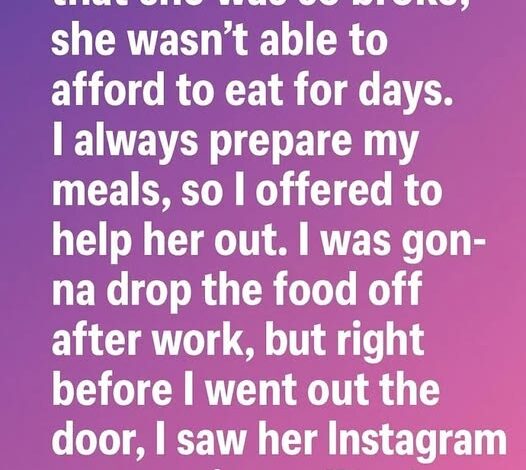
I was halfway through packing containers of food when something made me pause.
The kitchen counter was covered with neatly stacked meal-prep boxes—rice, roasted vegetables, chicken, soup, and a few snacks I knew my friend liked. I had spent most of Sunday cooking, as I usually did, portioning meals for the week ahead.
This time, though, the food wasn’t for me.
It was for her.
The night before, she’d called me in tears.
“I don’t know what to do anymore,” she had said.
Her voice sounded exhausted.
Defeated.
She told me money was so tight that she hadn’t eaten properly in days.
Not skipped a meal here or there.
Days.
The thought of someone I cared about sitting alone, hungry and stressed, broke my heart.
Without hesitation, I offered to help.
“I’ll bring you food tomorrow after work.”
There was a long silence before she thanked me.
The gratitude in her voice sounded genuine.
And honestly, I didn’t think twice about it.
Friends help each other.
That’s what we do.
So after work the next day, I rushed home, packed everything into reusable containers, and prepared to drive across town.
Before leaving, I sat down for a minute and opened my phone.
That simple decision almost changed everything.
The first thing that appeared on my screen was her Instagram story.
I tapped it absentmindedly.
Then froze.
There she was.
Smiling.
Laughing.
Sitting at a trendy café downtown.
A slice of elaborate chocolate cake sat in front of her.
Coffee beside it.
Several friends around the table.
The caption read:
“Needed this today ❤️”
I stared at the screen.
Then watched the story again.
And again.
A strange feeling settled in my stomach.
Confusion.
Disappointment.
Maybe even a little anger.
Less than twenty-four hours earlier, she had told me she couldn’t afford to eat.
Yet here she was buying dessert at a café.
The image and the story she told me didn’t seem to fit together.
Immediately, questions started forming.
Had she lied?
Had she exaggerated?
Was I being manipulated?
Was I about to spend my evening helping someone who wasn’t actually struggling?
The longer I stared at the photo, the more frustrated I became.
I looked at the meal containers sitting on my counter.
Hours of effort.
Groceries I had purchased myself.
Time I had gladly given because I believed she genuinely needed support.
Now I wasn’t sure what to believe.
Part of me wanted to cancel.
Another part wanted answers.
A third part wanted to send her a screenshot and demand an explanation.
Instead, I sat quietly.
And after a few minutes, I realized something important.
I was building an entire story based on one photograph.
One carefully selected moment.
A few seconds from someone’s day.
Social media has a way of convincing us we understand situations we actually know very little about.
The picture showed dessert.
It didn’t show her bank account.
It didn’t show her stress.
It didn’t show what happened before or after.
Maybe a friend bought the food.
Maybe she spent money she shouldn’t have spent.
Maybe she was making a bad decision.
Maybe she was simply desperate for a few minutes of feeling normal.
The truth was, I didn’t know.
And I couldn’t know from a photograph.
So instead of assuming, I texted her.
“Hey. Are you home? I’d still love to bring the food by.”
Her reply came almost immediately.
“Yes. Thank you.”
Simple.
No explanation.
No mention of the café.
Just gratitude.
I loaded the containers into my car and drove over.
When she opened the door, she looked different than she had in the photo.
The smile was gone.
The makeup from earlier had mostly disappeared.
Dark circles framed her eyes.
The apartment behind her was cluttered and dim.
She looked tired.
Really tired.
Not the kind of tired a good night’s sleep fixes.
The kind that settles into someone after carrying worry for too long.
We carried the food inside together.
At first, we talked about ordinary things.
Work.
Weather.
Mutual friends.
Neither of us mentioned the Instagram story.
Eventually, though, the silence around it became impossible to ignore.
I took a breath.
Then decided honesty was kinder than suspicion.
“I saw your post earlier.”
Her face immediately changed.
Embarrassment flashed across it.
Then shame.
She looked down at her hands.
For a moment, neither of us spoke.
Finally, she sighed.
“I figured you might.”
There was no defensiveness in her voice.
Just exhaustion.
“I owe you an explanation.”
I didn’t interrupt.
She stared at the floor before continuing.
“I’m not starving.”
The words came out quietly.
“But I’m struggling.”
Tears formed in her eyes.
“I made it sound worse than it was.”
I stayed silent.
Letting her continue.
She explained that money had become a constant source of anxiety.
Bills were piling up.
Unexpected expenses kept appearing.
Her savings were nearly gone.
She wasn’t literally unable to eat.
But she was scared.
Scared about rent.
Scared about debt.
Scared about the future.
And somewhere inside that fear, she exaggerated.
Not because she wanted to deceive me.
Because she didn’t know how to explain what she was actually feeling.
“I was embarrassed,” she admitted.
“I didn’t know how to say I was overwhelmed.”
I thought about the café photo.
“The dessert?”
She laughed softly through her tears.
“One of my friends paid.”
Then she shook her head.
“And honestly? It probably wasn’t the smartest thing to do anyway.”
She stared out the window.
“For one hour, I wanted to pretend everything was okay.”
That answer hit me harder than I expected.
Because suddenly the contradiction made sense.
The photograph wasn’t proof she wasn’t struggling.
It was proof she desperately wanted a break from struggling.
There was a difference.
A huge one.
For months, she’d been carrying stress privately.
Worrying constantly.
Pretending she was fine.
That afternoon at the café wasn’t a celebration.
It was an escape.
A brief pause.
A tiny attempt to feel normal.
As we talked, the frustration I’d felt earlier slowly disappeared.
Not because she had handled everything perfectly.
She hadn’t.
Not because exaggerating was okay.
It wasn’t.
But because I could finally see the person underneath the confusion.
Someone scared.
Someone ashamed.
Someone trying and failing to communicate honestly.
In other words, someone human.
We talked for nearly two hours.
More honestly than we had in years.
She apologized for exaggerating.
I admitted I had nearly judged her based on a single social media post.
By the time I left, neither of us felt angry.
Just understood.
A little more seen.
A little less alone.
Before I walked out the door, she hugged me tightly.
“Thank you,” she whispered.
“For the food?”
She shook her head.
“For listening.”
Driving home, I thought about how easy it would have been to choose a different path.
I could have assumed the worst.
I could have canceled.
I could have turned one confusing moment into a permanent fracture in our friendship.
Instead, a conversation gave us something better.
Perspective.
Because people are rarely as simple as they appear.
Especially when they’re struggling.
Pain doesn’t always look the way we expect.
Sometimes it hides behind smiles.
Sometimes it appears in bad decisions.
Sometimes it shows up in contradictions that don’t make sense until someone finally explains them.
That night taught me something valuable.
Empathy often begins with resisting the urge to create a story before hearing the truth.
It starts with pausing.
Asking.
Listening.
And remembering that a single moment rarely tells the whole story.
The meals eventually ran out.
The containers were returned.
Life moved forward.
But the lesson stayed with me.
Sometimes kindness isn’t about solving someone’s problems.
Sometimes it’s simply about giving them enough safety to tell the truth.
And often, that’s the gift they need most.