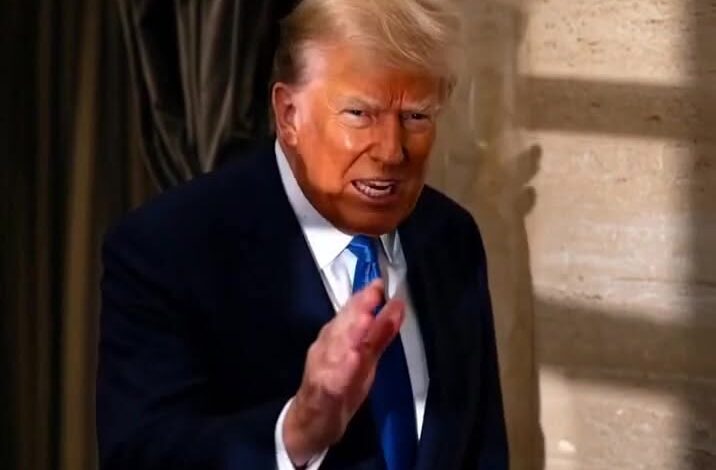
What made that late-night walk so captivating was not necessarily what Donald Trump was holding in his hand.
It was what everyone else brought to the image.
The assumptions.
The suspicions.
The hopes.
The frustrations.
The political battles people were already carrying long before the photograph ever appeared.
At first, it seemed like an ordinary moment. A public figure caught walking beneath a streetlight, photographed from an unusual angle, outside the carefully managed world of rallies, interviews, speeches, and official appearances. It was the kind of unscripted image that would likely have passed unnoticed if it involved almost anyone else.
But Trump has never been just anyone else.
Within minutes, the photograph took on a life of its own. It stopped being a simple image and became something larger—a symbol, a mystery, a debate, and a canvas onto which people projected their existing beliefs.
Supporters saw one story.
Critics saw another.
Commentators saw an opportunity.
Social media saw a puzzle waiting to be solved.
Before long, the question shifted from “What is happening here?” to “What does this prove?”
That shift is what fueled the frenzy.
The object in his hand quickly became secondary. What mattered more was the certainty people developed despite having very little information. Users zoomed in, cropped the image, adjusted brightness levels, compared screenshots, and shared competing theories. Some mocked the speculation while others treated it like an investigation.
The photograph became a modern-day Rorschach test.
Everyone looked at the same image and walked away with a different conclusion.
In many ways, that may be the most revealing part of the story.
The streetlight illuminated more than the man beneath it. It illuminated the audience watching him. It exposed how uncomfortable modern culture has become with uncertainty and how quickly curiosity can transform into obsession.
In another era, a photograph like this might have generated little interest. A public figure takes a walk. A camera captures the moment. People glance at it and move on.
Today, things work differently.
Every gesture feels open to interpretation.
Every expression invites analysis.
Every unexplained moment becomes a potential clue.
A folded piece of paper, a glance over a shoulder, a pause during an interview, or an object held in someone’s hand can become the center of endless debate. We have trained ourselves to believe that hidden meaning exists in every frame, waiting for someone to uncover it.
Ambiguity no longer feels acceptable.
People want answers immediately.
They want context instantly.
And when clear answers fail to appear, speculation rushes in to fill the gap.
That is exactly what happened here.
The unanswered questions became more interesting than any potential explanation. People refreshed timelines, searched for additional images, and demanded more information. Even when new details emerged, many had already decided what they believed the photograph represented.
The image had evolved from a moment into a symbol.
And once something becomes symbolic, facts often struggle to catch up.
This says something important about modern public life.
We no longer simply observe public figures.
We analyze them.
We scrutinize them.
We search their behavior for clues, patterns, and hidden meanings.
And the more influential or controversial the individual, the stronger that impulse becomes.
Trump has existed at the center of that dynamic for years. His public presence consistently generates intense reactions, making even routine moments feel larger than they are. Yet the reaction to images like this ultimately reveals as much about the audience as it does about the subject.
Perhaps even more.
Because the deeper question was never simply what he was holding.
The more revealing question was why so many people felt they needed to know.
Why did an ordinary public moment feel like a mystery demanding resolution?
Why did uncertainty feel unacceptable?
Why were so many people willing to draw firm conclusions from incomplete information?
Part of the answer may lie in how modern culture treats visibility. We have grown accustomed to believing that if something can be seen, it should be understood. If someone lives in the public eye, every visible moment begins to feel like public property.
But visibility is not the same as access.
A photograph is not a confession.
An object is not necessarily a clue.
And an unexplained moment is not automatically evidence of something hidden.
Yet the desire to interpret remains powerful.
That desire is now built into the way information spreads online. Images become stories. Stories become narratives. Narratives become arguments. And before long, a single photograph carries far more weight than it ever did in reality.
Eventually, attention moved on, as it always does. Another image appeared. Another controversy emerged. Another public figure found themselves at the center of online speculation.
But the pattern remained.
We continue searching for certainty in incomplete moments.
We continue treating fragments as if they contain entire stories.
We continue confusing observation with understanding.
And perhaps that is the most important lesson hidden inside the photograph.
The real story was never solely about the man walking beneath the streetlight.
It was about the crowd gathered around the image.
Because sometimes the most revealing thing about a viral moment is not what the photograph shows.
It is what our reaction to it reveals about us.