As a single mother working long shifts at the hospital, I often worried about whether I was giving my six-year-old son, Oliver, enough of my time.
What I never worried about was his heart.
Because somehow, despite all the rushed mornings, late dinners, and exhausted evenings, Oliver had developed a kindness that seemed far bigger than his small frame.
Across the street lived Mrs. Adele.
She was one of those neighbors everyone recognized.
She baked cookies for children.
She waved from her porch every morning.
She remembered birthdays.
She always seemed to have time for everyone else.
Oliver adored her.
Whenever she sat outside, he would run across the street just to tell her about school, show her a drawing, or share whatever important six-year-old thought was currently occupying his mind.
She listened every single time.
Then one week, something changed.
The porch light stopped turning on.
The curtains stayed closed more often.
And although she still smiled when we saw her, there was a sadness in her eyes that hadn’t been there before.
One evening after work, I learned from a neighbor that Mrs. Adele was struggling financially.
Her electric bill had fallen behind.
The power company had issued warnings.
She wasn’t sure how much longer she could keep the lights on.
I didn’t realize Oliver was listening from the hallway.
The next afternoon, he came downstairs carrying his bright red piggy bank.
He held it carefully with both hands.
“Mom,” he asked, “can money make Mrs. Adele’s light come back?”
The question caught me off guard.
I sat beside him and tried to explain that helping someone wasn’t always that simple.
He listened quietly.
Then he nodded.
Without another word, he picked up the piggy bank and disappeared upstairs.
Later that evening, I noticed him sitting on his bedroom floor.
He seemed unusually serious.
Focused.
Determined.
I assumed he was counting coins.
I had no idea what he was planning.
After dinner, while I was cleaning the kitchen, Oliver slipped out the front door and crossed the street.
By the time I noticed, he was already standing on Mrs. Adele’s porch.
He knocked.
She opened the door with a surprised smile.
Then Oliver held out his piggy bank.
Both hands.
All of it.
“I think you can use this,” he told her.
Mrs. Adele’s face crumpled instantly.
Tears filled her eyes.
She knelt down and hugged him tightly.
Oliver explained that he had been saving the money for a very long time.
It was everything he had.
When he came home later, he looked peaceful.
Almost proud.
That night, I tucked him into bed and kissed his forehead.
I thought the story ended there.
I was wrong.
The next morning, sirens shattered the quiet just after sunrise.
I rushed to the front window.
Police cars lined the street.
Neighbors gathered outside.
People pointed toward our yard.
Fear tightened in my chest.
I grabbed Oliver’s hand and hurried outside.
Then I stopped cold.
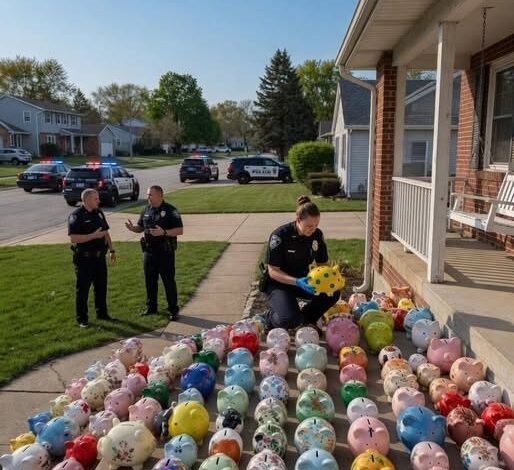
The entire lawn was covered with piggy banks.
Hundreds of them.
Large ones.
Tiny ones.
Ceramic pigs.
Glass jars.
Plastic banks shaped like animals and cartoon characters.
Everywhere I looked, there were piggy banks.
It looked like they had appeared overnight.
Officer Hayes stepped forward with a grin.
“Looks like your son started something,” he said.
As more neighbors gathered, the story slowly unfolded.
Word had spread about Oliver giving away his savings to help Mrs. Adele.
People had heard.
And they wanted to respond.
Not because of the money.
Because of what it represented.
One by one, neighbors began sharing stories.
An elderly man explained that years ago Mrs. Adele secretly paid for his groceries when he lost his job.
A police officer admitted that when he was a child, she made sure he had lunch money.
Another neighbor remembered finding winter coats on her doorstep during a difficult year.
Someone else described receiving groceries anonymously during a family emergency.
Again and again, people told similar stories.
Acts of kindness.
Quiet generosity.
Help offered without recognition.
Without expectation.
Without applause.
Standing there, I realized something I had never fully understood.
The woman we thought lived alone had spent years holding an entire community together.
Most of us simply never knew.
By midmorning, the yard had become something extraordinary.
Volunteers organized donation drives.
Local businesses offered assistance.
People signed up to help with repairs, groceries, transportation, and future expenses.
The piggy banks were no longer about money.
They had become symbols of gratitude.
A visible reminder that kindness eventually comes home.
When Mrs. Adele arrived, walking slowly down the sidewalk, the crowd erupted into applause.
She covered her mouth.
Tears streamed down her face.
For perhaps the first time in her life, she saw the full impact of everything she had done for others.
And she discovered she was no longer facing hardship alone.
That evening, after the excitement had finally settled, I tucked Oliver into bed.
Before turning off the light, I asked him one question.
“What did Mrs. Adele whisper to you when she hugged you?”
Oliver smiled sleepily.
He thought for a moment.
Then he said:
“She told me kindness travels farther than you can see.”
After he fell asleep, I sat quietly beside his bed.
I thought about everything that had happened.
A single act of generosity.
One small red piggy bank.
One little boy who saw a problem and decided to help.
That was all it took.
Weeks passed.
Life gradually returned to normal.
But every night, Mrs. Adele’s porch light glowed brightly again.
Whenever I saw it, I remembered what Oliver had taught me.
Kindness doesn’t disappear.
It multiplies.
It moves from person to person, often unnoticed, until one day it returns in ways nobody could predict.
My son believed a piggy bank could bring back someone’s light.
In the end, he was right.
He just brought back far more than electricity.
He reminded an entire town who they were.
And sometimes, that’s the brightest light of all.