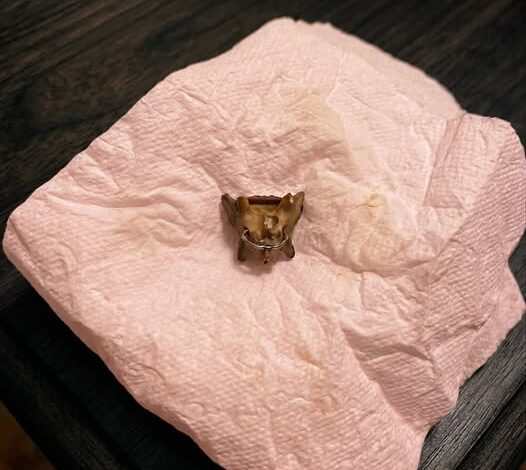
What started as an ordinary moment quickly turned into a mystery that left everyone in the room both fascinated and unsettled.
She walked over with a grin on her face and casually dropped the small object into my hand, clearly expecting me to identify it within seconds. At first glance, it seemed like the kind of thing someone might find on a sidewalk or tucked away in an old drawer—a random item with no obvious significance. But the moment I looked down at it, my confidence disappeared.
The object was strange.
Its pale color and rough texture immediately caught my attention. The jagged ridges along its surface looked uncannily similar to a row of tiny teeth fused together into a single piece. It was small enough to fit comfortably in the palm of a hand, yet detailed enough to make it feel unsettlingly organic. The longer I stared at it, the less certain I became about what I was holding.
What should have been a quick answer instead created an uncomfortable silence.
Everyone nearby leaned in for a closer look. The object passed from hand to hand as each person examined it from a different angle. Nobody seemed willing to make a confident guess. The shape resembled bone, but something wasn’t quite right. There was an unusual metal component attached to one side, and that detail complicated every theory we came up with.
At first, we assumed it had to be some kind of biological fragment. The texture, color, and overall appearance seemed too convincing to be anything else. Yet the metal piece suggested human intervention, which only made the mystery more bizarre.
Questions started flying around the room.
“Could it be part of a jawbone?”
“What if it’s from a small animal?”
“Is it some kind of medical device?”
“Why would there be metal attached to it?”
With every suggestion, the object seemed to become stranger.
Someone pointed out that the ridges looked almost exactly like teeth. Another person argued that the shape resembled part of a spine. Someone else wondered whether it could be a fragment from a surgical implant or a piece of orthopedic hardware. The theories grew increasingly dramatic as our imaginations took over.
The fact that nobody could immediately identify it only added to the tension.
As we continued examining it, the object began to feel less like a random find and more like something we weren’t supposed to be holding. There was something inherently unsettling about it. The possibility that it might have once been attached to a living creature made everyone slightly uncomfortable.
The atmosphere shifted from curiosity to genuine unease.
The more we looked, the more convinced we became that it had to be biological. The shape seemed too natural, too irregular, too convincing to be a manufactured object. Every tiny groove and ridge appeared to support that conclusion. The attached metal piece only deepened the mystery. If it really was bone, why was there metal attached to it? And how had it ended up lying unnoticed on a store floor?
Nobody had a satisfying answer.
Determined to solve the mystery, we turned to the internet.
Phones came out. Search engines were opened. Images of bones, teeth, implants, medical devices, and animal skeletons filled our screens. We compared photographs from countless websites, zooming in on details and matching shapes. For a while, every new image seemed to support a different theory.
One minute we were convinced it was part of a jaw.
The next minute we thought it might belong to a small animal.
Then someone found photos of surgical implants that looked vaguely similar, reigniting concerns that it could be some kind of discarded medical component.
The investigation continued for far longer than anyone expected.
What had begun as a simple question had evolved into a full-scale group effort. Everyone wanted an answer. Everyone wanted the mystery solved.
Then, finally, someone found an image that stopped the conversation cold.
The resemblance was undeniable.
Suddenly all the strange details that had confused us started making sense. The tooth-like ridges. The pale coloring. The attached metal piece. The unusual shape.
It wasn’t a bone.
It wasn’t part of a skeleton.
It wasn’t a medical implant.
It wasn’t anything remotely as horrifying as we had imagined.
The mysterious object was actually an old orthodontic component from a set of dental braces.
For a brief moment, nobody said anything as the realization sank in.
Then came the laughter.
All of the tension that had been building for the past several minutes disappeared instantly. The theories about jawbones, spinal fragments, and surgical hardware suddenly seemed ridiculous. What we had treated like a disturbing biological artifact was actually a forgotten piece of someone’s orthodontic treatment.
The relief was immediate.
Looking back at the object now, the clues seemed obvious. The metal piece that had confused us from the beginning was exactly what should have given it away. But once the mind starts constructing dramatic explanations, it becomes surprisingly easy to overlook simpler answers.
The experience became a reminder of how quickly human imagination can transform an ordinary object into something far more mysterious. A small item found on a store floor had managed to convince multiple people that they were looking at a fragment of bone. For a short time, every possibility felt plausible, and every new theory seemed more convincing than the last.
In the end, the mystery wasn’t solved through expertise or intuition but through persistence and a lot of internet searching.
What appeared to be a tiny piece of a skeleton turned out to be a tiny piece of someone’s smile.
And just like that, the horror story we had been building in our minds transformed into a comedy.
The strange object that had sparked confusion, concern, and more than a few wild theories was nothing more than a forgotten orthodontic component, accidentally lost and eventually discovered by a group of curious strangers. Yet for those few moments before the truth emerged, it had been one of the most mysterious things any of us had ever held.
Sometimes the scariest discoveries turn out to have the simplest explanations. And sometimes, what looks like a bone from a horror movie is really just a reminder that appearances can be incredibly deceiving.