For generations of moviegoers, Clint Eastwood never seemed like someone who could become fragile.
He walked through cinema history with the kind of presence that felt carved from stone:
the narrowed eyes,
the slow voice,
the silence more intimidating than shouting,
the sense that nothing—not fear, pain, or age—could truly bend him.
Even people who never watched westerns still understood what Clint Eastwood represented culturally.
Strength.
Control.
Endurance.
That is why news of serious health struggles now surrounding him lands with such unusual emotional weight.
Not simply because he is famous.
Because figures like Eastwood become woven into people’s understanding of permanence itself. They exist in memory almost outside ordinary aging. Audiences remember the gunslinger squinting through desert dust, the detective standing alone against corruption, the aging boxer trainer carrying grief quietly behind exhausted eyes.
The characters changed over decades, but one thing remained constant:
he always seemed unbreakable.
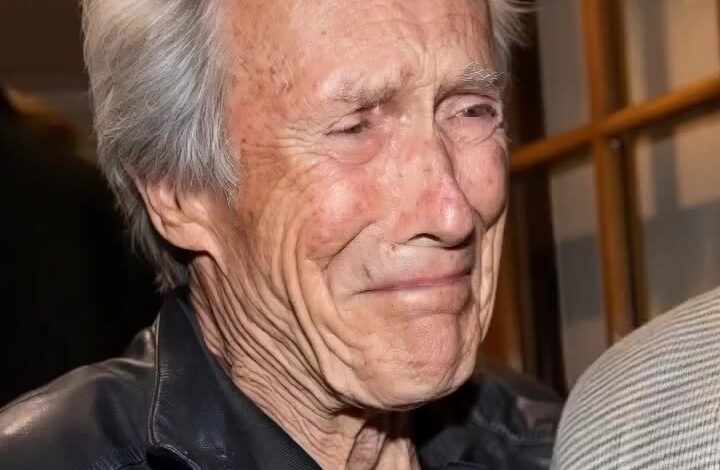
Now, for perhaps the first time, the public is being asked to confront something deeply human underneath the legend.
His children’s statement carried that emotional tension carefully. They did not reveal specific medical details, but they made one thing unmistakably clear:
their father is facing serious health challenges and receiving ongoing treatment.
And perhaps what resonated most was not fear alone.
It was protectiveness.
Their message sounded less like a publicity announcement and more like a family instinctively gathering around someone who has spent a lifetime being the steady center of gravity for everyone else.
They asked for compassion.
For space.
For understanding.
Those requests matter because illness transforms celebrity in uncomfortable ways. Public figures spend decades becoming symbols—icons larger than ordinary life. But sickness strips away mythology quickly. Suddenly the person audiences projected invincibility onto becomes simply:
someone’s father,
someone’s grandfather,
someone sitting through treatments,
someone surrounded by worried family members trying to remain hopeful.
That transition can feel emotionally jarring for fans because Clint Eastwood’s image has always been so closely tied to resilience itself.
From the beginning, his career revolved around men who survived harsh worlds through sheer willpower.
The “Man with No Name” in Sergio Leone’s westerns barely spoke, yet radiated complete command over every room, every duel, every threat. Later came Dirty Harry, perhaps one of the defining cinematic embodiments of relentless toughness in American film history.
Even as he aged, Eastwood did something unusual in Hollywood:
he allowed age to become part of his storytelling rather than pretending it did not exist.
That may be one reason audiences continued respecting him across generations.
He did not cling desperately to youthful image preservation. Instead, his later films became increasingly reflective, morally complicated, and emotionally vulnerable.
Unforgiven dismantled the mythology of violence.
Million Dollar Baby explored grief and mercy.
Gran Torino transformed an aging, isolated man into someone rediscovering humanity through reluctant connection.
Again and again, Eastwood’s later work returned to one recurring idea:
strength is not the absence of pain.
It is carrying pain without surrendering completely to bitterness.
Perhaps that is why the current news feels especially poignant.
Because the man who spent decades portraying endurance is now confronting the most universal limitation of all:
the body itself eventually weakens, no matter how powerful the legend surrounding it becomes.
Still, the statement from his children also emphasized something else repeatedly:
his resilience.
That word appears almost inevitable when people speak about Clint Eastwood. Not only because of his screen persona, but because of the life he actually built across nearly a century.
Few careers in entertainment history have remained culturally relevant for so long. Actor, director, producer, composer—Eastwood evolved constantly while many of his contemporaries faded. He survived changing film eras, shifting political climates, and an industry notorious for discarding aging stars.
And through all of it, people who worked with him often described him similarly:
disciplined,
focused,
calm,
unshakably steady.
His children’s reflections suggest that same steadiness existed privately too.
They spoke not only about his accomplishments, but his guidance.
His presence.
The feeling that he remained an anchor inside their lives regardless of fame or public mythology.
That detail matters because celebrity often distorts how audiences understand legacy. People focus on awards, box-office records, iconic scenes.
Families remember something quieter:
advice,
consistency,
humor,
the way someone entered a room,
the feeling of safety attached to their voice.
Those are the things illness suddenly makes feel fragile.
And perhaps that is why public reactions to the news have carried such tenderness online.
People are revisiting old films.
Sharing favorite lines.
Posting interviews and scenes that shaped entire generations of moviegoers.
Not because they believe nostalgia changes medical reality.
Because memory becomes a form of holding on.
When audiences fear losing someone culturally significant, they instinctively begin preserving the emotional imprint that person left behind.
For Clint Eastwood, that imprint stretches across decades of American storytelling itself.
He represented a particular kind of masculinity that modern culture simultaneously critiques and deeply misses:
reserved but dependable,
emotionally guarded yet fiercely loyal,
capable of violence but often haunted by it afterward.
Even people who disagreed with his politics or artistic choices usually acknowledged the force of his presence onscreen.
And now, as uncertainty surrounds his health, those decades of accumulated cultural memory suddenly feel more precious.
There is another emotional layer here too:
Clint Eastwood belongs to a shrinking generation of Hollywood giants whose careers connected directly to earlier eras of American cinema.
As figures like him age, audiences are not only confronting personal mortality—they are confronting cultural mortality too.
Entire cinematic worlds disappear with these people eventually:
the western era,
the gritty 1970s crime dramas,
the old studio systems,
the slower style of movie stardom built before social media turned celebrity into constant visibility.
Eastwood carried pieces of all those eras simultaneously.
Which makes the idea of losing him feel larger than losing one actor alone.
Still, perhaps the most moving part of his children’s message is the insistence that he is not facing this alone.
Surrounded by family.
Receiving the best care possible.
Held close by the people who know him not as icon, but as father.
That distinction matters enormously.
Because in the end, no amount of fame protects anyone from needing exactly the same things ordinary people need during illness:
comfort,
presence,
patience,
love,
someone holding your hand through uncertainty.
The public sees Clint Eastwood as a legend.
His children see the man who raised them.
And somewhere between those two identities sits the real emotional power of this moment.
Millions of fans are now hoping that the same quiet steel which defined his greatest performances still exists within him physically—that the resilience audiences watched onscreen for decades might somehow carry into this deeply human battle too.
Maybe that hope is unrealistic.
Maybe it is emotional projection.
But hope has always surrounded Clint Eastwood stories.
The lone man riding forward despite impossible odds.
The aging fighter refusing surrender.
The damaged hero carrying on anyway.
Audiences learned to associate him with survival.
So now, as uncertainty hangs over this painful chapter, people everywhere are holding onto that familiar instinct one more time:
believing the man who spent a lifetime portraying endurance may still have more fight left in him yet.