The collision between political comedy and real-world violence has become one of the most volatile fault lines in modern American culture.
What once might have been dismissed as another late-night joke now unfolds inside an atmosphere already saturated with fear, polarization, conspiracy, and constant outrage. That is exactly why the controversy involving Jimmy Kimmel, Melania Trump, and the security scare near the White House Correspondents’ Dinner escalated so quickly beyond ordinary celebrity backlash.
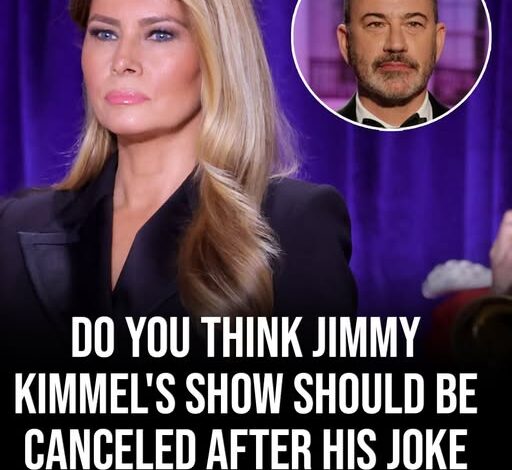
At the center of the dispute was a joke aired during Jimmy Kimmel Live! in which Melania Trump was referred to as an “expectant widow.” Kimmel framed the line as political satire tied to the couple’s age difference and public image, but critics immediately argued the wording crossed into dangerous territory because it implicitly referenced the possibility of Donald Trump’s death.
Under normal political conditions, the joke might still have generated backlash, but events unfolding days later dramatically altered the emotional context surrounding it.
When gunfire erupted near a security checkpoint during the White House Correspondents’ Dinner in Washington, D.C., panic spread rapidly through the high-profile event. Secret Service agents moved quickly to secure the president and attendees as confusion and fear rippled through the venue. Even though details surrounding the shooting remained limited initially, the incident instantly transformed public sensitivity around political rhetoric and violent imagery.
That timing is what intensified the controversy so dramatically.
To Melania Trump, the joke no longer felt like ordinary satire delivered safely inside the insulated world of late-night television. In her public response, she described the remark as “hateful and violent rhetoric,” arguing that language normalizing death or harm against political figures contributes to a broader atmosphere of hostility consuming American public life.
Her criticism reflected something larger than personal offense alone.
For many political families—regardless of party—security threats are not abstract concepts. Public figures routinely operate under constant protection precisely because violent threats, stalking, harassment, and attempted attacks have become increasingly common realities in modern politics. Families live with restricted movement, security screenings, online threats, and contingency planning that ordinary citizens rarely see.
That reality changes how jokes involving death or violence are experienced emotionally.
Donald Trump reacted similarly, arguing the comment crossed ethical boundaries and reflected a broader pattern of public hostility directed toward his family. His supporters echoed those criticisms online, accusing late-night comedians and media personalities of normalizing dehumanizing rhetoric toward political opponents while dismissing concerns as “just comedy” whenever backlash emerges.
Kimmel, however, defended the joke publicly during his broadcast. He insisted audiences misunderstood the intent and emphasized that the line was meant as a satirical jab about the Trumps’ age gap and relationship dynamic—not as a literal suggestion of harm. In his view, the outrage reflected selective interpretation rather than malicious intent.
That defense highlights one of the oldest tensions surrounding political satire:
where exactly does comedy end and recklessness begin?
Historically, satire has always occupied uncomfortable territory. Political comedians challenge authority by exaggerating flaws, mocking hypocrisy, and pushing against public figures who hold enormous power. Democratic societies have long treated satire as a form of protected cultural pressure—a way to criticize leaders without direct censorship.
But modern media environments complicate satire profoundly.
Today, jokes no longer exist only inside isolated comedy clubs or late-night monologues viewed casually before bed. Clips spread instantly across social media, stripped of context, amplified emotionally, and consumed by audiences already primed for outrage. Tone becomes harder to interpret. Intent becomes secondary to reaction.
And crucially, audiences now encounter political humor inside a climate shaped by real violence:
assassination attempts,
mass shootings,
threats against judges,
attacks on public officials,
and growing fears about domestic extremism.
That context changes how people emotionally process even hyperbolic jokes.
Critics of Kimmel argue that references implying death or widowhood become irresponsible when political tensions already feel dangerously unstable. They believe comedy loses moral protection when it touches imagery too close to actual threats against life and security.
Defenders of Kimmel see something entirely different.
To them, restricting satire because public figures experience threats creates a chilling effect where comedians become afraid to criticize powerful people at all. They argue that satire has always relied on exaggeration, discomfort, and provocation. If political jokes must avoid every emotionally sensitive topic, comedy itself becomes toothless.
Both sides are responding to legitimate anxieties.
One fears normalization of violent rhetoric.
The other fears erosion of free expression.
And perhaps what makes this conflict especially combustible is that entertainment and politics are no longer truly separate worlds in America.
Late-night hosts function partly as political commentators.
Politicians perform constantly through media.
Social media turns outrage into currency.
Public figures become entertainment products while entertainers become political actors.
The boundaries have collapsed.
That collapse creates strange cultural consequences.
A joke becomes a national controversy.
A security incident becomes instantly politicized.
A comedian’s monologue gets analyzed like a campaign speech.
A public official’s reaction becomes entertainment content itself.
Meanwhile, ordinary audiences are left navigating an exhausting emotional environment where every controversy feels existential depending on political identity.
For Trump supporters, Kimmel’s joke represented elite media cruelty toward a family already living under intense scrutiny and danger.
For Kimmel’s defenders, the backlash represented another attempt to weaponize outrage against criticism and satire.
Neither side trusts the other’s motives anymore.
And that distrust may be the deeper story underneath the controversy.
Because increasingly, Americans no longer merely disagree politically.
They disagree about reality,
intent,
language,
humor,
and what counts as acceptable humanity toward opponents.
One side hears satire.
Another hears incitement.
One hears sensitivity.
Another hears censorship.
The emotional distance between those interpretations keeps widening.
Melania Trump’s response also carried a more personal dimension often overlooked in political commentary. Throughout her years in public life, she has repeatedly attempted to position herself slightly outside the constant rhetorical warfare surrounding her husband. Her public statements are relatively rare compared to Donald Trump’s own media style, which gives moments like this additional visibility when she does choose to respond directly.
By framing the issue around toxicity and division, she attempted to shift the conversation beyond celebrity insult into broader concerns about national culture itself.
And perhaps that concern resonates more widely than either side fully acknowledges.
Because Americans across the political spectrum increasingly describe feeling emotionally exhausted by the constant escalation:
more outrage,
more hostility,
more personalization,
more language drifting toward cruelty rather than disagreement.
Comedy reflects that environment, but it also shapes it.
Political humor can expose hypocrisy brilliantly.
It can also harden tribal instincts until opponents stop feeling fully human to one another.
That is the uncomfortable tension modern satire now faces.
Not whether jokes should exist.
But whether audiences and creators alike still recognize the emotional difference between mocking power and feeding a culture already saturated with mutual contempt.
The Kimmel controversy may fade from headlines eventually, as most media storms do.
But the larger conflict surrounding it will remain unresolved.
Because the real argument is no longer only about one joke or one television host.
It is about whether Americans still share enough common emotional ground to laugh, criticize, disagree, and argue without constantly interpreting one another through the language of threat and destruction.
And right now, that common ground feels increasingly fragile.