Every Night, the Dog Would Not Leave the Baby’s Crib — What the Camera Captured Explained Everything

The first weeks after bringing a newborn home rarely feel peaceful in the way people imagine before becoming parents.
Even inside loving households, life changes shape almost overnight. Sleep disappears into fragments. Every tiny sound carries urgency. The silence between cries becomes strangely tense because new parents are constantly listening, monitoring, anticipating.
A baby transforms an entire house psychologically.
Rooms once ordinary suddenly feel fragile.
Nighttime feels heavier.
Responsibility hums beneath every moment.
That was exactly how life felt for Daniel and Rebecca after bringing their daughter home from the hospital.
Before the birth, their evenings had followed familiar routines:
quiet dinners,
television playing softly,
their golden retriever Lora stretched comfortably across the living room floor while the house settled into predictable calm.
After the baby arrived, everything changed.
The home became filled with soft crying sounds, hurried footsteps at strange hours, bottles warming in dim kitchen light, whispered conversations between exhausted parents trying not to wake the child they had just spent an hour soothing to sleep.
And woven quietly into all those changes was another shift neither of them fully understood at first:
Lora’s behavior.
At first, it seemed sweet.
Almost touching.
Like many dogs around newborns, Lora appeared fascinated by the baby from the very beginning. She followed Rebecca from room to room while she carried the infant. Whenever the baby slept in the crib during the day, the dog positioned herself nearby instinctively, watching with calm attention.
The couple interpreted it the way most people would.
Protectiveness.
Animals often respond strongly to infants. Stories about dogs becoming gentle guardians around babies are common enough that Lora’s attachment initially felt reassuring rather than strange.
But after several weeks, Rebecca began noticing something unusual about the pattern.
Lora was not simply “checking on” the baby occasionally.
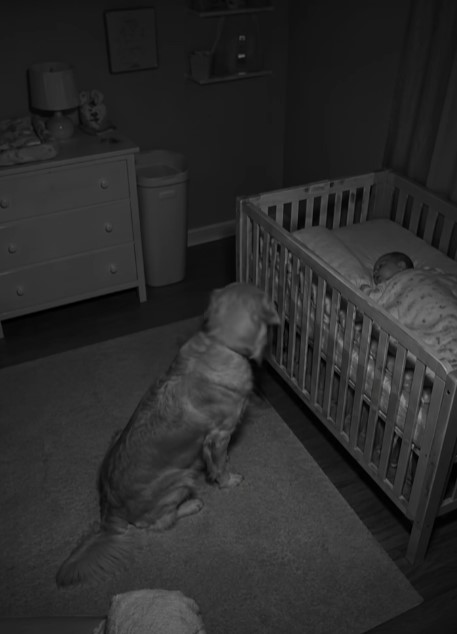
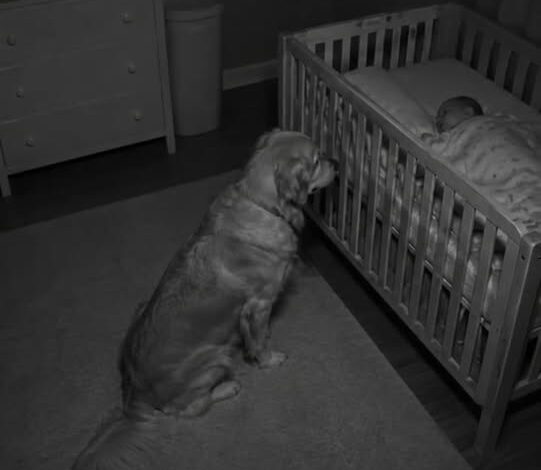
Every single night, once the house quieted completely, the dog walked directly into the nursery and stationed herself beside the crib with almost ritualistic consistency.
And then she stayed there.
Not sleeping.
Watching.
At first Rebecca assumed the dog would eventually curl up comfortably nearby once everyone settled in for the night. But whenever she checked the nursery hours later, Lora remained sitting upright in the same alert posture, eyes fixed toward the crib or occasionally the room itself.
The behavior repeated night after night.
Always the same.
During the daytime, Lora acted completely normal:
playful,
relaxed,
eating normally,
happy to greet visitors.
But at night something changed inside her.
A kind of vigilance settled over the dog so completely that even Daniel eventually admitted it felt unsettling.
“What if she hears something we don’t?” Rebecca whispered one night while watching the dog through the cracked nursery door.
Daniel tried to dismiss the thought initially.
Old houses make noises.
Dogs react to random sounds.
Maybe she simply felt protective.
Still, the consistency became impossible to ignore.
The dog never abandoned her post.
Never slept deeply.
Never relaxed fully.
Sometimes Rebecca would wake at three or four in the morning and quietly stand in the hallway watching the nursery doorway, trying to understand what exactly Lora seemed to be waiting for in the darkness.
Eventually the uncertainty itself became exhausting.
The couple began discussing possibilities:
perhaps animals outside,
unusual neighborhood sounds,
a smell drifting through vents,
or maybe simple overstimulation caused by the newborn’s arrival.
But uncertainty has a way of growing larger at night.
Especially for exhausted parents already emotionally raw from lack of sleep and overwhelming responsibility.
Finally, Daniel suggested installing a night-vision camera facing the crib.
“Just so we can see what she’s reacting to,” he said.
The idea sounded reasonable enough.
They set up the camera carefully the following evening, angling it to capture both the crib and most of the nursery window. Rebecca felt strangely nervous afterward despite telling herself nothing unusual would happen.
That night, Lora followed her routine exactly as before.
The house darkened.
Lights clicked off one by one.
The baby slept peacefully.
And the dog walked silently into the nursery and sat beside the crib.
For hours, nothing happened.
The footage later showed only ordinary nighttime movement:
the baby stirring occasionally,
Lora shifting positions slightly,
soft shadows moving across the room as headlights passed outside.
Then, sometime near dawn, everything changed instantly.
Lora reacted first.
The footage captured the exact moment her posture stiffened.
One second she sat calmly beside the crib.
The next, every muscle in her body tightened.
Her ears lifted sharply.
Head turning toward the nursery window.
Completely focused.
Daniel would later replay that moment repeatedly because what frightened him most was how certain the dog seemed before any visible threat even appeared.
Then the movement came.
Subtle at first.
The window frame shifted slightly.
Barely noticeable unless someone was already watching carefully.
Then again.
This time more deliberately.
A narrow gap appeared near the lower edge of the window, followed by something infinitely more horrifying:
fingers.
A hand slowly probing inward through the opening.
Testing the frame.
Trying to widen access quietly.
Rebecca later said the footage made her physically sick because of how calm the movement looked. Whoever stood outside moved carefully, patiently, as though expecting everyone inside to remain asleep while they entered a house containing a newborn child.
But before the intruder could move further, Lora exploded into motion.
The transformation was instantaneous.
Gone was the calm family pet sitting quietly beside the crib.
The dog launched toward the window barking with violent force, positioning herself directly between the crib and the intrusion point while snarling loud enough to shake the room itself.
The hand vanished immediately.
The window snapped shut.
And within seconds the figure outside disappeared completely.
Inside the house, chaos erupted.
Daniel woke first to the barking and sprinted toward the nursery while Rebecca grabbed the baby from the crib with trembling hands. Lora remained near the window barking furiously even after the threat disappeared, refusing to settle until Daniel checked every lock and room in the house.
Police arrived quickly after Rebecca called emergency services.
By sunrise, investigators were reviewing the footage carefully while the couple sat shaken beneath blankets in their kitchen trying to process how narrowly something terrible may have been avoided.
The investigation uncovered something even more disturbing afterward.
Their home was not random.
Authorities revealed that multiple attempted break-ins had been reported throughout nearby neighborhoods during recent weeks. Someone had apparently been targeting homes late at night, testing windows and entry points while families slept.
The footage from Daniel and Rebecca’s nursery became crucial evidence.
Combined with surveillance from nearby streets and physical traces collected elsewhere, investigators eventually identified a suspect connected to several attempted intrusions across the area.
Police later told the family something Rebecca never forgot:
Lora’s reaction likely stopped the intruder from entering fully.
That realization changed the emotional atmosphere inside the home completely.
For weeks, the dog’s behavior had created unease because it seemed unnatural and impossible to explain. Rebecca had even briefly worried something might be psychologically wrong with her.
Now every sleepless night beside the crib looked different in hindsight.
Lora had not been acting strangely.
She had been listening.
Watching.
Protecting.
Animals often perceive subtle environmental changes humans miss entirely:
movement,
vibrations,
scent,
tiny noises hidden beneath ordinary household sound.
Whether Lora sensed previous attempts near the home or simply detected danger faster than human perception could, her vigilance may have prevented a devastating outcome.
Afterward, Daniel and Rebecca never tried discouraging the behavior again.
In fact, the opposite happened.
Lora’s nighttime position beside the crib gradually transformed from something unsettling into something comforting. The dog became woven into the family’s sense of security itself.
Each night she resumed her quiet watch beside the sleeping baby, no longer viewed with suspicion but gratitude.
And perhaps that is what makes the story resonate so deeply.
Not only the attempted intrusion.
But the realization hidden inside it:
sometimes love looks like vigilance.
Sometimes protection arrives silently long before danger becomes visible.
And sometimes the creature everyone assumes is simply sleeping at the foot of the crib is actually standing guard over the people it loves most.