An Elderly Woman Was Ignored at a Car Dealership—Until One Unexpected Moment Changed Everything

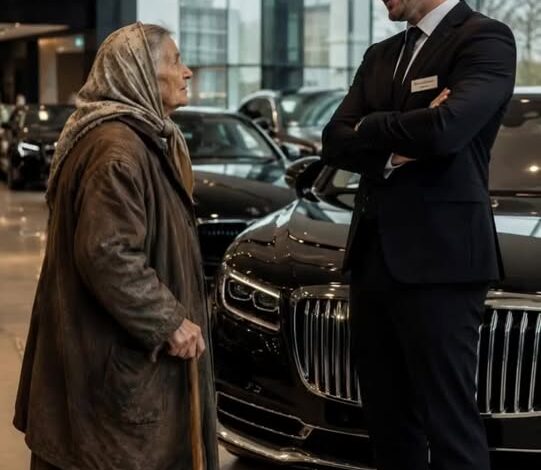
Luxury businesses often spend millions trying to create an image of sophistication, exclusivity, and prestige.
Polished floors.
Designer furniture.
Perfect lighting.
Employees trained to speak with practiced confidence beside products carrying six-figure price tags.
But no amount of branding can hide one simple truth:
the real character of a business reveals itself in the first few seconds of how it treats someone who appears powerless.
That was the lesson waiting quietly inside the luxury dealership the morning the elderly woman walked through its glass doors.
At first, nobody paid much attention to her.
The showroom moved with its usual rhythm: salespeople circulating confidently between expensive vehicles, customers discussing financing packages, soft music drifting through the polished space designed to signal wealth before a single word was spoken.
Inside environments like that, appearances become their own silent language.
People unconsciously sort one another almost immediately:
serious buyers,
casual visitors,
status symbols,
time-wasters.
And the elderly woman did not fit the image the dealership expected from high-end clientele.
Her coat looked worn from years of use.
Her shoes practical rather than fashionable.
She moved slowly, quietly, almost carefully, pausing beside vehicles with the kind of thoughtful attention most salespeople mistakenly interpret as curiosity rather than intent.
Several employees glanced toward her briefly before looking away.
That glance matters more than people realize.
Because prejudice often begins not with outright cruelty, but with assumption:
She probably cannot afford this.
She is not really buying.
She does not belong here.
The danger of assumptions is how quickly they become behavior.
Eventually the woman stopped beside a luxury SUV and rested her hand lightly against the vehicle’s side, studying it with genuine focus. She did not appear intimidated by the showroom itself. If anything, she looked reflective, as though carefully considering something meaningful rather than merely admiring an expensive object.
That was when the dealership manager approached.
At first, his tone remained professionally polite, but guarded in the way people become when they have already made silent judgments before conversation even begins. He asked whether she needed assistance.
The woman looked toward him calmly and said:
“I want to buy this car.”
Simple.
Direct.
Without performance or apology.
And almost instantly, the emotional atmosphere changed.
Instead of responding with enthusiasm—as luxury dealerships normally train employees to do when hearing the words “I want to buy”—the manager’s expression shifted toward skepticism. He crossed his arms. His posture tightened slightly. The conversation stopped feeling like customer service and started feeling like interrogation.
“How do you plan to pay for it?” he asked coldly.
Not:
Would you like to discuss options?
Can I show you the features?
Would you prefer financing or purchase?
The assumption underneath the question had already become visible:
prove you belong here.
The woman did not react emotionally.
Did not become defensive.
Did not argue.
She simply waited.
Perhaps expecting professionalism eventually to reappear.
Instead, the manager leaned closer and said something cruel enough for nearby customers and employees to overhear:
the dealership did not “do business with retirees,” and she likely would not live long enough for financing to matter anyway.
That moment transformed ordinary rudeness into humiliation.
Ageism often hides beneath jokes society tolerates too easily. People speak about older adults as burdens, irrelevancies, or inconveniences in ways they would never openly discuss other groups. The manager’s comment reflected something larger than personal arrogance:
a cultural obsession with visible wealth,
youth,
and performative status.
And perhaps most painful was what happened next.
Some people nearby laughed.
Not loudly.
Not maliciously enough to become memorable individually.
But enough.
Enough to reinforce the humiliation socially.
Enough to signal that public disrespect had become acceptable because of how the woman looked.
The manager continued speaking dismissively, insulting her appearance and suggesting she should leave entirely.
Still, the woman never raised her voice.
That restraint matters.
People often imagine dignity as dramatic confrontation:
the perfect comeback,
the public humiliation reversed instantly,
the crowd silenced by one powerful speech.
But real dignity often looks quieter than that.
Sometimes it looks like refusing to surrender your composure to people determined to strip it away.
The woman simply lowered her eyes, stepped away from the SUV, and walked toward the exit without another word.
Most people inside the showroom assumed the interaction was over.
To them, she became another forgettable customer who “could not afford” the lifestyle surrounding them.
What they failed to understand was that wealth often speaks softly.
Especially old wealth.
Especially people who no longer feel any need to prove themselves publicly.
Less than an hour later, the woman entered another luxury dealership across the street.
Same coat.
Same shoes.
Same quiet demeanor.
But everything changed immediately because one crucial variable changed too:
the attitude of the staff.
A young sales manager greeted her respectfully at the entrance and introduced himself professionally without hesitation or visible judgment. He asked how he could help. He listened carefully. He treated her exactly as any customer deserved to be treated before knowing anything about her finances.
That distinction became the entire story.
Because professionalism is not revealed when serving obvious wealth.
It is revealed when serving uncertainty with equal respect.
The young manager showed her vehicles patiently, explained features thoroughly, answered questions thoughtfully, and maintained the same calm professionalism throughout the interaction.
Then came the moment that shifted everything.
The woman requested not one vehicle—
but three identical luxury SUVs for her grandchildren.
The manager paused briefly in surprise.
But unlike the first dealership, surprise never turned into disrespect.
That difference changed the outcome entirely.
When the woman calmly revealed full payment for all three vehicles, the second dealership responded not with embarrassment, but efficiency. Paperwork began immediately. Every question she asked received serious attention. Every document was reviewed carefully.
And throughout the process, she remained composed, thoughtful, and emotionally unchanged by the contrast between the two experiences.
That emotional steadiness says something important too.
People who truly understand their own value rarely feel compelled to “teach lessons” loudly. The woman never returned angrily to confront the first dealership. Never demanded revenge. Never delivered a dramatic speech about prejudice.
Reality itself handled the lesson.
The following day, the three luxury vehicles left the second dealership together in coordinated delivery. Sunlight reflected across polished exteriors as they moved through the city streets toward their destinations.
And inside one of them sat the same elderly woman in the same modest coat.
When the convoy passed directly in front of the first dealership, the manager looked up toward the street almost absentmindedly at first.
Then recognition hit.
There she was:
the woman he dismissed,
the customer he humiliated,
the sale he lost entirely because he judged appearance before character.
Now seated comfortably inside a vehicle his dealership could have sold.
That realization carries a uniquely painful form of regret because it cannot be corrected retroactively. Some mistakes cost more than money. They expose flaws in judgment itself.
The dealership owner reportedly stood beside the manager silently watching the convoy disappear before finally speaking:
their assumptions had cost them a major business opportunity.
No dramatic punishment followed.
No public firing scene.
No cinematic revenge.
Only silence.
And perhaps silence felt worse.
Because underneath business loss sat something more uncomfortable:
proof that professionalism failed precisely where it mattered most.
Meanwhile, the second dealership gained far more than revenue.
They earned trust.
Reputation.
A story likely repeated for years afterward.
All because someone chose basic human respect before knowing whether profit existed.
That is ultimately why stories like this resonate so strongly emotionally.
Not because people enjoy watching arrogant individuals embarrassed.
But because almost everyone understands the deeper fear underneath it:
being dismissed before anyone truly sees you.
The elderly,
the poor,
the quiet,
the unfashionable,
the grieving,
the socially awkward—
many people know what it feels like to become invisible or underestimated in rooms built around status.
And stories like this offer a small emotional correction to that experience.
A reminder that appearances reveal very little about dignity,
capacity,
or worth.
The woman never needed expensive clothing to possess wealth.
Never needed loud confidence to command respect.
Never needed revenge to prove the first dealership wrong.
She simply continued being exactly who she already was.
And in the end, that calm certainty became more powerful than humiliation ever could.
Because true professionalism begins long before someone’s value becomes visible.
It begins the moment you decide whether another human being deserves respect before they have proven anything to you at all.