The Mind Blowing Reason This Terrified Pilot Burst Into Tears After An Emergency Landing Saved His Passengers From A Swarm Of Thousands Of Angry Birds

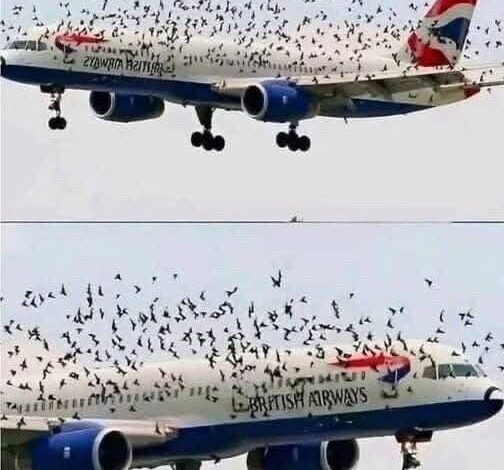
When the aircraft finally slammed onto the isolated lakeside airstrip, the passengers believed the nightmare was over. The landing gear screamed against the rough pavement, the cabin rattled violently, and for one terrifying second it felt as though the entire jet might split apart before coming to a stop. Then, suddenly, silence. The engines whined down into a trembling hum, and the plane rested motionless beneath a gray and endless sky.
For several seconds, nobody moved.
Then the cabin erupted.
People sobbed openly in their seats. A woman near the front clasped her husband’s face in both hands as if she couldn’t believe he was still alive. Someone laughed hysterically from the back rows. Oxygen masks still dangled from the ceiling like pale ghosts, swaying gently with the lingering vibrations of the aircraft. Hands shook uncontrollably. Flight attendants tried to calm passengers even as tears streamed down their own faces.
They had survived.
At least, that’s what everyone thought.
Captain Elias Mercer remained frozen in the cockpit, staring through the cracked windshield toward the lake beyond the runway. His fingers stayed locked around the controls even though the engines were idle now. Something outside felt wrong.
The birds hadn’t left.
Most wildlife would have scattered after the deafening chaos of an emergency landing. But these birds only gathered closer. Thousands of them.
The sky churned black with wings.
They lined the runway lights, crowded the hangars, covered the shoreline trees in restless layers of feathers and movement. More circled overhead in widening spirals, their cries sharp enough to pierce through the fuselage. It looked less like nature and more like an army surrounding its target.
Passengers slowly noticed it too.
A little boy pressed his face against the window and whispered, “Why are they still here?”
No one answered him.
Earlier that afternoon, the attack had begun without warning. The flight had been crossing remote wilderness when birds suddenly appeared out of nowhere—first a handful striking the windshield, then hundreds, then thousands. They battered the aircraft relentlessly, smashing into the nose, shredding part of an engine, clawing against windows with desperate fury.
At first, everyone thought it was a bizarre migration accident.
But accidents didn’t behave like this.
The birds had pursued the jet for nearly forty miles.
Even after the pilots changed altitude, they followed. Even after the engines roared louder, they came harder. Some slammed themselves against the plane so violently that feathers and blood streaked across the glass in horrifying smears. It felt coordinated. Intentional.
Predatory.
Now, stranded beside a forgotten lake in the middle of nowhere, the passengers watched in terrified silence as the flock thickened around them. The birds perched unnaturally close to the aircraft, heads twitching in sharp, synchronized movements. Their dark eyes reflected in the cabin windows like hundreds of tiny mirrors.
“Why aren’t they leaving?” someone whispered.
No one had an explanation.
Emergency crews from the tiny airstrip station were too frightened to approach. Even outside personnel remained locked inside vehicles, staring at the impossible sight gathering around the jet.
Then something changed.
A violent thud echoed from beneath the cabin floor.
Everyone jumped.
Another thud followed.
Not from outside.
From inside the aircraft.
Flight attendant Maria Torres turned pale. “The cargo hold,” she whispered.
Captain Mercer exchanged a glance with co-pilot Jason Hale before unbuckling himself. Every instinct screamed at him not to go below deck, but curiosity—and dread—dragged him forward.
The lower compartment was dim and cold, lit only by flickering emergency lights. Crates and luggage had shifted during the emergency landing, some overturned completely. The metallic smell of fuel mixed with something else now—something earthy, alive.
Then Jason noticed one crate shoved against the far wall.
Unlike the others, it carried no airline markings. No destination tags. No shipping labels.
Just a plain black container reinforced with steel mesh.
And it was moving.
A faint scratching sound came from inside.
Jason approached slowly, his pulse hammering in his ears. As he crouched beside it, another sound emerged—soft chirping. Weak. Fragile.
His stomach tightened.
Using a loose crowbar from the emergency kit, he forced the crate partially open.
Inside were dozens of eggs.
Large. Speckled. Rare-looking.
And alive.
Several trembled faintly under the dim light.
For a moment, neither man spoke.
Then the truth crashed into place with horrifying clarity.
The birds outside weren’t attacking the aircraft out of rage.
They were trying to stop it.
The eggs had been stolen.
Smuggled.
Trafficked through black-market wildlife channels hidden among ordinary cargo. Whatever species they belonged to, the parent birds had followed the plane across miles of open wilderness in a desperate attempt to recover them.
Suddenly the chaos of the day transformed into something entirely different.
Not random violence.
Not nature turning savage.
A rescue mission.
Jason stared down at the fragile eggs while distant screeches echoed through the hull above them. The birds outside weren’t monsters. They were parents.
And the humans aboard had unknowingly become kidnappers.
A heavy silence settled over the cargo hold. Jason felt shame crawl through him like ice water. Humanity had crossed oceans, built machines, conquered skies—and still managed to reduce living creatures to smuggled cargo hidden in darkness for profit.
Carefully, almost reverently, he lifted one of the eggs into his hands. It radiated faint warmth.
Alive.
Waiting.
Above them, another wave of cries swept across the sky.
Not angry now.
Desperate.
Jason closed the crate slowly and looked toward the ladder leading back into the cabin. The terrified passengers upstairs still believed they had survived an attack by mindless animals. They had no idea the real danger aboard the aircraft had come from human greed.
When he finally climbed back into the cabin, carrying the truth with him, the atmosphere felt different. The panic, the fear, the confusion—it all seemed smaller somehow.
Outside, thousands of birds still circled beneath the darkening sky.
Watching.
Waiting.
And for the first time that day, Jason no longer feared them.
Instead, he understood them.
As night settled over the silent lake, he looked through the window at the endless storm of wings and realized something humbling: humans may have learned to conquer the skies with steel and engines, but the sky itself was never ours alone.