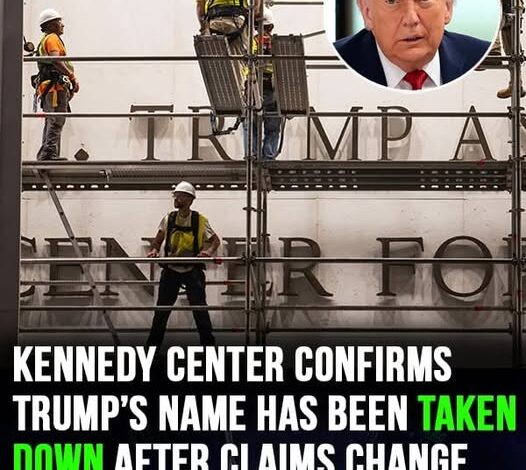
What began as a dispute over a name quickly evolved into something far larger—a battle over memory, power, and who gets to claim ownership of America’s cultural landmarks. The decision to remove Donald Trump’s name from the Kennedy Center was never just about signage. For many observers, it became a symbolic judgment on legacy itself, drawing a sharp line between honoring history and rewriting it.
To longtime patrons and supporters of the institution, the ruling represented a necessary act of preservation. The Kennedy Center was created as a living memorial to President John F. Kennedy, born from national grief and dedicated to celebrating the arts in his memory. In their eyes, attaching Trump’s name to that legacy transformed a place of remembrance into a political statement—one they believed violated the spirit of the institution.
Their reaction was not subtle.
Many described the move to associate Trump with the center as deeply inappropriate, arguing that a national monument should never become a vehicle for personal branding. Some expressed outright disgust, viewing the effort as an attempt to stamp a contemporary political identity onto a landmark whose purpose transcended party lines. To them, it felt less like recognition and more like appropriation—a powerful figure placing his mark on history that did not belong to him.
The ruling, therefore, was seen as more than a legal outcome. It was a reaffirmation of boundaries.
Supporters of the decision argued that certain institutions should remain larger than the political struggles of any single era. The Kennedy Center, they said, was intended to represent cultural achievement and national memory, not the ambitions of whoever happened to hold influence at a particular moment. By removing Trump’s name, they believed the institution was reclaiming its original purpose and protecting its identity from becoming entangled in partisan conflict.
But if one side viewed the ruling as a restoration, the other saw it as an attack.
Trump’s allies wasted little time pushing back. Far from accepting the decision, they framed it as yet another example of what they describe as an entrenched cultural establishment dismissing the millions of Americans who support the former president. To them, the controversy is not about preserving history—it is about exclusion.
In their view, Trump’s influence on American politics and culture is undeniable, regardless of whether his critics approve of it. They argue that recognizing his impact is not an act of self-promotion but an acknowledgment of reality. Efforts to remove his name, they contend, are driven less by principle than by political hostility.
As a result, the fight is far from over.
Supporters have promised appeals, public campaigns, and continued efforts to reverse the ruling. What opponents see as safeguarding a historic institution, Trump’s defenders see as erasing a figure they believe reshaped the nation. The disagreement has become another front in the broader cultural war that increasingly defines American public life.
At the center of the conflict stands a striking contrast.
On one side is a judge pointing to the clear language of federal law and the original mission of the Kennedy Center. The argument is straightforward: the institution exists to honor John F. Kennedy, and its purpose should not be altered to serve contemporary political interests.
On the other side is a determined movement unwilling to concede the symbolic ground. Members of the board and Trump supporters continue to insist that the former president deserves recognition, pledging to fight for what they call a correction of an unfair and politically motivated decision.
Neither side believes it is defending a mere name.
Instead, both view the dispute as a struggle over deeper questions: Who controls public memory? Who decides which figures deserve permanent recognition? And where is the line between honoring history and reshaping it?
Those questions have transformed a cultural institution into a national battleground.
The irony is impossible to ignore. The Kennedy Center itself remains physically unchanged. Its halls still host performances. Its stages still celebrate artists. Visitors still walk beneath the same architecture that has stood for decades. Yet the meaning attached to those walls has become fiercely contested.
What was once primarily a center for the arts has become a symbol of America’s political divide.
For some, the removal of Trump’s name represents a victory for historical integrity and institutional independence. For others, it represents an attempt by powerful cultural gatekeepers to deny recognition to a leader they dislike. The disagreement extends far beyond Washington and reflects a broader struggle over how Americans interpret their past, their present, and their future.
And that may be the most significant consequence of all.
The controversy is no longer about a plaque, a title, or a legal ruling. It has become a mirror reflecting the country’s deepest divisions. Each side sees the same decision and reaches a completely different conclusion. One sees protection. The other sees exclusion. One sees respect for history. The other sees political bias.
Meanwhile, the Kennedy Center stands quietly at the center of the storm.
Its marble walls remain untouched. Its grand façade looks much as it always has. Yet beneath that appearance of permanence, something has changed. The battle surrounding the institution has exposed how deeply questions of identity, legacy, and power now shape even the nation’s cultural spaces.
In the end, the building itself may endure unchanged, but the conflict surrounding it has left a lasting mark. The stone has not moved, the architecture has not shifted, and the memorial still honors the same president it was built to remember.
Yet the divisions revealed by the fight have become etched just as deeply into the national consciousness as any inscription carved into its marble.