The Secret Language of Your Cat: Why That Persistent Head-Butt Might Actually Be a Life-Altering Declaration

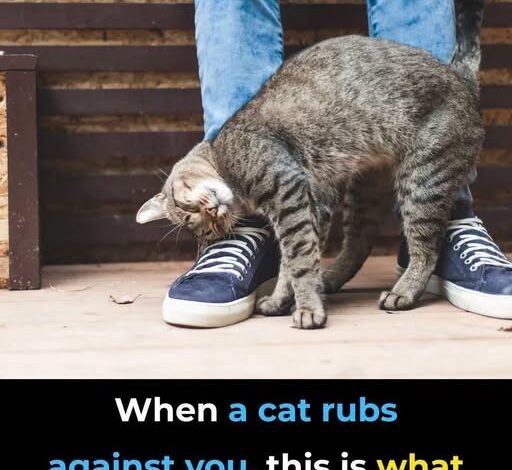
If your cat constantly rubs against your legs, presses their forehead into your hand, or insists on weaving through your ankles every time you walk across the room, you might assume they’re simply looking for food or trying to get your attention.
But in the feline world, those affectionate little collisions mean far more than most people realize.
What may seem like a quirky habit is actually one of the most important ways cats communicate trust, comfort, and belonging. Every head bump, cheek rub, and figure-eight around your legs is part of a silent language that has existed for thousands of years.
And if your cat is doing it regularly, they’re telling you something remarkable.
To understand why, you have to look beyond modern house cats and into their instincts.
Cats are often portrayed as independent creatures that tolerate humans rather than truly bond with them. Yet research and observation have repeatedly shown that cats form deep social attachments with the people they trust. Unlike dogs, whose affection is often loud and obvious, cats express their feelings in more subtle ways.
Rubbing is one of the clearest examples.
When your cat approaches and brushes against your legs after you’ve been away, they aren’t merely acknowledging your presence.
They’re greeting you.
In feline society, physical contact is a sign of familiarity and safety. Friendly cats often rub against one another as a form of social bonding. Mothers do it with kittens. Cats living together do it with trusted companions. It is their equivalent of a warm welcome home.
To your cat, you are not simply the person who fills the food bowl.
You are part of their social world.
That greeting matters.
But there’s an even deeper reason behind the behavior.
Cats experience the world through scent in ways humans can barely imagine.
While people rely heavily on sight and sound, cats gather enormous amounts of information through smell. Their bodies contain specialized scent glands located around the cheeks, chin, forehead, lips, and base of the tail.
These glands produce pheromones—chemical signals that communicate familiarity, safety, and identity.
When your cat rubs their face against your leg, hand, or furniture, they’re leaving behind those pheromones.
In other words, they’re marking you.
That may sound possessive, but in feline language it’s actually a compliment.
Your cat is essentially saying, “This is part of my safe world.”
By mixing their scent with yours, they create what behaviorists often call a shared social scent. This scent helps cats identify trusted individuals and familiar environments. It’s one reason cats living together often rub against each other repeatedly.
They are creating a collective family identity.
And if your cat includes you in that ritual, you’ve earned a place inside their inner circle.
For many cats, this scent-marking behavior becomes part of a daily routine.
You leave for work.
Your scent begins to fade.
You return home.
Your cat immediately reestablishes the connection.
The process isn’t random.
It’s reassurance.
Each rub renews the feeling of security and familiarity that helps your cat feel comfortable in their environment.
Of course, cats are also incredibly intelligent when it comes to getting what they want.
Over time, many learn that rubbing against their humans produces desirable results.
A treat.
A scratch behind the ears.
A cuddle.
A play session.
Attention.
If your cat has successfully used affectionate rubbing to earn rewards in the past, they’ll likely continue using it in the future.
From their perspective, it’s an excellent strategy.
Why meow repeatedly when a quick head bump gets immediate results?
This doesn’t make the affection fake.
Quite the opposite.
Cats tend to reserve physical contact for people they trust.
The fact that they’ve also learned it works to gain your attention is simply an added bonus.
However, not all rubbing behavior should be ignored.
While occasional rubbing is perfectly normal, sudden changes can sometimes signal a problem.
If your cat begins rubbing their face or body excessively against furniture, walls, floors, or people, it may indicate discomfort rather than affection.
Skin irritation, allergies, ear infections, parasites, or other medical issues can cause cats to rub more aggressively than usual.
The difference is often noticeable.
Affectionate rubbing appears relaxed and purposeful.
Problem-related rubbing may seem frantic, repetitive, or accompanied by scratching, hair loss, or signs of distress.
Whenever behavior changes dramatically, a veterinary evaluation is the safest course of action.
Another common source of confusion is the famous “head-butt followed by bite.”
Many cat owners know the experience.
Your cat rubs affectionately against you.
You begin petting them.
Everything seems perfect.
Then suddenly—nip.
The shift can feel completely unexpected.
But from the cat’s perspective, it often makes perfect sense.
Cats can become overstimulated more quickly than people realize. Physical affection that feels enjoyable one moment may become overwhelming the next. When that happens, some cats respond with a warning bite.
Usually, the signs appear before the nip.
A twitching tail.
Flattened ears.
Tense muscles.
Rapid skin twitching along the back.
These subtle signals indicate that your cat’s tolerance threshold is approaching.
Learning to recognize those cues can prevent misunderstandings and keep interactions positive.
Ultimately, what makes this behavior so meaningful is what it reveals about trust.
Cats are naturally cautious animals.
They don’t freely expose themselves to every person they encounter.
Trust is earned.
Built slowly through consistency, safety, and positive experiences.
When a cat presses their forehead against you, curls around your legs, or deliberately transfers their scent onto you, they’re offering something valuable.
Acceptance.
They are including you in their world.
Inviting you into a circle that few others enter.
So the next time your cat nearly trips you while weaving around your ankles in the kitchen, pause before feeling annoyed.
That furry obstacle isn’t trying to inconvenience you.
They’re performing an ancient ritual of connection.
They’re greeting you.
Marking you.
Trusting you.
And reminding you, in the only language they know, that you belong.
In a world that often feels uncertain, your cat has made a simple decision.
Of all the places they could be, all the people they could avoid, and all the corners they could hide in, they’ve chosen to make you part of their safe place.
And for a cat, there is no greater expression of affection than that.