Millions of Login Credentials Exposed Online — Here’s How to Check If Your Information Was Affected

For years, most people believed that protecting their online accounts was relatively simple.
Choose a strong password.
Avoid suspicious websites.
Maybe update your password once in a while.
That seemed like enough.
But cybersecurity experts now warn that the digital threats facing ordinary internet users have evolved far beyond those basic precautions. Modern cybercriminals are no longer focused solely on breaking into major corporations or exploiting weaknesses in large websites. Increasingly, they are targeting individual users directly, often through sophisticated malware that operates silently in the background while collecting valuable personal information.
One of the fastest-growing dangers in this area is a category of malicious software known as infostealer malware.
Unlike ransomware, which announces its presence by locking files or demanding payment, infostealer malware is designed to remain invisible.
Victims often have no idea their devices have been compromised.
The malware quietly searches infected computers for information that criminals can use for financial fraud, identity theft, account takeovers, and further cyberattacks.
Once installed, these programs can extract saved passwords from web browsers, login credentials, autofill information, browser cookies, authentication tokens, cryptocurrency wallet details, email account access information, and other sensitive data.
The stolen information is then transmitted to cybercriminals, who may sell it on underground marketplaces or use it themselves to access accounts and services.
What makes this threat particularly dangerous is that it bypasses traditional assumptions about cybersecurity.
Many people worry about whether a specific website has been hacked.
But infostealer malware changes the equation.
Instead of attacking the company that stores your information, criminals target your own device and take the information directly from you.
As a result, even users of highly secure services can become victims if their personal computer or smartphone is compromised.
Cybersecurity researchers have observed a dramatic increase in infostealer activity over the past several years.
The growth has been fueled by underground criminal networks that package and sell malware as a service, making sophisticated attacks available even to criminals with limited technical skills.
Today, entire cybercrime ecosystems exist where stolen credentials are bought, sold, traded, and shared among malicious actors around the world.
The scale of the problem became especially apparent following a recent discovery involving the Have I Been Pwned (HIBP) database.
Have I Been Pwned is a widely respected service that allows users to check whether their email addresses or account credentials have appeared in known data breaches or exposures.
The platform has become one of the most trusted public resources for monitoring compromised accounts.
Researchers recently added an enormous collection of stolen credentials to the database after uncovering a massive dataset compiled from infostealer malware infections.
The numbers are staggering.
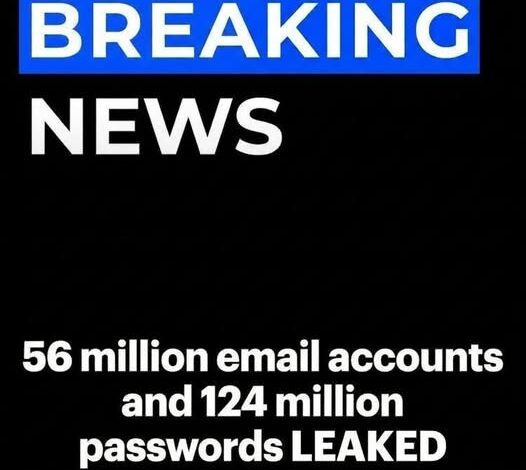
According to HIBP, the newly added records contain more than 56 million unique email addresses and approximately 124 million unique passwords.
Importantly, this was not the result of a single company being hacked.
Instead, the information came from hundreds of millions of individual infostealer logs collected from infected devices worldwide.
Each log represented data stolen directly from someone’s computer or device.
Together, they reveal the immense scale of modern credential theft.
For cybersecurity professionals, the discovery serves as another reminder that password security alone is no longer sufficient.
Even strong passwords can become vulnerable if malware gains access to the device where those passwords are stored.
This is one reason security experts strongly encourage users to avoid reusing passwords across multiple accounts.
When the same password is used repeatedly, a single compromise can quickly lead to unauthorized access across numerous services.
A criminal who obtains login credentials for one account may immediately attempt to use the same information on banking platforms, email providers, shopping websites, social media accounts, cloud storage services, and workplace systems.
The consequences can be severe.
Account takeovers can lead to financial losses, fraudulent purchases, identity theft, unauthorized transactions, data theft, and reputational damage.
In some cases, compromised email accounts become gateways to resetting passwords for dozens of other services.
That is why security professionals consistently recommend using unique passwords for every online account.
While managing numerous passwords manually can be difficult, password managers provide a practical solution.
These tools generate strong, random passwords and securely store them, reducing the temptation to reuse credentials across different platforms.
Experts also emphasize the importance of enabling two-factor authentication (2FA) whenever possible.
Two-factor authentication adds an additional layer of security beyond a password.
Even if criminals obtain login credentials, they may still be unable to access the account without a secondary verification method such as a mobile authenticator app, security key, or one-time verification code.
This extra step dramatically reduces the likelihood of successful account compromise.
For users who discover their information in the HIBP database, researchers recommend taking immediate action.
Affected passwords should be changed as soon as possible.
Priority should be given to email accounts, banking services, cloud storage platforms, work-related systems, and any accounts containing sensitive personal information.
Users should also review account activity for signs of unauthorized access and update security settings where necessary.
Importantly, finding your information in a breach database does not necessarily mean an account is currently compromised.
Some exposed credentials may be outdated or no longer active.
However, others may still be valid and protecting important accounts.
Because there is often no way to know which credentials remain usable to criminals, experts advise treating every exposure seriously.
The rise of infostealer malware also highlights the importance of broader device security.
Keeping operating systems updated, installing security patches promptly, avoiding suspicious downloads, using reputable antivirus solutions, and exercising caution with email attachments can significantly reduce infection risks.
Many infostealer infections begin with seemingly harmless downloads, fake software updates, pirated applications, malicious advertisements, or phishing emails.
Cybercriminals often rely on users lowering their guard.
Ultimately, the latest findings underscore a fundamental reality of modern cybersecurity.
Threats are no longer limited to large-scale corporate breaches that dominate headlines.
Increasingly, attackers are targeting individuals directly, harvesting information from personal devices one victim at a time.
The discovery of tens of millions of exposed email addresses and more than one hundred million passwords demonstrates just how widespread these attacks have become.
While the scale of the threat may seem intimidating, security experts stress that proactive measures can significantly reduce risk.
Using strong and unique passwords, enabling two-factor authentication, monitoring account security, updating devices regularly, and remaining alert to suspicious activity are among the most effective defenses available.
Cybersecurity is no longer just a concern for businesses, governments, or technology professionals.
It has become an essential part of everyday life.
And in an era where a single compromised password can open the door to an entire digital identity, staying informed and taking preventive action may be one of the most valuable investments a person can make in protecting themselves online.