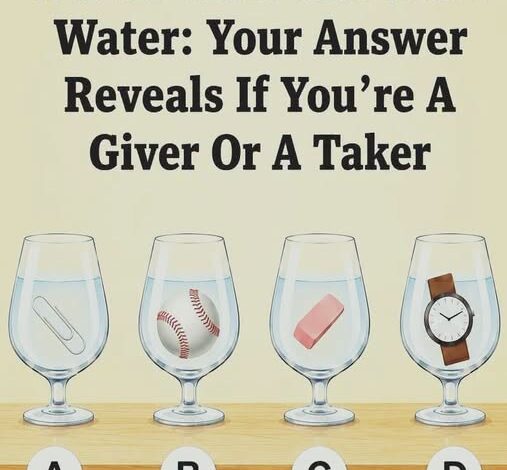
At first glance, the answer seems so obvious that most people don’t hesitate. Four identical glasses sit in a row, each filled to exactly the same visible water level. Inside each glass is a different object. The challenge appears simple:
Which glass contains the most water?
Thousands of people have confidently answered this puzzle online—only to discover they were wrong.
What makes this brain teaser so fascinating is that it exposes a hidden flaw in the way we think. Our eyes immediately tell us one story, while logic and science reveal another. The difference between those two perspectives is exactly why this puzzle continues to fool so many adults.
The setup could not be simpler.
There are four glasses labeled A, B, C, and D. Each glass appears equally full because the water reaches the same height in every container. The only difference is what sits inside.
Glass A contains a small paperclip.
Glass B contains a baseball.
Glass C contains an eraser.
Glass D contains a wristwatch.
Most people glance at the image and instantly assume all four glasses contain the same amount of water. After all, the containers are identical, and the water level appears perfectly equal.
That conclusion feels logical.
Unfortunately, it is also exactly what the puzzle wants you to think.
The trick lies in a detail that many people overlook because it is hidden beneath the surface.
To understand the correct answer, you have to forget about what the glasses look like and focus instead on a basic scientific principle: displacement.
Whenever an object is placed into water, it takes up space. That space cannot be occupied by water at the same time, so the object pushes water aside. The larger the object, the more water it displaces.
It’s the same reason a person stepping into a bathtub causes the water level to rise.
This principle completely changes the puzzle.
Although the water reaches the same height in all four glasses, not all of that visible volume is water. Part of the space inside each glass is occupied by the object submerged in it.
In other words, the bigger the object, the less room there is for actual water.
Now look at the glasses again.
The baseball in Glass B is by far the largest object. It occupies a significant portion of the glass, leaving much less space available for water. The wristwatch in Glass D also takes up a noticeable amount of room, while the eraser in Glass C occupies a moderate volume.
The paperclip in Glass A, however, is tiny.
Compared with the other objects, it barely takes up any space at all.
Because it displaces the least amount of water, Glass A contains more actual water than any of the others.
That means the correct answer is Glass A.
The beauty of this puzzle lies in how effectively it exploits a common mental shortcut.
Human brains are designed to make rapid judgments. We constantly rely on patterns and visual cues to help us navigate the world efficiently. Most of the time, this works remarkably well.
If we see four identical glasses filled to the same level, our minds automatically classify them as equal without conducting a detailed analysis.
It saves time.
It saves mental energy.
But occasionally, those shortcuts lead us astray.
This puzzle is a perfect example.
The moment people realize the answer depends on displacement rather than appearance, they often experience a mixture of surprise and amusement. They suddenly notice the crucial detail that had been sitting in plain sight the entire time.
That “aha” moment is one reason puzzles like this spread so quickly online.
People love being challenged.
Even more, they love discovering that the solution was hiding just beneath the surface all along.
Some versions of this puzzle go a step further by attaching personality interpretations to each answer choice. These descriptions are meant purely for entertainment and have no scientific validity, but many people enjoy them anyway.
According to these playful interpretations, people who choose Glass A are often described as detail-oriented thinkers who carefully analyze situations before reaching conclusions. They tend to notice subtle clues that others overlook and enjoy solving problems through logic.
Those who select Glass B are sometimes portrayed as confident decision-makers who trust their instincts and focus on the bigger picture rather than getting caught up in small details.
People who choose Glass C are often said to possess a balanced mindset, blending logic with intuition and approaching challenges from multiple angles.
Meanwhile, those drawn to Glass D are frequently described as reflective individuals who enjoy exploring deeper meanings and considering possibilities beyond the obvious.
Whether these descriptions have any truth to them is debatable, but they certainly add an extra layer of fun to the experience.
Yet the most valuable part of this puzzle goes beyond entertainment.
It teaches an important lesson about how easily appearances can mislead us.
In everyday life, people often make decisions based on what seems obvious at first glance. We form opinions from first impressions. We draw conclusions from limited information. We assume we understand a situation because it looks familiar.
But reality is often more complicated.
The most important details are not always visible.
A person may appear confident while struggling internally. A business opportunity may seem promising while hiding serious risks. A simple problem may contain complexities that only emerge after closer examination.
The paperclip in Glass A serves as a powerful metaphor for this idea.
At first glance, it seems insignificant.
Yet it is precisely because it occupies so little space that it becomes the key to solving the puzzle.
The smallest detail changes everything.
That lesson applies far beyond a row of water glasses.
Whenever something seems obvious, it is worth pausing for a moment and asking a simple question:
What might I be missing?
That extra moment of curiosity often reveals information others overlook.
It encourages critical thinking instead of automatic assumptions.
It transforms observation into understanding.
And that is why puzzles like this remain so enduringly popular. They are not really about finding the correct answer. They are about training the mind to look beyond appearances, question assumptions, and search for deeper truths.
So yes, the correct answer is Glass A.
But the real challenge is not identifying which glass contains the most water.
The real challenge is learning to recognize that what we see first is not always the full story.
Sometimes the truth is hidden in the smallest detail of all.