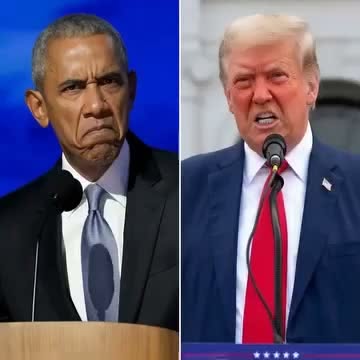
The most influential part of the exchange wasn’t what happened in the studio.
It was what happened afterward.
By the time millions of people encountered the moment online, they weren’t watching a conversation anymore. They were watching a reaction. A carefully selected fragment. A clip stripped of its surrounding context and repackaged for maximum impact.
The original discussion had already begun its transformation.
A political comment became a headline.
The headline became a clip.
The clip became a battleground.
And within hours, the battle itself became the story.
That transformation says as much about modern politics as the exchange that sparked it.
When Donald Trump criticized Barack Obama, the remark did not remain confined to the room where it was made. It immediately entered a media ecosystem designed to reward speed, emotion, and engagement. Producers clipped the most provocative moments. Social media accounts amplified the sharpest lines. Commentators interpreted, reframed, and redistributed the exchange through the lens of their own audiences.
By the end of the cycle, many people were no longer responding to what was actually said.
They were responding to what the moment had come to represent.
And those are rarely the same thing.
This is one of the defining realities of modern political communication.
Events no longer travel intact.
They travel edited.
Compressed.
Packaged.
Optimized for attention.
A conversation that may have lasted several minutes becomes a thirty-second clip. A nuanced exchange is reduced to a headline. A complicated discussion is transformed into a simple emotional choice: agree or disagree, support or oppose, cheer or condemn.
The space between those options grows smaller every year.
As a result, political moments increasingly function less as information and more as signals.
They tell audiences where they belong.
Who they should support.
Who they should distrust.
What they are expected to feel.
The actual content often becomes secondary.
What matters is the reaction it produces.
That reaction begins almost instantly.
Before people have time to examine the full context, conclusions are already forming. Opinions harden. Allegiances activate. Social media feeds fill with declarations of certainty from individuals who may have seen only a fraction of the original exchange.
Reflection becomes a casualty of speed.
The expectation is no longer to understand first and react later.
It is to react immediately.
The faster the response, the greater the visibility.
The greater the visibility, the more attention the moment receives.
And attention, in today’s media environment, is often treated as the highest form of currency.
This creates a powerful incentive structure.
The most emotionally charged moments spread the fastest.
The most divisive interpretations generate the strongest engagement.
The most dramatic framing attracts the largest audience.
Context, unfortunately, tends to move much more slowly.
A raised voice can travel around the world in minutes.
A full explanation often struggles to catch up.
That imbalance helps explain why political flashpoints frequently feel larger than the events themselves.
The moment stops being a conversation and becomes a symbol.
Supporters see validation.
Critics see confirmation of their concerns.
Both sides walk away believing the exchange proved something significant.
And because each group often consumes entirely different interpretations of the same event, they can leave with radically different understandings of what actually occurred.
The clip becomes a mirror.
People do not simply watch it.
They project themselves onto it.
Their frustrations.
Their loyalties.
Their expectations.
Their fears.
What they see often depends less on the moment itself and more on what they already believed before pressing play.
That is where the real challenge begins.
Because once political discussions become symbolic battles, truth becomes harder to locate.
Not necessarily because anyone is deliberately hiding it.
But because the surrounding noise grows so loud.
Every faction highlights details that support its perspective. Every platform rewards engagement over nuance. Every participant enters the conversation carrying assumptions shaped by previous battles.
The result is a public sphere where interpretation frequently outruns understanding.
In that environment, outrage becomes highly valuable.
It captures attention.
It generates clicks.
It encourages sharing.
Most importantly, it creates emotional investment.
People who feel angry are more likely to engage.
People who engage are more likely to remain involved.
And involvement drives the cycle forward.
The outrage itself becomes the product.
The exchange that started everything becomes almost incidental.
What remains is performance.
Political figures perform for supporters.
Commentators perform for audiences.
Platforms perform for engagement metrics.
Even ordinary users often find themselves performing loyalty through reactions, reposts, and declarations of agreement.
The pressure to choose a side becomes stronger than the desire to fully understand the issue.
That dynamic carries consequences.
Not just for individual political debates, but for public discourse itself.
When every disagreement is treated as a battle, compromise begins to look suspicious.
When every criticism is interpreted as an attack, dialogue becomes difficult.
When every exchange is viewed through the lens of loyalty, independent thinking can feel like betrayal.
The culture gradually shifts.
Conversations become contests.
Differences become divisions.
Opponents become enemies.
And politics transforms from a discussion about ideas into a constant test of belonging.
That may be the most lasting impact of moments like this.
Not the comment itself.
Not the interview.
Not even the individual personalities involved.
The deeper consequence is the habit they reinforce.
The habit of reacting before reflecting.
The habit of assuming before investigating.
The habit of interpreting every event as evidence that confirms what we already believe.
Over time, those habits become powerful.
They shape how people consume information.
They shape how communities discuss politics.
And they shape how society distinguishes between fact, opinion, and emotion.
The tragedy is that genuine understanding often becomes the first casualty.
Because understanding requires patience.
It requires context.
It requires a willingness to sit with complexity rather than immediately reducing it to a slogan or a side.
Those qualities rarely thrive in environments built around speed and outrage.
Yet they remain essential.
Especially when political tensions are high.
Especially when public trust is fragile.
Especially when every new controversy arrives already wrapped in competing narratives.
Moments like this reveal more than divisions between political camps.
They reveal the mechanics of the system itself.
A system that increasingly rewards reaction over reflection.
Conflict over conversation.
Certainty over curiosity.
And spectacle over substance.
The exchange in the studio may have lasted only minutes.
But the reactions it generated will likely travel much farther.
Because in modern politics, the original moment is often only the beginning.
The real battle starts when the cameras stop rolling.
And by then, the truth is often forced to fight its way through a crowd of interpretations already convinced they know what happened.
Sometimes it succeeds.
Sometimes it doesn’t.
But increasingly, it arrives long after everyone has chosen a side.