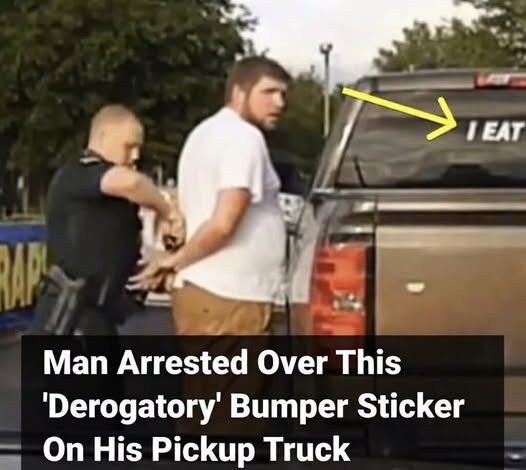
What began as an ordinary traffic stop in Lake City, Florida, quickly grew into a national conversation about the limits of government authority and the protections of free expression. Dillon Shane Webb was not accused of speeding, driving recklessly, or endangering anyone on the road. Instead, the encounter centered on a sticker displayed on the rear window of his truck—a message a deputy considered offensive and inappropriate for public display. Within minutes, a disagreement over that decal escalated into an arrest, raising constitutional questions that extended far beyond one roadside encounter.
According to reports, the deputy instructed Webb to remove the sticker, describing it as derogatory and citing concerns about its public visibility. Webb declined, maintaining that the message, while undeniably offensive to some people, was protected speech under the First Amendment of the United States Constitution. He believed that the government could not compel him to remove it simply because someone found its language objectionable.
The disagreement intensified rather than ending there.
Instead of receiving a warning or citation related to driving, Webb was taken into custody and charged under a Florida statute concerning obscene or offensive material. The arrest immediately drew attention because it appeared to place the limits of free expression at the center of a criminal case rather than a routine traffic matter.
As the legal process unfolded, the outcome shifted dramatically.
Prosecutors ultimately decided not to pursue the charges, and the case against Webb was dismissed. The dismissal did not erase what had happened, however. By then, news of the arrest had spread widely, prompting debate among legal experts, civil liberties advocates, law enforcement professionals, and members of the public. Webb later filed a civil rights lawsuit, arguing that his constitutional rights had been violated during the encounter.
The case quickly became larger than one individual or one sticker.
At its heart was a question that has challenged courts and lawmakers for generations: how far does the constitutional protection of free speech extend, particularly when that speech is offensive, provocative, or unpopular?
The First Amendment generally protects a broad range of expression from government restriction, including speech that many people may find distasteful or offensive. At the same time, the law recognizes certain narrow categories of expression—such as true threats, incitement to imminent unlawful action, defamation, and some forms of obscenity—that may receive different legal treatment. Determining where those boundaries lie has long been the subject of court decisions and constitutional interpretation.
That complexity is one reason the incident attracted such widespread attention.
To many observers, the case raised concerns about the role of personal discretion during law enforcement encounters. If a government official interprets protected expression as unacceptable based primarily on personal offense, critics argue that constitutional protections could become inconsistent or vulnerable to individual judgment rather than established legal standards. Others emphasized the difficult balance officers sometimes face when responding to complaints or attempting to enforce laws they believe may apply.
Regardless of where individuals stood on the sticker itself, the broader constitutional issues resonated widely.
Freedom of speech often receives its greatest legal tests not when the message is popular, but when it is controversial. The principle underlying constitutional protections is that governments generally may not suppress expression simply because it is offensive or unpopular. Courts have repeatedly confronted difficult questions involving that balance, recognizing both the importance of protecting free expression and the need to address speech that falls outside constitutional safeguards.
The public discussion surrounding Webb’s arrest reflected those enduring tensions.
Many people saw the incident as a reminder that constitutional rights are often examined through ordinary encounters rather than dramatic courtroom battles. A routine traffic stop became the setting for a debate touching on individual liberty, governmental authority, and the practical application of constitutional law in everyday life.
Ultimately, the charges were dropped, but the legal and public conversations continued.
The case encouraged renewed discussion about officer discretion, constitutional training, and the importance of ensuring that laws are enforced consistently with established legal protections. It also served as a reminder that disagreements over free expression frequently arise in unexpected places—not only in legislative chambers or courtrooms, but during everyday interactions between citizens and public officials.
In the end, Dillon Shane Webb’s experience became more than the story of a traffic stop. It evolved into a broader reflection on one of the nation’s most fundamental constitutional principles: that the protection of free speech is often tested most seriously when the speech itself is unpopular or offensive. Whether discussed in classrooms, courtrooms, online forums, or around family dinner tables, the questions raised by the case continue to underscore the ongoing challenge of balancing individual rights with the responsibilities of government in a democratic society.