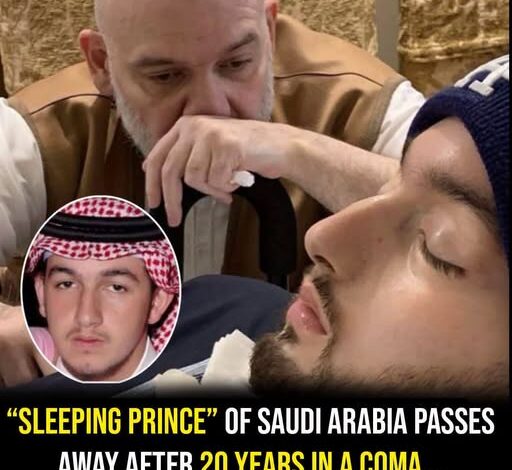
For twenty years, a father began each day with the same hope.
Not a grand hope.
Not a miracle he could predict.
Just the quiet possibility that when he entered the hospital room, something might be different.
A movement.
A blink.
A squeeze of the hand.
Anything.
For two decades, Prince Al-Waleed bin Khaled bin Talal Al Saud existed in a space that seemed suspended between life and loss. To much of the world, he became known simply as the “Sleeping Prince”—a young royal whose tragic accident left him in a coma from which he never fully emerged.
But inside the hospital room where he spent those years, he was never a headline.
He was never a symbol.
He was a son.
And for his father, that distinction changed everything.
While governments changed, technologies evolved, and generations grew up outside those hospital walls, life inside the room followed a different rhythm.
Time was not measured by calendars.
It was measured by visits.
By prayers.
By medical updates.
By the sound of machines quietly doing their work.
And by a father’s unwavering presence.
Many people struggle to comprehend what twenty years truly means.
It means birthdays passing without celebration.
Holidays arriving and departing.
Family milestones unfolding while one chair remains permanently occupied by absence.
It means watching seasons change thousands of times while waiting for a moment that may never come.
Most people, faced with such circumstances, might eventually surrender to despair.
Prince Khaled never did.
His faith remained remarkably steadfast.
Again and again, he refused to describe his son as a lost cause.
Instead, he viewed him as something sacred—a life entrusted to him by God, deserving of care, dignity, and unconditional love regardless of outcome.
That belief became the foundation of his endurance.
While others saw a patient lying motionless, a father saw the child he once held in his arms.
The young man who laughed.
Dreamed.
Spoke.
Lived.
The son whose life had been interrupted but whose worth had never diminished.
Throughout the years, occasional reports of slight movements generated waves of hope across social media and news outlets. A finger twitch. A small response. A subtle sign that seemed to suggest awareness might still exist somewhere beneath the silence.
For families who have loved someone in a prolonged coma, those moments carry enormous emotional weight.
Hope can become both a comfort and a burden.
It sustains you.
Yet it also prevents closure.
Every tiny movement becomes a question.
Every sign becomes a possibility.
And every possibility keeps the heart waiting.
Still, Prince Khaled remained committed.
Not because he ignored reality.
But because he believed that love should not depend on certainty.
He chose presence over prediction.
Faith over despair.
Devotion over surrender.
Day after day.
Year after year.
Decade after decade.
Outside the hospital, the world continued moving forward.
Entire generations were born who knew the story of the Sleeping Prince but had never known the young man before the accident.
Children became adults.
Leaders came and went.
The Middle East changed.
The world changed.
But inside that room, a father kept watch.
What made the story resonate so deeply with people across cultures was not simply the tragedy.
It was the extraordinary persistence of love.
Many parents understand fear.
Many understand sacrifice.
But few can fully imagine what it means to remain emotionally present through twenty years of uncertainty.
To continue speaking to someone who cannot answer.
To continue hoping when logic offers little encouragement.
To continue showing up every day simply because love demands it.
That kind of devotion touches something universal.
It transcends nationality, religion, status, and language.
Because at its core, the story was never really about royalty.
It was about parenthood.
About the fierce and stubborn bond between a parent and a child.
A bond that often survives circumstances that would break almost anything else.
Then, in July 2025, the long vigil finally came to an end.
The announcement spread quickly.
After twenty years in a coma, Prince Al-Waleed had passed away.
For many observers, the news felt heartbreaking.
For his family, it was something even more complicated.
Grief.
Relief.
Sorrow.
Acceptance.
All arriving together.
The loss was immense.
Yet there was also an undeniable sense that a long chapter of suffering had finally closed.
The young prince who had existed between worlds for so many years was no longer suspended in uncertainty.
The waiting had ended.
The vigil was over.
The burden carried by those who loved him had changed form.
Not disappeared.
But changed.
Prince Khaled’s public statement reflected that balance of heartbreak and faith.
Rather than expressing bitterness, he turned to the language that had sustained him throughout the ordeal: trust in God, gratitude, and acceptance of divine will.
His words resonated far beyond Saudi Arabia.
Parents everywhere recognized the emotion behind them.
Because even those who have never experienced such profound loss understand the fear of losing a child.
It is one of humanity’s deepest anxieties.
The thought that a child might leave before a parent feels fundamentally unnatural.
Yet Prince Khaled had spent twenty years living in the shadow of that possibility.
And still he chose love.
Again and again.
Every day.
His devotion became the true legacy of the story.
Not the accident.
Not the medical details.
Not the years spent in a hospital bed.
But the extraordinary commitment that surrounded those years.
In many ways, Prince Al-Waleed’s story became a reminder of something people often forget.
Love is not measured only by what we receive.
Sometimes it is measured by what we continue giving when nothing comes back.
When there are no conversations.
No reassurances.
No guarantees.
Only presence.
Only faith.
Only the decision to remain.
That is what made this story so powerful.
A father standing beside a motionless hand.
A family refusing to abandon hope.
Twenty years of loyalty that never asked whether it was convenient or easy.
Twenty years of choosing love despite uncertainty.
In the end, the Sleeping Prince’s story was never solely about tragedy.
It was about endurance.
About faith.
About the quiet heroism of showing up when there is no promise of reward.
And above all, it was about a father’s love so unwavering that it stood watch over his son for twenty unbroken years.
The world may remember the prince who slept.
But many will remember even more deeply the father who never stopped keeping vigil beside him.