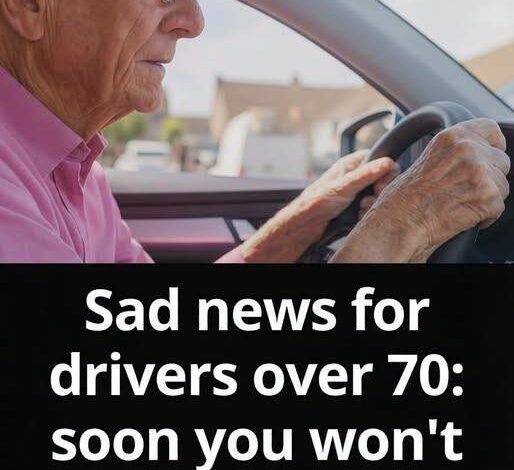
For many older adults, a driver’s license represents far more than permission to operate a car.
It represents freedom.
The ability to buy groceries without asking for help. To visit friends whenever they choose. To attend medical appointments independently. To drive to a favorite café, see grandchildren, or simply leave the house without explaining where they’re going.
That is why one of the hardest conversations a family can have often begins with a deceptively simple question:
“Is it still safe for you to drive?”
In France, that question carries particular weight because ordinary private-car licenses generally do not expire simply because the driver reaches a certain age. Unlike systems that automatically require every older motorist to undergo age-based testing, the emphasis remains heavily on individual responsibility and identifying genuine medical problems rather than assuming that a birthday determines someone’s ability behind the wheel.
There is good reason for that approach.
Age alone does not determine driving competence.
One 80-year-old may remain alert, physically capable, and cautious, while someone decades younger may have a medical condition, poor eyesight, dangerous habits, or medications that make driving considerably riskier.
A date of birth cannot measure judgment.
But aging can bring changes that matter.
Vision may deteriorate gradually enough that a person doesn’t immediately recognize how much has changed. Glare from headlights can become harder to tolerate. Reading road signs from a distance may take longer. Peripheral vision can narrow.
Hearing may decline.
Neck and shoulder mobility can decrease, making it more difficult to check blind spots.
Reaction times can become slower.
Some medications may cause dizziness, fatigue, blurred vision, or reduced alertness.
Cognitive changes can also affect the ability to process several pieces of information simultaneously—something modern driving demands constantly.
None of these changes automatically means someone must stop driving.
They do mean honest evaluation becomes increasingly important.
The difficulty is that driving ability is closely connected to identity.
Imagine having driven safely for fifty or sixty years and suddenly hearing your adult child suggest that you might no longer be capable.
It can sound less like concern and more like accusation.
“I’ve never caused an accident.”
“I’ve been driving longer than you’ve been alive.”
“I know these roads.”
Those responses are understandable.
Experience genuinely matters. Older motorists often compensate for changing abilities by driving more cautiously, avoiding unfamiliar routes, traveling during daylight, reducing speed, or staying home during poor weather.
But experience cannot compensate for everything.
Modern roads can be unforgiving.
Roundabouts require rapid observation and decision-making. Motorways demand confident merging. Cyclists, motorcycles, pedestrians, electric scooters, navigation screens, and increasingly complex intersections can require several judgments within seconds.
A familiar journey can suddenly present an unfamiliar hazard.
That’s why the discussion should not be framed as young people taking freedom away from older people.
The better question is whether someone’s current abilities still match the demands of the journeys they are making.
Medical checkups can be valuable.
Eyesight deserves particular attention because changes may develop gradually. Hearing, mobility, medication effects, and cognitive health can also influence driving safety.
A healthcare professional may identify a problem that can actually be corrected.
Perhaps new glasses dramatically improve vision.
Maybe a medication can be adjusted.
Physical therapy could improve mobility.
A hearing problem may be treatable.
Sometimes the solution isn’t surrendering the license.
It’s adapting.
A voluntary driving assessment can provide another useful perspective. Rather than relying on arguments between relatives, an experienced instructor or appropriate professional can observe how someone actually performs behind the wheel.
Can the driver check mirrors effectively?
Do they notice pedestrians?
Are they comfortable at junctions?
Do they maintain appropriate speed and distance?
Can they respond calmly when something unexpected happens?
Real-world observation can reveal far more than assumptions based solely on age.
Refresher lessons may also help.
Road rules evolve.
Infrastructure changes.
Vehicles acquire new technology.
Someone who passed a driving test decades ago may benefit from reviewing current practices, especially if most of their driving occurs along the same familiar routes.
Families also have a responsibility.
Warning signs should not be ignored simply because the conversation feels uncomfortable.
Repeated unexplained dents deserve attention.
So does getting lost on familiar routes.
Confusing the accelerator and brake, repeatedly missing signs, drifting between lanes, struggling at intersections, or experiencing several near-collisions should prompt serious discussion.
But that conversation needs dignity.
Taking away someone’s keys without considering what those keys represent can create another problem.
If driving stops, how will that person shop?
How will they attend appointments?
How will they see friends?
Will they become isolated?
Will every journey now require asking a relative for a favor?
Those questions matter because mobility is closely connected to independence and quality of life.
Before asking someone to stop driving, families should help create alternatives wherever possible.
Public transportation.
Taxis.
Community transportation programs.
Rides from relatives arranged on predictable days rather than requested reluctantly each time.
Grocery and prescription delivery.
Walking routes for nearby errands when mobility permits.
The goal shouldn’t simply be removing a car.
It should be preserving as much independence as possible without ignoring safety.
And sometimes compromise works.
A person may stop driving at night while continuing short daytime journeys.
They might avoid motorways.
They may drive only in familiar neighborhoods.
They could stop during bad weather or heavy traffic.
For some people, these adjustments can extend safe mobility without pretending nothing has changed.
Eventually, however, there may come a point when adaptation is no longer enough.
That moment can be painful.
Giving up driving can feel like admitting that another chapter of life has closed.
For someone who has spent decades taking care of themselves and others, surrendering the keys may represent dependence in a way younger relatives struggle to understand.
That deserves compassion.
But compassion cannot mean ignoring danger.
A serious collision does not affect only the driver.
There may be passengers.
Pedestrians.
Cyclists.
Children crossing a street.
Families whose lives can change because of a decision made in a fraction of a second.
The conversation, therefore, is not really about whether older people should drive.
Many can and do drive safely.
It is about whether every driver—regardless of age—is physically and mentally capable of controlling a vehicle safely today.
That distinction protects both dignity and public safety.
France’s approach places considerable responsibility on individuals, families, healthcare professionals, and the wider community to recognize when circumstances have changed.
That responsibility requires something no law can completely manufacture:
Honesty.
Honesty about eyesight.
Honesty about reaction time.
Honesty about frightening near misses.
Honesty when familiar roads suddenly feel confusing.
And honesty from relatives who may notice changes before the driver is ready to acknowledge them.
The best outcome isn’t necessarily taking someone’s keys away.
It’s making the decision before an accident makes it for them.
Sometimes that means new glasses.
Sometimes it means a refresher lesson.
Sometimes it means changing when and where someone drives.
And sometimes, after every reasonable alternative has been considered, it means placing the keys on the table for the last time.
That moment should never be treated as punishment.
It can be an act of responsibility, dignity, and love.
Because independence matters enormously.
But so does arriving home safely.
And recognizing when those two things no longer fit together may be one of the hardest—and most courageous—decisions a driver and family ever make.