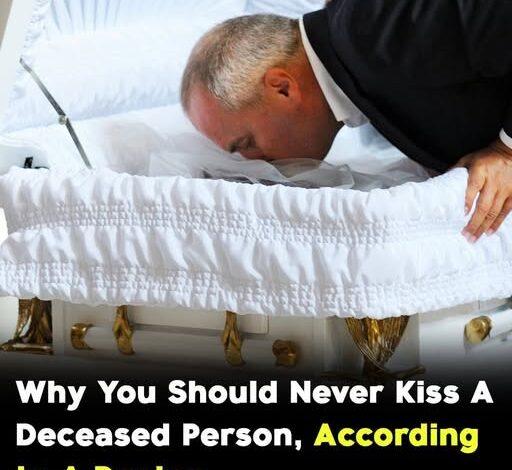
Few moments in life are as emotionally overwhelming as saying goodbye to someone you love.
In the hours after a death, grief often takes over where logic leaves off. Families gather, tears are shed, hands are held, and final gestures of affection become deeply meaningful. For many people, a kiss on the forehead, cheek, or hand of a deceased loved one feels like a final expression of love—a last chance to say what words cannot.
That is why a recent warning from Dr. Viktor Ivanovik, a medical content creator with nearly 300,000 followers on TikTok, sparked such a strong reaction online.
In a video that quickly gained attention, Ivanovik urged viewers to avoid kissing deceased individuals during final farewells.
“Never kiss the deceased,” he said bluntly.
His reasoning was rooted in the biological changes that occur after death. Once the body stops functioning, natural decomposition begins. Over time, bacteria that normally exist within the body can multiply and spread as tissues break down.
According to Ivanovik, this process can become increasingly active within hours after death, potentially creating health risks for people who come into very close contact with the body. He suggested that exposure to certain bacteria could, in rare circumstances, affect a person’s health and potentially impact the sense of smell.
The warning immediately generated discussion.
For some viewers, the information was surprising.
Many admitted they had never considered the possibility that a final kiss could carry any health implications at all. In moments of grief, most people focus on loss, remembrance, and connection—not microbiology.
Others, however, responded from a very different perspective.
One comment that resonated widely came from a viewer who wrote:
“I kissed my father and would do it a million times over. I can lose taste and smell—he is my father.”
The response captured the emotional tension at the center of the debate.
Because while medical professionals may focus on reducing risk, grief rarely operates according to clinical guidelines.
For countless families around the world, touching or kissing a deceased loved one is an important cultural, religious, or personal ritual. These acts can provide comfort, closure, and a final sense of connection during one of life’s most painful experiences.
A hand held for the last time.
A forehead kissed goodbye.
A quiet moment beside someone who mattered deeply.
Such gestures often carry significance that extends far beyond physical contact.
That is why conversations about health risks in these situations can feel complicated.
They touch not only on science but also on tradition, emotion, and the deeply personal ways people process loss.
Medical experts generally agree that the level of risk depends on several factors, including the cause of death, the condition of the body, environmental circumstances, and how much time has passed. In many funeral settings, professional preparation and embalming procedures are specifically designed to reduce potential hazards.
Still, awareness remains valuable.
Understanding that biological changes occur after death allows families to make informed choices about how they wish to say goodbye.
Some may continue traditional practices.
Others may choose alternative forms of farewell.
A gentle touch.
A whispered prayer.
A flower placed nearby.
A final moment of reflection.
None of these choices are inherently right or wrong.
They simply reflect different ways people navigate grief.
What Ivanovik’s video ultimately revealed was not just concern about bacteria, but the powerful emotional role that farewell rituals play in human life.
Loss forces people to make intensely personal decisions.
Some will prioritize caution.
Others will prioritize connection.
Many will find a balance between the two.
In the end, grief rarely follows a universal rulebook.
Medical advice can provide guidance, but love, memory, culture, and personal belief often shape how people choose to honor those they have lost.
Perhaps the most important takeaway from the discussion is not fear, but awareness.
Understanding potential risks allows families to make informed decisions.
Understanding grief allows us to respect those decisions.
Because when people stand beside someone they love for the last time, they are not simply thinking about health advice or statistics.
They are thinking about a relationship.
A lifetime of memories.
And one final goodbye.