Trump threatens to deport Hollywood legend after actor’s ‘sick and demented’ comments about him

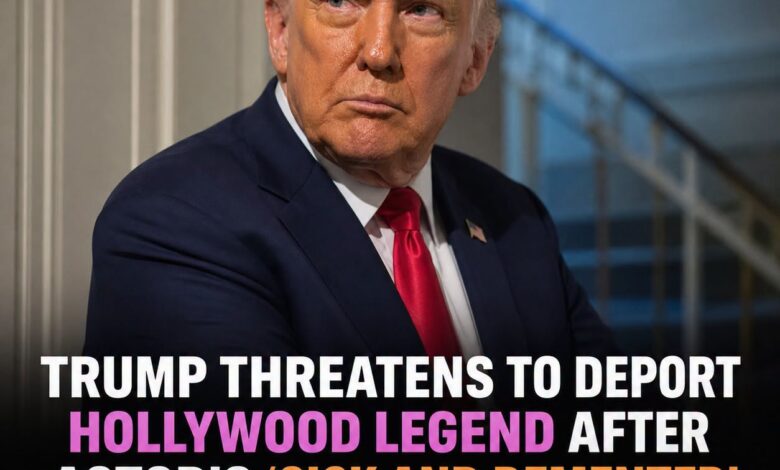
Robert De Niro did not sound like an actor delivering carefully polished lines.
He sounded angry.
At times, furious.
To his supporters, that anger reflected something deeper than personal dislike of Donald Trump. De Niro has repeatedly framed his criticism as concern about American democracy, political norms, and what he believes could happen when too much power becomes concentrated around one leader.
To his critics, the performances have looked very different.
They see a wealthy Hollywood celebrity using his fame to lecture voters, escalating political hostility while claiming to defend democratic values.
That divide is important.
Because the argument between Trump and De Niro has never really been only about two famous men insulting each other.
It is about competing definitions of patriotism.
For De Niro, patriotism appears to include confrontation.
His message has essentially been that loving a country doesn’t require praising its leaders. Sometimes, he argues, citizenship demands precisely the opposite.
Criticize them.
Question them.
Vote against them.
Challenge them publicly.
Defend institutions when you believe those institutions are threatened.
That principle is deeply embedded in the American political tradition.
The First Amendment protects speech precisely because disagreement is inevitable.
A constitutional democracy isn’t designed around unanimous admiration for whoever holds power.
Americans are allowed to mock presidents.
Actors are allowed to condemn politicians.
Politicians are allowed to condemn actors.
Newspapers can investigate governments.
Citizens can protest.
Voters can say the president is terrible.
They can also say his opponents are terrible.
The freedom works in every direction.
The difficulty begins when political disagreement becomes something more personal.
When criticism stops meaning:
You’re wrong.
And starts meaning:
You don’t belong here.
That distinction has repeatedly surfaced during the Trump era.
Trump’s political style has long relied on counterattack.
When someone attacks him, he rarely ignores it.
He responds.
Sometimes with policy arguments.
Frequently with ridicule.
Nicknames.
Questions about intelligence.
Appearance.
Motives.
Character.
Loyalty.
Supporters often enjoy this because they believe Republican politicians spent decades absorbing attacks without fighting back.
To them, Trump’s willingness to strike at critics is part of his appeal.
He doesn’t behave like a conventional politician.
He doesn’t apologize merely because elite institutions demand it.
He treats politics as combat and makes no effort to hide that fact.
Critics see something more dangerous.
They argue that when a powerful political leader repeatedly describes opponents as enemies, traitors, or people who should leave the country, he can blur the distinction between opposition to himself and opposition to America.
That concern became especially intense around Trump’s rhetoric toward Democratic congresswomen.
His comments telling political opponents to leave or “go back” became a national controversy years earlier, particularly because several of the lawmakers targeted were women of color and most were born in the United States.
Trump and his supporters argued that the underlying point was about people who harshly criticize America while enjoying its freedoms.
Opponents heard something historically loaded:
You disagree with the country as I define it, therefore you don’t belong in it.
Those are fundamentally different interpretations.
And the difference matters because America has always had an uneasy relationship with dissent.
Some of the country’s most celebrated political movements were deeply unpopular when they occurred.
Abolitionists were condemned.
Labor organizers were attacked.
Civil-rights protesters were accused of creating disorder.
Antiwar demonstrators were called un-American.
Women’s-rights activists were mocked and arrested.
History has a habit of transforming yesterday’s troublemakers into tomorrow’s monuments.
That doesn’t mean every protester is correct.
It means dissent cannot be judged solely by how uncomfortable it makes the majority.
De Niro’s defenders place his political interventions inside that tradition.
He had wealth.
Fame.
A comfortable life.
He could have remained silent.
Instead, he chose to use his public platform to warn about something he believed threatened the country.
Whether his assessment was correct is a separate question.
His right to make it isn’t.
Trump possesses exactly the same right to answer.
He can call De Niro ridiculous.
He can question his judgment.
He can argue that Hollywood celebrities are disconnected from ordinary voters.
He can say De Niro’s political predictions are hysterical.
He can mock the actor’s speeches.
Free expression doesn’t protect critics from criticism.
That’s where discussions of political rhetoric require precision.
An insult isn’t automatically censorship.
A nasty social-media post isn’t the same thing as government punishment.
Political leaders are citizens too, and they retain the right to respond to their opponents.
But power changes the significance of words.
When an ordinary person says, “I wish that critic would disappear,” it is usually just rhetoric.
When a president or potential president targets identifiable opponents, people reasonably ask a second question:
Could these words become government action?
That’s the line democracies must watch carefully.
Not whether politicians are rude.
America has survived rude politicians.
The more consequential question is whether political power is used to punish lawful dissent.
Investigating someone merely because they criticized the government would cross a serious line.
Using state institutions to retaliate against protected speech would be far more consequential than a social-media insult.
Suppressing journalists because their reporting is unfavorable would raise profound constitutional concerns.
So would using governmental authority to threaten lawful political opponents simply because they are opponents.
Those are questions about institutions, not manners.
And institutions were central to De Niro’s criticism.
His rhetoric wasn’t subtle.
That created its own problem.
When every election is described as the final battle for democracy, voters can become numb.
When every opponent is portrayed as an existential threat, ordinary political compromise begins looking like surrender.
When celebrities use apocalyptic language, people who already distrust Hollywood may become even less receptive.
De Niro’s intensity may energize people who share his fears.
It may also strengthen Trump’s argument that cultural elites despise him and the voters who support him.
Political communication has consequences beyond intention.
Trump faces the same problem in reverse.
His attacks excite supporters who appreciate his refusal to submit to criticism.
But rhetoric suggesting opponents should leave the country can alienate Americans who hear something much larger than political combat.
For naturalized citizens and immigrant families especially, language about who belongs can carry historical and personal weight.
That is why context matters.
So does accuracy.
It is tempting to turn every confrontation into a morality play.
Hero versus villain.
Patriot versus traitor.
Democracy versus dictatorship.
Those categories produce excellent social-media engagement.
They aren’t always good tools for understanding politics.
De Niro is entitled to believe Trump represents a profound danger.
Trump voters are entitled to reject that argument.
Trump is entitled to attack De Niro’s political judgment.
De Niro is entitled to answer.
Congresswomen are entitled to criticize the United States without forfeiting their citizenship or belonging.
Other Americans are entitled to criticize those congresswomen in return.
That’s not democracy malfunctioning.
Much of the time, that’s democracy happening.
The challenge is preserving the distinction between disagreement and exclusion.
A democracy doesn’t require citizens to like each other.
It requires them to accept that political legitimacy isn’t reserved for people who agree with them.
The Trump supporter remains American.
The Trump critic remains American.
The immigrant who protests American policy remains American if she is a citizen.
The actor who uses an awards platform to attack a politician doesn’t lose his rights.
The voter who thinks that actor is an arrogant celebrity doesn’t lose hers.
Citizenship isn’t a prize awarded for ideological obedience.
That sounds obvious.
During periods of political anger, it becomes surprisingly easy to forget.
And anger now travels faster than almost anything else.
A politician posts an insult.
Within seconds, screenshots spread.
Cable television assembles panels.
Influencers produce reaction videos.
Supporters celebrate.
Opponents condemn.
Each side receives a slightly different version of what happened.
One audience sees courage.
Another sees authoritarianism.
One sees patriotic resistance.
Another sees celebrity hysteria.
By evening, millions of people may be arguing about motives rather than the actual words.
That is why the healthiest response to inflammatory political rhetoric is often the least exciting one.
Read the original statement.
Check the context.
Separate insult from policy.
Separate prediction from evidence.
Ask what governmental action, if any, actually followed.
Distinguish what someone literally said from what commentators say the statement “really means.”
Then decide.
Democracy depends partly on that discipline.
Not because citizens should become emotionless.
Politics involves moral questions that deserve emotion.
People should become angry about injustice.
They should care when institutions are threatened.
They should care when fellow citizens are demeaned.
But outrage without precision is easily manipulated.
Both politicians and entertainers understand that.
Attention is power.
Fear creates attention.
Anger creates attention.
Humiliation creates attention.
Trump built much of his political communication around that reality.
Hollywood understands it too.
So does cable news.
So do social-media platforms.
The result is a political culture constantly encouraging Americans to experience the next statement as an emergency.
De Niro versus Trump becomes irresistible because both men symbolize something larger to their respective audiences.
De Niro represents an entertainment establishment that many conservatives believe looks down on them.
Trump represents a political movement that many liberals believe threatens democratic norms.
When the two collide, nobody hears merely two men.
They hear two Americas shouting through them.
But there aren’t really two Americas.
There are hundreds of millions of Americans with overlapping, contradictory beliefs.
People who dislike Trump but distrust Hollywood.
People who support Trump but dislike his rhetoric.
People who admire De Niro’s acting and hate his politics.
People who agree with his concerns but think his delivery is counterproductive.
People who don’t fit comfortably into either camp.
Those citizens matter too.
Perhaps especially now.
Because the health of a democracy isn’t measured by whether everybody agrees on the president.
It is measured partly by what happens when they don’t.
Can criticism occur without punishment?
Can elections be lost without opponents becoming enemies of the state?
Can journalists investigate leaders without being treated as illegitimate merely because the reporting is unfavorable?
Can politicians be fiercely criticized without every harsh response being mislabeled as censorship?
Can citizens separate someone’s right to speak from their own obligation to agree?
Those questions are larger than Robert De Niro.
They’re larger than Donald Trump.
Presidents change.
Actors age.
Social-media posts disappear beneath tomorrow’s outrage.
The precedent surrounding dissent lasts longer.
America’s political system was never designed to eliminate conflict.
It was designed, imperfectly, to contain it.
Ballots instead of violence.
Courts instead of vengeance.
Arguments instead of enforced silence.
Opposition instead of obedience.
That arrangement only works if people resist the temptation to define citizenship according to agreement.
Robert De Niro can be furious with Donald Trump and remain patriotic.
Donald Trump can condemn Robert De Niro and remain entitled to his own political speech.
Americans can criticize their country while loving it.
They can praise it while demanding it change.
They can vote for completely different futures while possessing exactly the same constitutional rights.
The real test comes afterward.
When someone says something we despise, do we answer them?
Or do we decide they should no longer be allowed inside the national conversation?
That is the more consequential question hiding beneath all the insults.
Not whether De Niro went too far.
Not whether Trump delivered the sharper comeback.
Not which side won another day’s news cycle.
But whether Americans still believe the freedom they demand for themselves belongs equally to the people they cannot stand.
Because dissent isn’t an exception democracy reluctantly tolerates.
It is one of the reasons democracy exists.