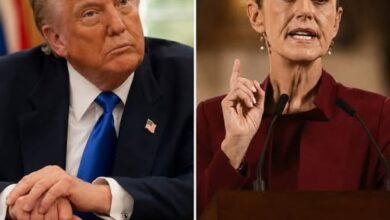
Donald Trump’s niece Mary reveals what ‘terrifies’ him most and claims he’s in a ‘downward spiral’


The most unsettling warnings often come from people who know the story long before the public does. For Mary Trump, her assessment of her uncle is not merely another chapter in a bitter family conflict—it is something she presents as far more serious. In her view, it is a cautionary tale about power, insecurity, and a man increasingly trapped by the very image he spent decades constructing.
According to Mary, the driving force behind Donald Trump’s behavior is not political ideology or strategic calculation, but a relentless need for validation. She paints a picture of someone who survives on admiration and attention, yet is constantly haunted by the possibility of losing both. Beneath the confident speeches, the combative rhetoric, and the carefully crafted public persona, she sees a man fighting an endless battle against feelings of inadequacy.
Her description is striking because it focuses less on politics and more on psychology. She argues that every criticism, every public setback, and every highly visible mistake lands with unusual force because it threatens the foundation of his self-image. While most public figures can weather embarrassment and move on, Mary suggests that humiliation represents something far more dangerous to him. It is not simply an uncomfortable experience—it is a direct assault on the identity he has spent a lifetime trying to protect.
In her telling, the world stage has become an increasingly difficult arena. Every stumble during a speech, every moment of confusion, every awkward exchange with foreign leaders, and every controversial social media post becomes more than a news cycle. Each incident risks exposing vulnerabilities that he works tirelessly to conceal. The fear, she claims, is not criticism itself. It is the possibility that millions of people might see weakness where strength is supposed to be.
That fear, she argues, fuels much of the aggression and defensiveness that have become defining features of his public presence. The louder the criticism grows, the harder he pushes back. The more questions arise, the more fiercely he seeks to dominate the conversation. To Mary, these reactions are not signs of confidence. They are signs of someone desperately trying to maintain control over a narrative that constantly threatens to slip away.
Unsurprisingly, the response from the White House and Trump allies was immediate and uncompromising. They dismissed her claims as nothing more than a personal vendetta wrapped in political commentary. Officials and supporters accused her of seeking attention, exploiting family ties, and attempting to remain relevant by attacking a high-profile relative. They pointed to favorable medical evaluations, public appearances, and cognitive assessments as evidence that concerns about his mental and emotional state were unfounded.
The counterattack was fierce, portraying Mary’s observations as biased and unreliable. From their perspective, her accusations reflected resentment rather than insight. They argued that her criticism was motivated by personal grievances and ideological opposition, not objective analysis.
Yet despite those efforts to discredit her, Mary’s words continue to resonate with many observers. Part of their power lies in where they come from. Political opponents frequently criticize public figures, but criticism from within a family carries a different weight. Whether one agrees with her conclusions or not, her perspective feels uniquely personal. She is not presenting herself as a distant commentator examining events from afar. She speaks as someone who witnessed the family dynamics that helped shape the man long before he entered politics.
That insider perspective is what keeps the conversation alive. Her arguments are not built around campaign strategies, polling numbers, or legislative battles. Instead, they focus on character, emotional patterns, and the private insecurities she believes have influenced public behavior for decades. For supporters, her claims may seem unfair or exaggerated. For critics, they may feel like confirmation of suspicions they already held. But for many people, the enduring fascination lies somewhere in between: the possibility that understanding the person might explain the politics.
As public scrutiny intensifies, every appearance becomes another test. Every speech is dissected. Every interview is analyzed. Every unscripted moment is examined for clues about confidence, competence, and control. In such an environment, the gap between perception and reality becomes increasingly important. Leaders are expected to project strength, certainty, and stability, particularly when representing a global superpower. Any sign that contradicts those expectations can quickly become a source of controversy.
Mary’s central argument ultimately returns to a single idea: fear. Not fear of political defeat, legal challenges, or media criticism, but fear of exposure. She suggests that the greatest threat facing her uncle is the possibility that the image he carefully cultivated could crack under pressure, revealing someone far less secure than he appears.
Whether that interpretation is accurate remains a matter of intense debate. Supporters view him as resilient, combative, and uniquely capable of withstanding attacks that would overwhelm other politicians. Critics see evidence supporting Mary’s assessment in his reactions to setbacks and criticism. The truth, as with most questions involving public figures, is likely more complicated than either side admits.
Still, her conclusion remains one of the most provocative aspects of her portrait. She argues that behind the confidence, the bravado, and the relentless pursuit of dominance lies a man consumed by a simple but powerful anxiety: the fear of appearing small.
And in her view, that fear matters because it shapes more than personal behavior. It influences decisions, reactions, and the way power itself is exercised. If she is right, then the story is not merely about one individual struggling with insecurity. It is about what happens when the person entrusted with projecting strength to the world is fighting his most important battle within himself.
That is why her warning continues to echo long after the headlines fade. It is not just a family dispute. It is a question about leadership, perception, and the hidden vulnerabilities that can exist behind even the most imposing public image.