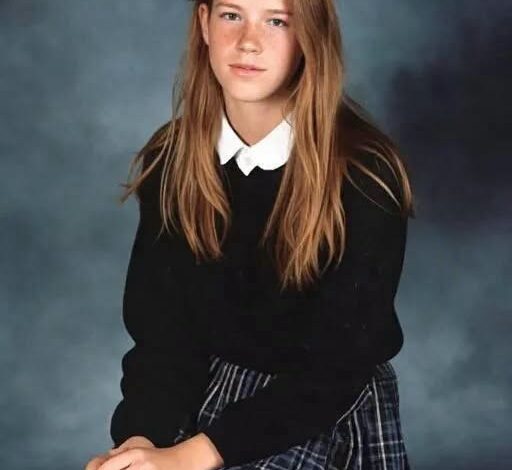
MY TEEN DAUGHTER VANISHED! Named Amber, 13, reddish hair, freckles. Missing for a week. Guys this is the hardest thing a parent can experience. No, she’s not the type to run away. I know every parent says that, but it’s true. I know my daughter. Thinking something bad happened to her… Gosh, just unbearable. The police just shrugged, totally helpless. To be honest they did their part. But then all of a sudden, just crying outside I saw a homeless woman with AMBER’S BACKPACK! I knew it was hers! I stopped her and I offered money until she gave it to me. I asked her around about the bag and she told me what she knew. Which wasn’t enough. The bag was empty. Completely empty. My heart sank. I threw it down in despair and cried. That’s when a note fell out. I picked it up and read it. There were only two words

I never imagined an empty backpack could carry so much weight.
When the detective placed it on the table in front of me, it looked painfully ordinary. The faded fabric was scuffed from use, one zipper was half open, and the keychain my daughter had insisted on attaching years earlier still dangled from the side.
It should have been comforting.
Instead, it stole the air from my lungs.
For weeks, every lead had ended the same way—with unanswered questions, false hope, and long nights that seemed to stretch forever. We had searched parks, neighborhoods, bus stations, abandoned buildings, and anywhere someone thought they might have seen her.
Each phone call made my heart race.
Each disappointment left me a little more exhausted.
By then, I had almost forgotten what hope felt like.
Then that backpack appeared.
It was empty.
No phone.
No wallet.
No note explaining where she had gone or why.
Just an ordinary school backpack lying on the detective’s desk.
Most people would have seen what was missing.
I couldn’t stop thinking about what remained.
She had carried it.
She had touched it.
Somewhere, somehow, my daughter had been alive when it ended up there.
That thought settled deep inside me.
Fragile.
Uncertain.
Impossible to prove.
But impossible to ignore.
The detectives immediately treated the discovery as their strongest lead yet.
Forensic teams carefully examined every inch of the bag.
Investigators retraced where it had been found, speaking again with nearby residents, reviewing reports they had already read dozens of times, and expanding the search area.
For the first time in what felt like forever, the investigation was moving instead of standing still.
Days later, another call came.
This one sounded different.
The detective didn’t make promises.
He didn’t say everything would be all right.
He simply told me they needed me to come to the station.
When I arrived, he pointed toward a computer screen.
Security footage had been recovered from a nearby business.
The quality wasn’t perfect.
The figures were distant.
But I recognized her instantly.
Every parent would have.
She was walking.
Alive.
Her backpack was still over one shoulder.
Beside her walked an unidentified adult.
Neither of them appeared to notice the camera.
For a moment, my emotions refused to make sense.
Relief crashed into terror.
She hadn’t vanished into nothing.
She was still out there.
But she wasn’t alone.
And I didn’t know whether the person beside her was helping her—or keeping her from coming home.
The investigation accelerated.
Detectives followed every available lead generated by the footage.
License plates were checked.
Businesses were contacted.
Hours of surveillance recordings were reviewed frame by frame.
Neighbors were interviewed again.
One small clue led to another until, at last, investigators identified a house connected to the case.
I will never forget the drive there.
Every mile felt longer than the last.
Police vehicles surrounded the property while officers quietly took their positions.
No one spoke much.
There was nothing left to say.
The waiting began.
Waiting has its own kind of cruelty.
Every passing second stretches beyond reason.
Every sound becomes significant.
A radio transmission.
A car door.
Footsteps.
A voice you can’t quite make out.
Your mind imagines every possible ending, and none of them feel survivable.
I stood behind the police tape with my hands trembling so badly I had to grip the barrier just to stay upright.
Then everything happened at once.
Officers moved.
Voices rose.
Someone shouted.
For a heartbeat, the entire world seemed to hold its breath.
The front door opened.
She stepped outside.
She looked smaller than I remembered.
Her clothes hung loosely from her frame.
Her face carried an exhaustion no child should ever know.
Fear lingered in her eyes, as though she still wasn’t certain she was safe.
But she was standing.
She was breathing.
She was alive.
I don’t remember crossing the distance between us.
One moment I was standing still.
The next, we were holding each other so tightly it felt as though letting go might allow the nightmare to begin all over again.
Neither of us spoke.
Words were too small for everything that filled that moment.
There were only tears.
Relief.
And the overwhelming certainty that I finally had my daughter back.
People often imagine that rescue is the ending.
It isn’t.
It’s the beginning.
Coming home did not erase what had happened.
There were medical appointments.
Counseling sessions.
Long nights interrupted by nightmares.
Ordinary sounds sometimes triggered overwhelming fear.
Trust, once broken by trauma, returned slowly.
Some days felt hopeful.
Others felt impossibly difficult.
Healing refused to follow a straight line.
There were setbacks.
Moments of frustration.
Silences neither of us knew how to fill.
But little by little, we learned something important.
Healing doesn’t require pretending the pain never existed.
It requires facing it together.
We learned to ask difficult questions without forcing answers.
To listen without judgment.
To sit beside each other during the hardest days instead of trying to fix what couldn’t simply be fixed.
The fear never completely disappeared.
Perhaps it never will.
Some experiences leave permanent marks.
Not always visible.
But real all the same.
Yet alongside those scars, something else grew.
Strength.
The kind built not through avoiding hardship but through surviving it together.
Looking back now, I still think about that empty backpack.
At first, it seemed like another reminder of everything we had lost.
Instead, it became the first thread leading us back to each other.
It reminded me that hope doesn’t always arrive wrapped in certainty.
Sometimes it appears quietly, disguised as the smallest piece of evidence, asking only that you hold on a little longer.
Our lives will never be exactly as they were before.
Trauma changes people.
It changes families.
But it doesn’t have to erase them.
Today, we keep talking.
We keep listening.
We choose honesty over silence, even when the conversations are difficult.
Because we know how dangerous silence can become.
The nightmare left its mark on both of us.
But it also revealed something no fear could destroy.
Love refused to stop searching.
It refused to surrender to despair.
It followed my daughter through the darkest chapter of her life.
And in the end, it helped bring her home.