The Driveway War: My Neighbors Stole My Property, So I Taught Them a Lesson They’ll Never Forget

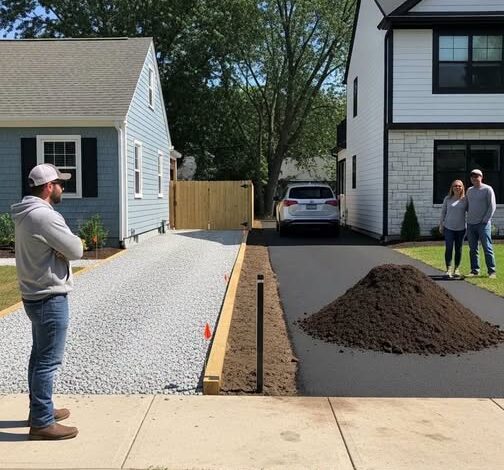
I never imagined a strip of gravel would become the center of a legal battle.
To most people, it looked insignificant—a narrow stretch of land separating two neighboring properties. It wasn’t beautiful or dramatic. It wasn’t valuable because of what grew there or what stood on it.
But it was mine.
I had owned it for years.
The property lines were clearly established, the surveys had been completed, and every legal document confirmed exactly where my land began and ended.
I thought that would be enough.
I was wrong.
Everything changed when Brent and Elise moved in next door.
At first, they seemed friendly enough.
They renovated their house, landscaped the yard, and quickly became known for hosting elegant backyard gatherings and showing off the expensive upgrades they had made to the property.
They cared deeply about appearances.
Unfortunately, that concern eventually extended beyond their own land.
Before long, they began treating part of my gravel area as though it belonged to them.
It started with casual comments.
“We’ve always thought this section really belongs with our yard.”
Then came suggestions that I should stop parking there.
Eventually, those suggestions became demands.
They insisted the boundary wasn’t where every official record said it was.
They spoke with remarkable confidence.
The problem was that confidence isn’t evidence.
I didn’t respond with arguments.
I didn’t match their anger with my own.
Instead, I began gathering paperwork.
I located the original property survey.
I requested updated boundary records.
I collected photographs taken over the years.
I reviewed deeds, plats, and every document that described the legal property lines.
The more information I gathered, the clearer the situation became.
Nothing had changed.
The land had always belonged to me.
Brent and Elise weren’t relying on facts.
They were relying on the hope that persistence would eventually wear me down.
Perhaps they mistook my calm for uncertainty.
Perhaps they believed that avoiding confrontation meant I wasn’t prepared to defend my rights.
Patience is often misunderstood.
Remaining respectful doesn’t mean surrendering.
As the disagreement escalated, legal proceedings became unavoidable.
By then, every conversation had turned into another disagreement, and every attempt to resolve the issue informally had failed.
In court, emotion quickly gave way to documentation.
Surveys were examined.
Property records were reviewed.
Witnesses testified.
Measurements were compared.
Every claim required evidence.
Every assertion faced scrutiny.
The facts spoke far more clearly than anyone’s opinions ever could.
According to the evidence presented, the legal boundary remained exactly where the official records had always placed it.
The disputed gravel belonged to my property.
The court also examined materials submitted by both sides.
Arguments that had once sounded convincing outside the courtroom became much harder to support under careful examination.
Claims unsupported by reliable documentation simply could not withstand legal review.
One by one, they fell apart.
When the ruling was issued, it confirmed what the records had shown all along.
The property line had never moved.
The gravel remained mine.
Any encroachments had to be removed.
The fence that had become a symbol of the dispute eventually came down.
Complaints that had once arrived with such confidence gradually disappeared.
The legal questions had finally been answered.
Time moved on.
Neighborhood conversations shifted to other topics.
Construction equipment left.
Life slowly returned to normal.
Then one afternoon, I noticed something standing in Brent and Elise’s front yard.
A real estate sign.
The house was for sale.
I didn’t celebrate.
There was no victory parade.
No triumphant speech.
Just a quiet recognition that the conflict had finally reached its end.
Sometimes people lose not because someone else defeats them, but because their own choices leave them nowhere else to go.
Looking back, I don’t think the dispute was ever truly about gravel.
It was about assumptions.
About believing confidence could replace evidence.
About mistaking courtesy for weakness.
It taught me that remaining calm during conflict isn’t a disadvantage.
In fact, it often becomes your greatest strength.
While others spend their energy escalating arguments, patience leaves room to prepare.
To verify facts.
To build a case based on evidence instead of emotion.
Today, I still park on that same stretch of gravel whenever I come home.
To anyone passing by, it looks completely ordinary.
Just a parking spot.
Just another piece of property.
They would never know how much time, paperwork, and perseverance it took to protect something so simple.
And that’s perfectly fine.
Because the gravel itself was never the real reward.
The real victory was knowing that integrity, preparation, and quiet determination proved stronger than intimidation and entitlement.
Sometimes justice isn’t loud.
It doesn’t always arrive with dramatic speeches or public celebrations.
Sometimes it arrives in the form of carefully preserved documents, patient persistence, and a judge confirming what the truth has said from the very beginning.
Every time I pull onto that gravel now, I don’t think about the arguments anymore.
I think about the lesson they left behind.
You don’t have to raise your voice to stand your ground.
You don’t have to match arrogance with arrogance.
When the facts are on your side, quiet resolve often lasts far longer than the loudest display of confidence ever could.