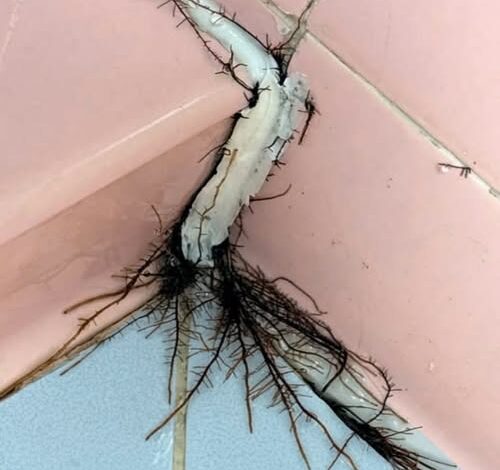
At first, we thought it was dust.
A faint cluster of pale, threadlike strands had appeared between two bathroom floor tiles near the base of the vanity. They were so fine they almost disappeared unless the light struck them at the right angle. We swept them away without giving them much thought, assuming they were lint or fibers tracked in on a shoe.
Three days later, they were back.
This time there were more of them.
They seemed to be emerging from the grout itself, stretching outward in delicate lines that looked almost too orderly to be accidental. We crouched down to examine them, and the closer we looked, the stranger they appeared. They weren’t fuzzy like mold. They weren’t sticky like cobwebs. They didn’t resemble hair, fabric, or anything we’d ever found inside a house before.
Our bathroom had been thoroughly cleaned less than two weeks earlier.
The floors had been scrubbed, the grout inspected, the corners wiped down. Nothing unusual had been there then. Now these mysterious strands had quietly appeared, as though something beneath the floor had decided to announce itself overnight.
Naturally, our imaginations began filling in the blanks.
Maybe it was a rare type of mold.
Perhaps insects had built a hidden nest beneath the tiles.
Someone even suggested fungus, while another wondered if moisture had caused insulation fibers to push through tiny gaps in the flooring.
The more possibilities we considered, the less reassuring any of them became.
The strands continued to multiply over the next few days. They remained concentrated around one section of the floor, creeping through microscopic cracks in the grout with remarkable precision. They looked almost deliberate, as though they knew exactly where they were going.
That unsettling thought lingered longer than it should have.
Bathrooms are supposed to feel clean, predictable, and under control. Discovering something unfamiliar emerging from beneath the floor challenged that sense of security in an unexpected way.
Rather than continuing to guess, we decided it was time to investigate properly.
A closer inspection ruled out several possibilities almost immediately. The material wasn’t soft enough to be mold, and it lacked the discoloration or fuzzy texture typically associated with fungal growth. There was no unpleasant odor, no visible insect activity, and no signs that the grout itself was deteriorating.
Eventually, a professional identified the real cause.
The mysterious strands weren’t mold.
They weren’t insects.
They weren’t fungus.
They were plant roots.
Tiny feeder roots from nearby vegetation had found microscopic openings beneath the bathroom floor and were gradually working their way upward in search of moisture. The constant humidity inside the bathroom had created an ideal source of water, encouraging the roots to exploit every available crack, no matter how small.
The explanation was surprisingly simple.
Plants naturally extend fine roots through soil, searching for water and nutrients. If those roots encounter tiny gaps in foundations, concrete, or tile joints, they may continue growing toward reliable moisture sources. Bathrooms, with their regular exposure to water and damp conditions, can become attractive targets when surrounding vegetation is close enough.
The discovery brought relief—but not complete comfort.
Knowing the cause meant we weren’t dealing with a dangerous mold outbreak or a hidden infestation. Yet it also revealed something we hadn’t considered before: the barrier between our home and the outside world wasn’t as solid as we believed.
Nature had quietly found a way inside.
The roots themselves were not necessarily a major structural threat at first. Very fine roots can enter through cracks that are already present rather than creating them. However, their presence signals an opportunity for further investigation because moisture and small openings can eventually allow larger roots or water intrusion to become more significant problems if left unaddressed.
Addressing the issue required more than simply pulling the roots away.
Visible strands are only the symptom.
The underlying cause must also be corrected.
That often means identifying where the moisture is attracting root growth, inspecting for hidden cracks, sealing grout or tile joints where appropriate, and evaluating nearby landscaping. Trees, shrubs, or aggressive-rooted plants growing close to foundations sometimes need pruning, root barriers, or relocation depending on the circumstances.
Moisture control is equally important.
Bathrooms benefit from good ventilation, functioning exhaust fans, prompt repair of leaks, and allowing surfaces to dry after heavy use. Reducing excess humidity not only discourages root intrusion but also helps prevent mold growth and other moisture-related problems.
Professional assessment may be worthwhile if the roots continue returning after cleanup or if larger cracks begin appearing in floors or walls.
In some situations, persistent root intrusion can indicate drainage problems or hidden structural issues that deserve closer attention before they become more expensive to repair.
Looking back, what surprised us most wasn’t the roots themselves.
It was how quickly something so small changed the way we looked at the room.
For years, the bathroom had felt like every other part of the house—a controlled space separated from the unpredictable world outside. Seeing living roots emerge through the floor reminded us that homes are never completely isolated from nature. Beneath every foundation lies soil, moisture, and countless living systems quietly carrying on their work whether we notice them or not.
After the repairs were completed, the strange strands disappeared.
The floor looked exactly as it had before.
Yet every now and then, while standing in that bathroom, we still remember the morning we first noticed those delicate threads pushing through the grout.
The room no longer feels frightening.
It simply feels more honest.
It reminds us that houses are not sealed boxes standing apart from the natural world. They exist within it, constantly interacting with the environment in ways we rarely consider. Sometimes those interactions are invisible. Occasionally, they reveal themselves in surprising ways.
What first seemed like the beginning of a mystery turned out to be a quiet lesson in how persistent nature can be. Given enough time, enough moisture, and the smallest opening, life will keep searching for what it needs.
And sometimes, it finds a way beneath your feet before you ever realize it was there.