SHOCKING LIVE TELEVISION COLLISION Trump and Obama Go Head To Head In The Greatest Political Showdown Ever Captured On Camera

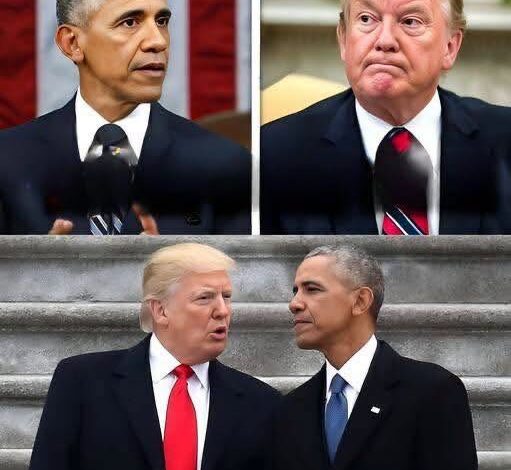
What played out on that stage felt like far more than a televised interview. It became a vivid illustration of the deep political and cultural divisions that continue to shape public life in the United States. As the conversation shifted from policy debates to pointed personal criticism, attention moved away from specific issues and toward competing interpretations of character, leadership, and legacy. In a matter of moments, the broadcast evolved into a symbol of a nation where even the same exchange can produce entirely different conclusions depending on who is watching.
The reaction was immediate. Supporters and critics alike rushed to social media, sharing short video clips, headlines, and commentary that reinforced their existing perspectives. Rather than creating a shared understanding of what had taken place, the discussion splintered into countless competing narratives, each emphasizing different moments and assigning different meanings to the same event. Context quickly gave way to selective highlights, while emotional responses often traveled faster than careful analysis.
In that environment, the broadcast became more than a political exchange. It reflected the way modern media consumption increasingly encourages people to experience major events through separate digital communities, each with its own priorities, interpretations, and assumptions. The result was not a single public conversation but many parallel ones, unfolding simultaneously with little agreement about what mattered most.
Beneath the rapid exchanges and viral reactions, however, a broader pattern emerged. The moment underscored how politics has increasingly adopted the rhythms of performance, where presentation can sometimes attract as much attention as policy itself. Memorable lines, dramatic confrontations, and emotionally charged moments often dominate public discussion, while more detailed arguments receive far less attention.
For many observers, this reflects a broader shift in how political communication is evaluated. Rather than asking only whether a statement is accurate, comprehensive, or well supported, audiences may also respond to whether it is emotionally compelling, rhetorically effective, or memorable enough to shape the conversation. Impact and perception can become just as influential as substance in determining which moments endure.
Whether viewed as a powerful confrontation, a divisive spectacle, or simply another chapter in an increasingly polarized political landscape, the exchange illustrated the challenges of maintaining a shared public understanding in an era of fragmented media. Different audiences often leave the same event with sharply different conclusions, making consensus more difficult to achieve.
Ultimately, the significance of that evening may not rest on declaring a clear winner or loser. Instead, it lies in what it revealed about the modern political environment itself—one in which dramatic moments can rapidly define public attention, where competing narratives emerge almost instantly, and where the first impressions formed in the heat of the moment can shape public memory long after the broadcast has ended. In an age driven by constant connectivity and rapid information sharing, the loudest moments often become the most enduring, influencing not only the day’s headlines but also how history itself is remembered.