My Daughter’s Best Friend Created Her Dream Prom Dress—What Happened That Night Left the Entire Room Silent

Hazel stopped so suddenly that the music spilling from the ballroom barely seemed real anymore.
Her fingers tightened around mine until they trembled. I looked at my daughter and saw the panic rising in her eyes—the same fear that had kept her hidden from the world for nearly a year.
“I can’t do this,” she whispered.
For a moment, I thought she was going to turn around and run.
A year earlier, Hazel had been counting the days until her senior prom. She talked about dresses, playlists, and whether she’d dance or spend most of the evening laughing with friends. She had been seventeen then, full of plans that stretched far beyond graduation.
Then everything changed.
Her older brother, Mason, was killed in a highway accident.
The phone call shattered more than our family. It shattered Hazel.
The outgoing girl who once filled the house with music and laughter disappeared behind a locked bedroom door. She stopped answering texts. Invitations from friends went unanswered. Some days she barely ate enough to make it through the afternoon. Even getting her to leave the house felt like asking her to climb a mountain.
I kept searching for something—anything—that might help her take one small step back toward life.
Then I remembered a promise Mason had made years before.
“If nobody asks you to prom,” he’d teased his little sister, “I’ll rent a tux, embarrass you completely, and take you myself.”
Hazel had rolled her eyes, laughing so hard she nearly spilled her drink.
After Mason died, that memory became almost too painful to mention.
Still, when prom season arrived, I gently suggested we go dress shopping.
“Just look,” I told her. “We don’t have to buy anything.”
She hesitated before quietly agreeing.
For the first time in months, I allowed myself to hope.
That hope didn’t last long.
Store after store ended the same way.
Some salespeople apologized politely before explaining they didn’t carry dresses in Hazel’s size.
Others barely looked up before shaking their heads.
Each rejection chipped away at the fragile courage it had taken her just to leave home.
The final boutique hurt the most.
Hazel stood staring through the window at a beautiful ivory gown decorated with delicate flowers stitched across the skirt.
“It doesn’t matter,” she said softly. “I know it won’t fit.”
Before I could respond, the salesperson walked over.
“I’m sorry,” she said flatly, “but that dress was never made in your size.”
The words weren’t shouted.
They didn’t need to be.
I watched Hazel’s shoulders sink.
The tiny spark I’d seen all morning disappeared.
Neither of us spoke during the drive home.
I glanced toward the passenger seat several times, searching for something comforting to say, but every sentence felt painfully inadequate.
When we reached the house, she went straight to her room.
The door closed.
It stayed closed for days.
Whenever I mentioned prom, she quietly changed the subject.
Eventually, I stopped asking.
Then, one rainy afternoon, someone knocked on the front door.
It was Eli.
He had lived two houses away since kindergarten. He and Mason had been inseparable growing up, and Hazel had always tagged along behind them. After Mason’s death, Eli never stopped checking in, even when Hazel wasn’t ready to answer.
He stood on the porch holding a worn notebook.
“I need a favor,” he said.
“What kind of favor?”
He looked past me toward the hallway.
“I need Hazel’s measurements.”
I blinked.
“For what?”
He smiled nervously.
“If you’ll trust me… I’d like to make something.”
I almost laughed.
“Eli… you sew?”
“Not exactly.”
“Then why—”
“Because nobody else did.”
There was something so certain in his voice that I stopped questioning him.
That evening, I found Hazel’s measurements tucked inside his notebook.
From then on, something unusual happened.
Every night, long after the neighborhood had gone quiet, light poured from Eli’s bedroom window.
Sometimes I saw him surrounded by fabric spread across the floor.
Other nights he worked behind a sewing machine that seemed determined to fight him every step of the way.
His mother eventually confessed the truth.
“I’ve never seen him work this hard,” she said. “His fingers are covered with needle marks. He’s barely sleeping.”
“Why doesn’t he take a break?”
She smiled.
“Because he says Hazel has already waited long enough.”
Prom week arrived before either of us realized it.
That afternoon, Eli appeared on our porch carrying an elegant garment bag.
“I think it’s ready.”
Hazel slowly unzipped it.
Neither of us spoke.
Inside hung the most beautiful gown I’d ever seen.
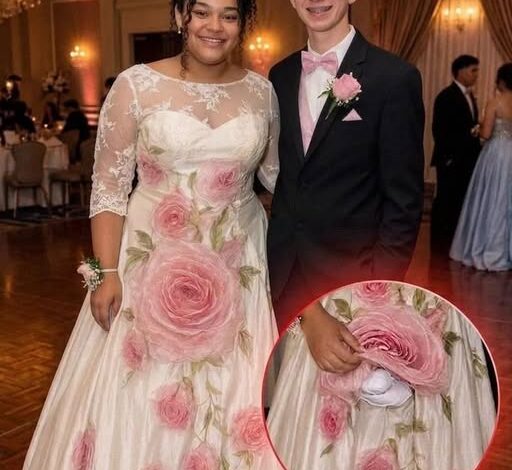
Soft ivory fabric flowed gracefully to the floor, covered with dozens of handcrafted roses that looked as though they’d bloomed directly from the dress itself.
Hazel touched one flower with shaking fingers.
“It’s beautiful,” she whispered.
Eli smiled.
“I know it isn’t exactly what Mason promised.”
His voice caught.
“But… maybe you could wear it for one dance.”
When Hazel looked into the mirror wearing that gown, I saw something I’d almost forgotten.
Hope.
Real hope.
By the time we arrived at the ballroom, students stopped talking as she entered.
Whispers filled the room.
Everyone noticed the extraordinary dress.
Before anyone could ask where it had come from, Eli quietly walked onto the stage and accepted the microphone from the DJ.
“I need to tell you something,” he began.
The room fell silent.
“I didn’t make these flowers just because they looked pretty.”
He gently lifted one of the fabric roses.
“Every flower represents something cruel someone once said to Hazel.”
People exchanged uncomfortable glances.
“‘Too big.'”
He touched another rose.
“‘You’ll never fit in.'”
Another.
“‘Nobody will ask you.'”
Hidden beneath each flower, he explained, was embroidered a different message.
“You are enough.”
“You belong.”
“Kindness is stronger.”
“Your worth was never decided by someone else’s words.”
The insults had been transformed into reminders of hope.
Not erased.
Rewritten.
Parents sitting around the ballroom quietly wiped away tears.
An attorney removed his glasses.
An insurance executive looked down at the floor.
A mortgage advisor pressed a hand against her mouth.
An investment consultant blinked back tears.
Even a retired court employee sitting near the back quietly reached for a tissue.
Nobody seemed to notice the dress anymore.
They were looking at Hazel.
Really looking at her.
One by one, students began crossing the room.
Some apologized for things they’d said years before.
Others admitted they’d witnessed bullying and done nothing to stop it.
A few simply hugged her.
For the first time since Mason’s death, Hazel cried without trying to hide.
Not because she felt broken.
Because she finally felt seen.
When the evening ended, she climbed into the car beside me with mascara-smudged cheeks and the smallest smile I’d seen in over a year.
Neither of us hurried to start the engine.
We simply sat there in peaceful silence.
The next morning, I walked into the kitchen expecting another empty chair.
Instead, Hazel was already there.
She had made herself breakfast.
When she looked up, she smiled.
It wasn’t a big smile.
It didn’t erase our grief.
It didn’t make us forget Mason.
But it was real.
As sunlight filled the room, I realized healing rarely arrives the way we expect.
It doesn’t always come through dramatic speeches or miraculous moments.
Sometimes it arrives quietly, stitched into thousands of tiny acts of kindness by someone who refuses to let another person disappear into their pain.
Mason never got the chance to keep his promise.
But somehow, through the unwavering heart of a lifelong friend, that promise found its way back to Hazel anyway.
And that morning, as we shared breakfast together for the first time in what felt like forever, I understood that hope had never truly left us.
It had simply been waiting for someone brave enough to carry it until Hazel was ready to hold it herself.